 Central Steel
Central Steel
Central Steel
Central Steel
Central Steel
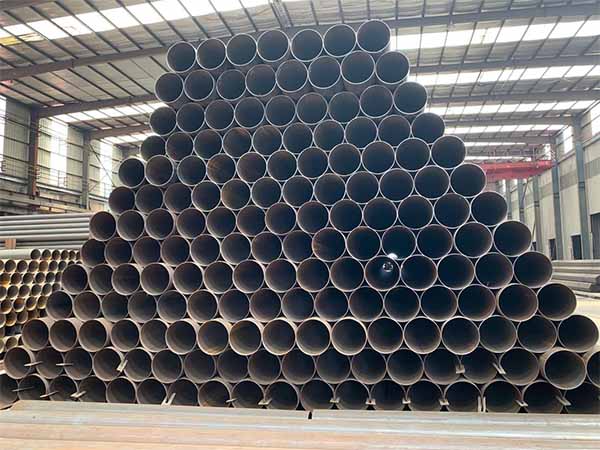
ERW welded pipe (Electric Resistance Welded pipe) is a type of welded steel pipe produced by forming steel coils into a cylindrical shape and welding the edges together using high-frequency electrical resistance. With stable mechanical properties, smooth internal and external surfaces, and excellent dimensional accuracy, ERW steel pipes are widely used in water and gas transportation, scaffolding, construction structures, machinery, and automotive applications.
This article explains what ERW welded pipe is, how it is manufactured, and why it is preferred in modern engineering projects.
1. Definition of ERW Welded Pipe
ERW welded pipe is manufactured from flat steel strip that is shaped into a round, square, or rectangular tube and welded along the longitudinal seam using resistance welding.
Unlike arc welding, ERW uses heat generated by electrical current—no filler metal is added, ensuring uniformity and structural integrity.
Characteristics of the ERW welding method
Uses high-frequency current to heat the joint;
Weld seam is forged under pressure, creating a strong bond;
Produces a clean internal weld bead after proper smoothing;
Suitable for low-to-medium pressure pipelines and structural applications;
Primary product forms: black ERW pipe, galvanized ERW pipe, precision ERW tubing.
2. How ERW Welded Pipe Is Manufactured—Production Process
The ERW manufacturing process is designed for high efficiency, consistent quality, and continuous production, making it cost-effective compared to seamless pipes.
Step-by-step ERW pipe production process:
1) Steel Coil Preparation: Raw material (hot-rolled or cold-rolled coil) is uncoiled, leveled, and inspected.
2) Forming & Edging: The steel strip is gradually formed into a round tube through multiple forming rollers.
3) High-Frequency Welding: Edges are heated using electrical resistance and pressed together to create a longitudinal weld.
4) Weld Seam Treatment: Weld bead is removed internally and externally to ensure smooth flow and appearance.
5) Sizing & Straightening: Pipe is calibrated to the required OD and wall thickness for dimensional accuracy.
6) Cutting & Cooling: Pipes are cut to specified lengths and cooled.
7) Non-Destructive Testing (Optional): Ultrasonic or eddy current testing ensures seam integrity and product reliability.
Standards commonly applied: ASTM A53 / ASTM A500 / API 5L / EN 10217 / EN 10219 / JIS G3444
3. Key Features & Advantages of ERW Steel Pipes
ERW welded pipes offer a balance between performance, cost, and availability, making them a preferred choice in multiple industries.
Why choose ERW welded pipe?
Excellent dimensional accuracy—suitable for structural frames and precision fabrication
Smooth weld seam after treatment—improves flow efficiency for fluid transportation
High production efficiency—large, consistent supply ideal for project needs
Cost-effective alternative to seamless pipes—without sacrificing reliability
Good weld seam strength—suitable for bending, threading, or further processing
Available in multiple coatings—black, varnished, galvanized, or powder-coated
4. Applications of ERW Welded Pipe
ERW welded pipes are widely used in fields requiring uniform cross-sections, structural stability, and reliable weld seams:
Construction & scaffolding
Water & gas pipelines
Oil & low-pressure fluid conveyance
Automotive components and mechanical tubing
Steel structure supports
Fencing & handrails
Agricultural and greenhouse frames
If the project demands high precision and consistent size, ERW pipe is often the best match.
5. Available Specifications
Outer Diameter (OD): 21.3 mm–660 mm
Wall Thickness: 1.0 mm–22 mm
Length: 6 m, 12 m, or customized
Steel Grades: Q235, S235, S355, Gr.B, X42, X52, and more
Summary
ERW welded pipe combines manufacturing efficiency, weld reliability, and cost advantages, making it ideal for infrastructure, construction, and fluid transportation systems.


 Language
 English
 Español
 بالعربية
 sales@central-steels.com
 0086-731-8865-5017