 Central Steel
Central Steel
Central Steel
Central Steel
Central Steel
What does CHWS piping mean?
CHWS stands for chilled water supply. CHWS piping refers to the piping that transports chilled water produced by chiller units to cooling equipment, such as air handling units (AHUs), fan coil units (FCUs), heat exchangers, and cooling coils.
In HVAC engineering, chilled water piping is the main loop that provides cooling capacity to buildings, enabling stable indoor temperature control and energy-efficient air conditioning systems.
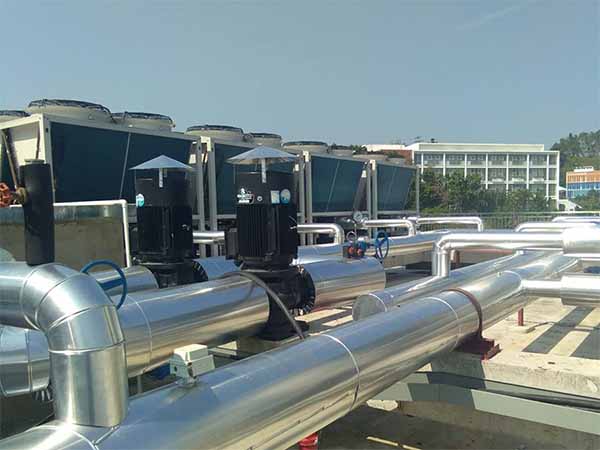
CHWS vs. CHWR — Why Both Terms Matter in HVAC Cooling
A chilled water system always includes two pipelines:
|
Term |
Full Name |
Purpose |
Typical Temperature |
|
CHWS |
Chilled Water Supply |
Sends chilled water to cooling terminals |
4–7°C (39–45°F) |
|
CHWR |
Chilled Water Return |
Sends warmed water back to the chiller |
10–15°C (50–59°F) |
The temperature difference, or ΔT, determines energy efficiency:
Higher ΔT → better system efficiency, lower pump energy consumption
Lower ΔT → potential flow imbalance & reduced cooling performance
Where Are CHWS Pipes Used? (Real Project Scenarios)
CHWS piping is fundamental to large-scale cooling systems, including:
High-rise commercial buildings & office complexes
Hospitals, laboratories, pharmaceutical manufacturing
Data centers and server rooms
District cooling plants in hot-climate regions (UAE, Singapore, Saudi Arabia)
Industrial cooling for production lines & equipment
Airports, stadiums, shopping malls, metro stations
District cooling is a rapidly growing application — using insulated underground CHWS pipelines to distribute chilled water to multiple buildings.
Common Materials Used for CHWS Pipes
Different CHWS pipe materials balance cost, corrosion resistance, installation speed, and lifespan:
|
Material |
Advantages |
Limitations |
Typical Uses |
|
Carbon Steel (ASTM A53 / A106) |
High strength, economical |
Corrosion risk without protection |
Large buildings, mechanical rooms |
|
Copper (Type K/L) |
Corrosion-resistant, smooth inside |
Expensive, theft risk |
Hospitals, medium buildings |
|
HDPE / PPR |
Lightweight, no corrosion, flexible |
Limited high-temp capability |
District cooling, underground |
|
Stainless Steel |
Long lifespan, hygienic |
High cost |
Food & pharma, clean rooms |
CHWS Pipe Insulation — A Critical Requirement
Because the chilled water temperature is below the dew point, condensation naturally forms on uninsulated CHWS pipes.
Proper insulation prevents:
Dripping & water damage
Mold development
Loss of cooling efficiency
Corrosion Under Insulation (CUI) — a major maintenance problem
Common insulation materials:
Rubber foam (Armaflex)
Elastomeric foam
Fiberglass + vapor barrier jacket
How to Size CHWS Pipes — Engineering Considerations
When designing CHWS piping systems, engineers typically calculate:
1. Cooling load (RT or kW) → determines flow rate
2. Velocity control (≤ 3 m/s recommended to reduce erosion)
3. Friction loss & pump head
4. Thermal expansion allowance & anchor placement
5. Pipe wall thickness (Schedule 40 / Sch 80 for pressure rating)
6. Hydraulic balancing to maintain ΔT stability
A well-designed CHWS/CHWR loop minimizes pump energy consumption over decades of system operation.
Frequently Asked Questions About CHWS Pipes
1. What does CHWS stand for in piping?
CHWS stands for Chilled Water Supply. CHWS piping carries chilled water from a chiller or central cooling plant to cooling equipment such as AHUs, FCUs, cooling coils, and heat exchangers.
2. What is the difference between CHWS and CHWR?
CHWS means Chilled Water Supply and carries chilled water to the cooling equipment. CHWR means Chilled Water Return and carries warmer water back to the chiller for recooling.
3. What is the difference between CHW and CHWS?
CHW means Chilled Water and is a general term for the chilled water system. CHWS specifically identifies the supply side, while CHWR identifies the return side.
4. What material is commonly used for CHWS pipes?
Carbon steel is commonly used for CHWS piping, particularly in large commercial and industrial chilled water systems. Stainless steel, copper, HDPE, and other materials may also be selected depending on the application and project requirements.
Conclusion
Understanding the meaning of CHWS pipe is essential for HVAC engineers, building managers, and project designers. From material selection to insulation requirements, pipe sizing, and flow balancing, CHWS piping defines the efficiency and reliability of chilled-water cooling systems used worldwide.


 Language
 English
 Español
 بالعربية
 sales@central-steels.com
 0086-731-8865-5017