 Central Steel
Central Steel
Central Steel
Central Steel
Central Steel
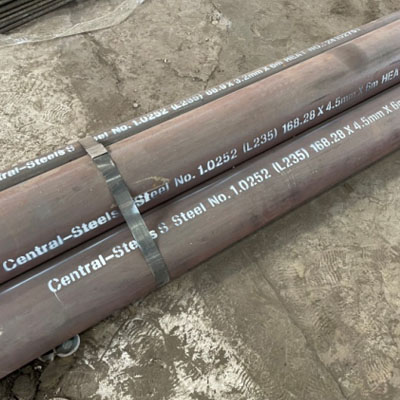
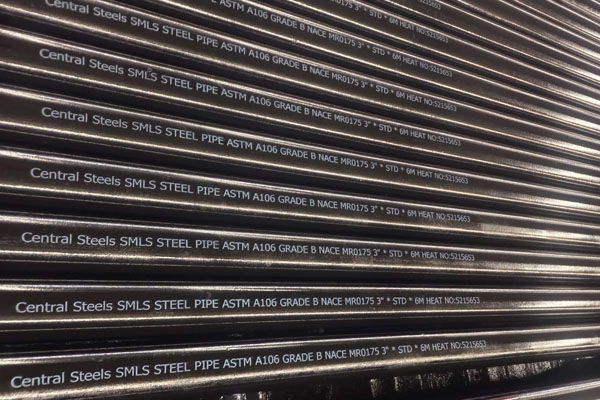
□ Carbon Seamless Pipe
□ Alloy Seamless Pipe
□ Boiler Tube
□ Line Pipe
□ Mechanical Tube
□ Hydraulic Tube
□ Precision Seamless Tube
Standard for seamless steel pipe:
|
ASTM A53 Gr.B |
Black and hot-dipped zinc-coated steel pipes welded and seamless |
|
ASTM A106 Gr.B |
Seamless carbon steel for high temperature service |
|
ASTM SA179 |
Seamless cold-drawn low-carbon steel heat exchanger and condenser tubes |
|
ASTM SA192 |
Seamless carbon steel boiler tubes for high pressure |
|
ASTM SA210 |
Seamless Medium-carbon boiler and superheater tubes |
|
ASTM A213 |
Seamless alloy-steel boiler, superheater, and heat-exchanger tubes |
|
ASTM A333 GR.6 |
seamless and welded carbon and alloy steel pipe intended for use at low temperatures. |
|
ASTM A335 P9,P11,T22,T91 |
Seamless ferritic alloy-steel pipe for high-temperature service |
|
ASTM A336 |
Alloy steel forgings for pressure and high-temperature parts |
|
ASTM SA519 4140/4130 |
Seamless carbon for mechanical tubing |
|
API Spec 5CT J55/K55/N80/L80/P110/K55 |
Seamless steel pipe for casing |
|
API Spec 5L PSL1/PSL2 Gr.b, X42/46/52/56/65/70 |
Seamless steel pipe for line pipe |
|
DIN 17175 |
Seamless steel tube for elevated temperture |
|
DIN 2391 |
Cold drawn seamless prevision pipe |
|
DIN 1629 |
Seamless circular unalloyed steel tubes subject to special requirements |
The chemical composition of seamless pipes
Carbon Steel Seamless Pipe:
Element
Content Range
Function
Carbon (C)
0.02% – 0.25% (Low Carbon Steel) / up to 1.0% (High Carbon Steel)
Determines strength and hardness
Manganese (Mn)
0.30% – 1.50%
Improves toughness and wear resistance
Phosphorus (P)
≤ 0.050%
Control brittleness
Sulfur (S)
≤ 0.050%
Improve machinability (but controlled to avoid cracking)
Alloy Seamless Pipe:
Element
Content Range
Function
Chromium (Cr)
0.3% – 12%
Corrosion resistance & hardness
Molybdenum (Mo)
0.2% – 1.0%
High-temperature strength & corrosion resistance
Nickel (Ni)
0.3% – 5%
Toughness and low/high temperature performance
Vanadium (V)
Trace – small %
Strength & wear resistance
Tungsten (W)
Trace
High-temperature stability
Titanium (Ti)
Trace
Grain refinement & strength improvement
The mechanical properties of seamless pipes
API 5L Carbon Steel Seamless Pipe
Grade
Yield Strength (MPa)
Tensile Strength (MPa)
Characteristics
API 5L B
245 MPa
~415 MPa
General pipeline service
X42
≥ 290 MPa
≥ 415 MPa
Medium pressure pipelines
X52
≥ 360 MPa
≥ 460 MPa
High-pressure transmission
X60
≥ 415 MPa
≥ 520 MPa
High strength applications
X65
≥ 450 MPa
≥ 535 MPa
High-pressure oil & gas
X70
≥ 485 MPa
≥ 570 MPa
Extreme conditions pipeline
ASTM A106 Carbon Steel Seamless Pipe
|
Grade |
Tensile Strength |
Yield Strength |
Application |
|
Grade B |
≥ 415 MPa |
≥ 240 MPa |
High-temperature service |
|
Grade C |
≥ 485 MPa |
≥ 275 MPa |
Higher strength applications |
The production process of seamless pipes
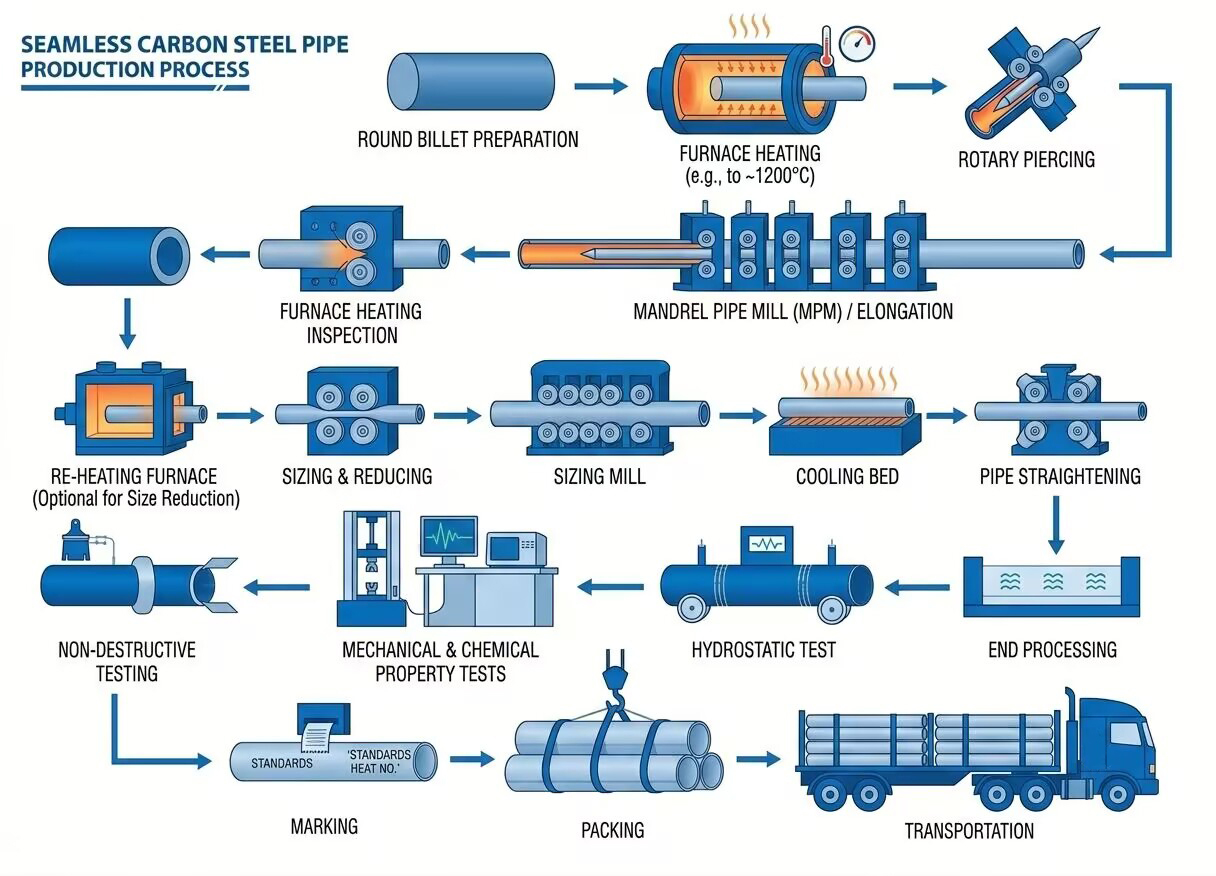
1. Raw Material Preparation
Seamless steel pipe production typically uses round steel billets or continuously cast billets as raw materials. Common materials include carbon steel, alloy steel, and stainless steel. Before production, the raw materials must be inspected for chemical composition, dimensions, surface quality, and internal defects to ensure they meet production requirements.
2. Billet Cutting
After inspection, the qualified steel billets are cut to length according to the product's outer diameter, wall thickness, and production process requirements to ensure dimensional accuracy and production stability during subsequent piercing and rolling processes.
3. Heating
The cut steel billets are then uniformly heated in a heating furnace, typically to 1100°C–1300°C, to improve material plasticity, reduce deformation resistance, and create suitable processing conditions for the subsequent piercing process.
4. Piercing
The high-temperature steel billet is formed into a hollow tube by the rotating extrusion of the rolls and the action of the mandrel in a piercing mill. This is the core forming step in transforming a solid steel billet into a hollow tube blank for seamless steel pipe production.
5. Pipe Rolling / Elongation
After piercing, the tube is elongated and its wall thickness reduced by a rolling mill, increasing the tube's length and gradually bringing its outer diameter and wall thickness closer to the target specifications. This also improves the internal structure and dimensional accuracy.
6. Sizing / Reducing
After rolling, the tube enters a sizing or reducing mill. Further adjustments to the outer diameter, roundness, and dimensional tolerances bring the product to the final specifications required by the standard.
7. Heat Treatment
Depending on the material and standard requirements, seamless steel tubes typically undergo heat treatments such as normalizing, annealing, quenching, or tempering to improve the metallographic structure and enhance strength, toughness, and high-temperature resistance.
8. Straightening
The hot-worked steel tube is straightened using straightening equipment to improve the tube's straightness and meet standard and engineering installation requirements.
9. Surface Treatment
Depending on product application and customer requirements, seamless steel pipes can undergo surface treatments such as oiling, rust-preventive painting, pickling, sandblasting, or galvanizing to improve corrosion resistance and appearance.
10. NDT Inspection & Quality Testing
Finished seamless steel pipes undergo multiple quality inspections, including ultrasonic testing, hydrostatic testing, mechanical property testing, and chemical composition analysis, to ensure compliance with international standards such as ASTM, API, and EN.
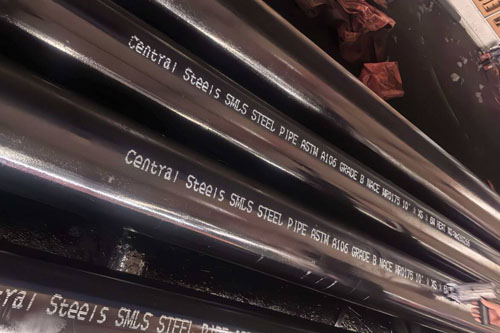
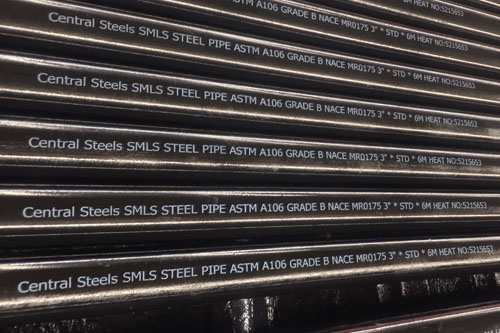
11. Marking & Traceability
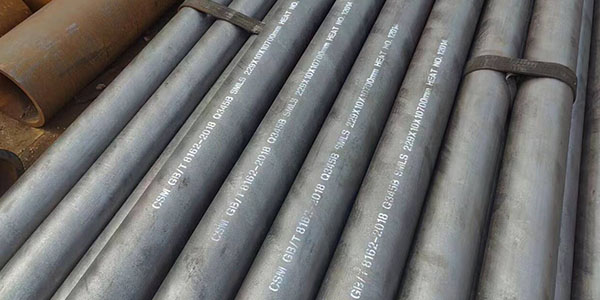
After inspection, the steel pipes are marked with specifications, material, standard, furnace number, and manufacturer information to establish a complete product traceability system.
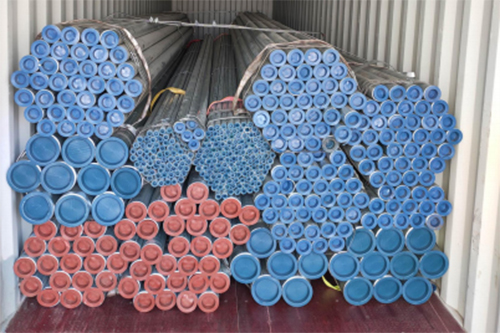
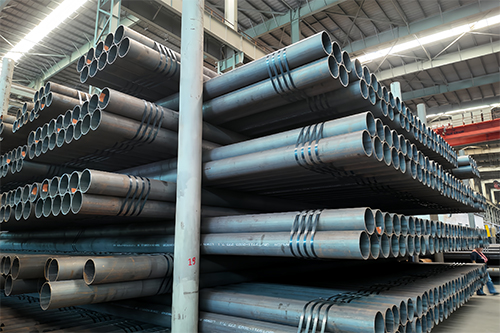
12. Packaging & Shipping
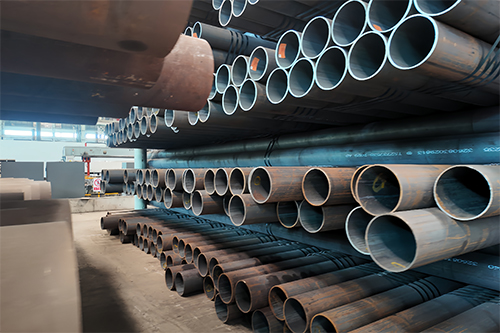
Final finished products are bundled, capped, crated, or containerized according to transportation and project requirements to ensure the product remains safe and intact during storage, handling, and international transport.
Application areas of seamless steel pipes
Oil and gas exploration and refining
Power generation (boiler and heat exchanger tubes)
High-pressure hydraulic systems
Structural and mechanical applications
Advantages of seamless pipes High Strength: No welded seams, making them stronger and more reliable for high-pressure applications.
Uniformity: Consistent wall thickness and smooth interior surface.
High-Temperature Resistance: Suitable for extreme temperature conditions.
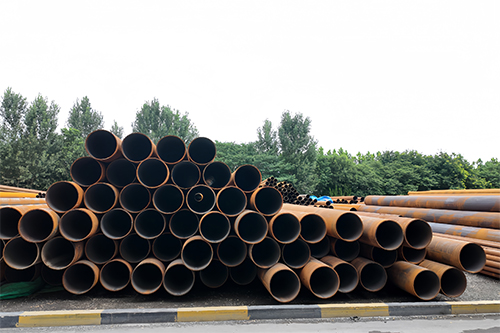
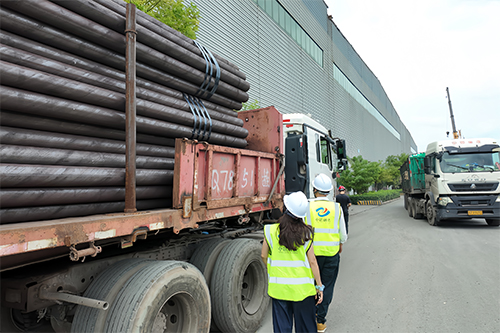
Packaging and transportation of seamless pipes
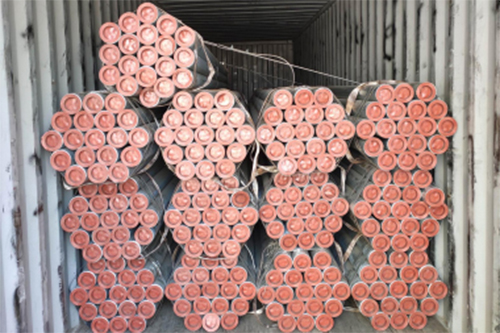
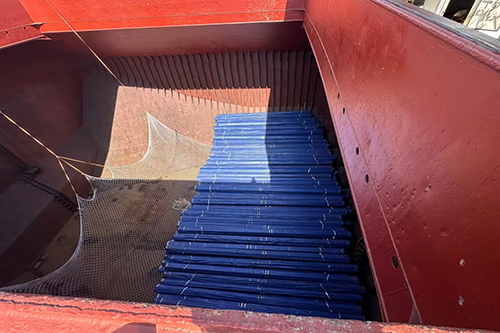
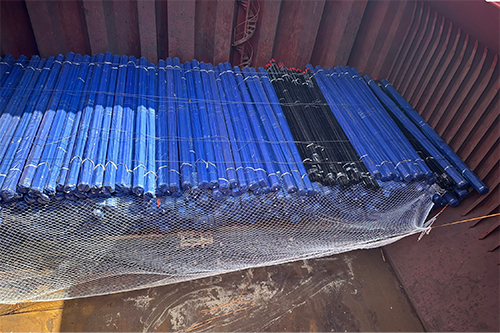
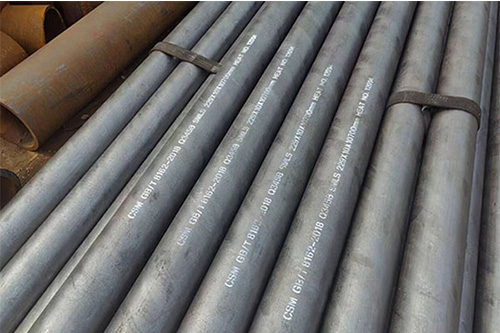
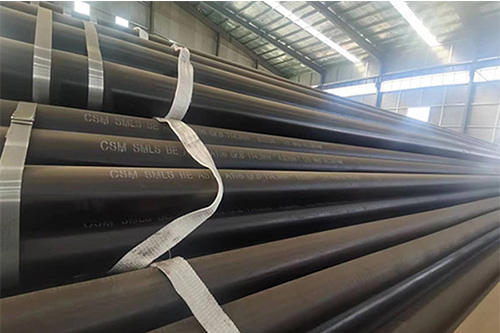
We coordinate all types of transport, including containerized loading (FCL/LCL), bulk vessels, and rail or truck transport for overland deliveries.
Container shipment:
Break bulk shipment:


 Language
 English
 Español
 بالعربية
 sales@central-steels.com
 0086-731-8865-5017