 Central Steel
Central Steel
Central Steel
Central Steel
Central Steel
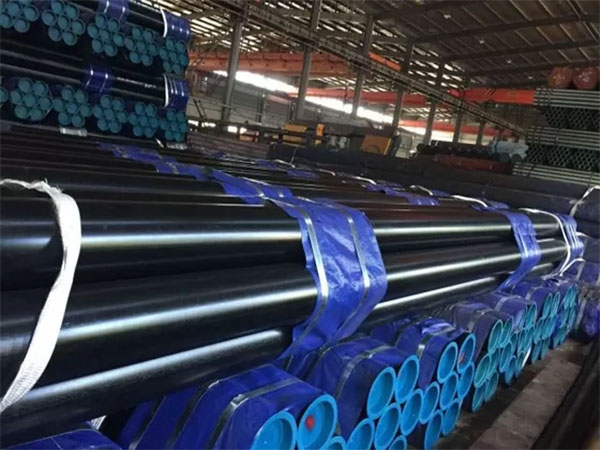
API 5L ERW carbon steel pipe is made by resistance welding technology. After rolling the steel coil into a tubular shape, it is welded along the longitudinal direction of the tube wall and pressure is applied to completely fuse the two ends of the tube blank. Steel pipes produced by resistance welding have uniform weld seams, high dimensional accuracy, and can be mass-produced. They are particularly suitable for API 5L pipes of medium and small diameters. High-frequency ERW process can enhance the quality, strength and density of weld seams.
API is a standard formulated by the American Petroleum Institute for pipeline systems transporting fluids such as oil, natural gas, and water, covering seamless pipes and welded pipes (including ERW, LSAW, SSAW, etc.). It can be divided into two product specification grades: PSL1 and PSL2.
API 5L PSL1 vs PSL2
One of the most important distinctions when purchasing API 5L ERW pipe is the difference between PSL 1 and PSL 2.
PSL 1 provides the basic level of product requirements under API 5L. PSL 2 introduces additional and more stringent requirements, particularly for chemical composition, mechanical properties, testing, manufacturing control and product traceability.
|
Requirement |
API 5L PSL 1 |
API 5L PSL 2 |
|
Quality requirements |
Standard |
More stringent |
|
Chemical composition control |
Required |
More restrictive requirements |
|
Mechanical properties |
Specified |
More stringent requirements |
|
Weld inspection/control |
Applicable requirements |
Additional requirements depending on product/service |
|
NDT requirements |
According to applicable specification |
More extensive requirements |
|
Impact testing |
When specified/applicable |
More stringent requirements for applicable products |
|
Traceability |
Required according to specification |
More comprehensive control |
|
Typical use |
General pipeline applications where permitted |
More demanding pipeline and service conditions |
Common material grades and size ranges
Widely applied: It performs exceptionally well in the petroleum, natural gas and water conservancy industries.
FAQ about API 5L ERW carbon steel pipe
1. Is API 5L ERW pipe suitable for oil and gas pipelines?
Yes. API 5L is a line-pipe specification for pipeline transportation applications in the petroleum and natural gas industries. ERW is one of the welded manufacturing methods that can be used for applicable API 5L pipe.
2. What is the difference between API 5L PSL1 and PSL2?
PSL 2 has more stringent requirements than PSL 1 for areas such as chemical composition, mechanical properties, testing and product control. The appropriate PSL depends on the project and service requirements.
3. What are the common API 5L ERW grades?
Common grades include Grade B, X42, X52, X60, X65 and X70. The actual grades available for ERW production depend on the required dimensions, manufacturing capability and applicable specification.
Conclusion
API 5L ERW carbon steel pipe is a cost-effective welded line-pipe solution for applicable oil and gas pipeline projects. Its key selection factors are grade, PSL level, diameter, wall thickness, testing requirements and service conditions. PSL 2 provides tighter product and inspection requirements than PSL 1, while grades such as X52, X60 and X65 provide different strength levels for different pipeline designs.


 Language
 English
 Español
 بالعربية
 sales@central-steels.com
 0086-731-8865-5017