Large diameter seamless steel tubes are manufactured mainly by hot rolling, hot extrusion, or hot expansion, depending on the required outside diameter, wall thickness, material grade, dimensional tolerances, and application. For very large diameters, hot expansion is commonly used to enlarge a smaller seamless tube into the required diameter, while hot rolling and extrusion can be used for direct forming when suitable production equipment is available. The complete process generally includes billet preparation, heating, piercing or extrusion, hot forming, sizing, heat treatment, straightening, and final inspection.
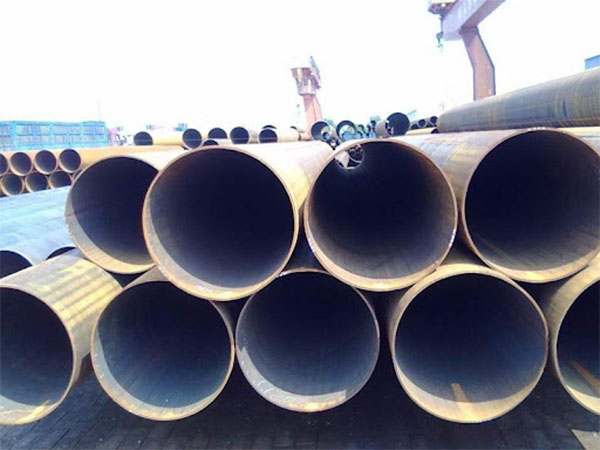
Main Manufacturing Methods for Large Diameter Seamless Steel Tubes
There are three main manufacturing routes:
Hot rolling
Hot extrusion
Hot expansion
The first two methods can form the tube directly from a heated billet or tube shell, while hot expansion enlarges an existing seamless tube to a larger diameter.
The perforated tube is hot rolled, gradually reducing the wall thickness and increasing the diameter until the specified size requirements are reached. In the process of hot rolling, the plastic deformation of the steel tube is sufficient, and the tube with uniform wall thickness and large outer diameter can be manufactured. The main processes are:
Rough rolling: initially reduce the tube wall thickness and adjust the outside diameter.
Finishing: Further accurate sizing, so that the steel tube to meet the design requirements of the diameter and wall thickness.
Sizing and reducing: to ensure the uniformity and dimensional accuracy of the outer diameter of the steel tube through the sizing machine.
Through the hot rolling process, continuous production of steel tubes can be achieved, with high efficiency and suitable for mass manufacturing.
Disadvantages: high requirements for equipment, the need for large rolling machines, complex processes and high production costs, and the size of the processed large-caliber steel tube is limited, can not produce large caliber and special purpose seamless steel pipe.
Extrusion process
The basic principle of extrusion is to put the round billet into the extrusion cylinder and apply pressure through the extrusion rod to make the billet flow and form the desired shape under the restriction of the mold. This process significantly changes the internal structure of the material and improves its mechanical properties. The main processes are:
Heating billet: The billet is heated to a high temperature so that it reaches its optimal plastic state.
Perforation: The blank is processed by the perforator to form a hollow tube.
Extrusion molding: the tube is put into the extrusion cylinder, and the pressure is applied to it by the extrusion rod and the mold, so that it passes through the mold outlet and is formed into a seamless tube.
Cooling and straightening: The extruded tube is cooled and straightened to ensure dimensional accuracy and surface quality.
Thermal expansion process
For ultra-large diameter steel tubes, small-diameter seamless steel pipes are usually expanded by thermal expansion process. The main processes are:
Raw material preparation: Select small and medium diameter seamless steel tube after hot rolling as the master tube.
Heating expansion: The master tube is heated to a high temperature state and the pipe is extended to the desired diameter through a die in the expanding machine.
Cooling and straightening: the expanded steel tube is quickly cooled and straightened.
Extremely large diameter steel tubes (usually up to 1 meter and above) can be produced through the thermal expansion process.
Disadvantages: poor quality uniformity, decreased mechanical properties, reduced accuracy.
Hot Rolling vs. Hot Expansion for Large Diameter Seamless Tubes
The choice between hot rolling and hot expansion depends primarily on the required dimensions and available manufacturing equipment.
|
Feature
|
Hot Rolling
|
Hot Expansion
|
|
Starting Material
|
Solid billet/tube shell
|
Smaller seamless tube
|
|
Forming Principle
|
Piercing and rolling
|
Heating and expanding
|
|
Large Diameter Capability
|
Depends strongly on rolling equipment
|
Particularly suitable for very large diameters
|
|
Production Efficiency
|
High for suitable production ranges
|
Suitable for customized or large-diameter production
|
|
Dimensional Control
|
Generally good with appropriate equipment
|
Requires careful control of expansion ratio
|
|
Wall Thickness
|
Wide range depending on equipment
|
Suitable for large-diameter thick-wall products
|
|
Equipment Requirement
|
Large rolling mill
|
Dedicated expansion equipment
|
|
Best Use
|
Standardized large-diameter production
|
Very large or customized seamless tube sizes
|
Frequently Asked Questions About Large Diameter Seamless Steel Tube
1. How are large diameter seamless steel tubes manufactured?
Large diameter seamless steel tubes are generally manufactured by hot rolling, hot extrusion, or hot expansion. The selected process depends on the required diameter, wall thickness, material grade, dimensional tolerances, and application.
2. What is the most common process for large diameter seamless steel tubes?
Hot rolling is widely used for seamless tube production, while hot expansion is an important method for producing very large diameters when direct rolling is limited by equipment capacity.
3. How does hot expansion produce a large diameter seamless tube?
A smaller seamless steel tube is heated and passed through an expansion machine using a mandrel or forming system. The tube diameter is increased to the required size, followed by cooling, straightening, sizing, and inspection.
Conclusion
The manufacturing process of large diameter seamless steel tubes generally consists of raw material preparation, heating, piercing or extrusion, hot rolling or hot expansion, sizing, cooling, straightening, heat treatment, finishing, and final inspection. For standard large-diameter products, hot rolling can provide efficient continuous production, while hot expansion is particularly useful when very large diameters are required.
Read more : What is a seamless steel pipe?
 Central Steel


 Language
 English
 Español
 بالعربية
 sales@central-steels.com
 0086-731-8865-5017