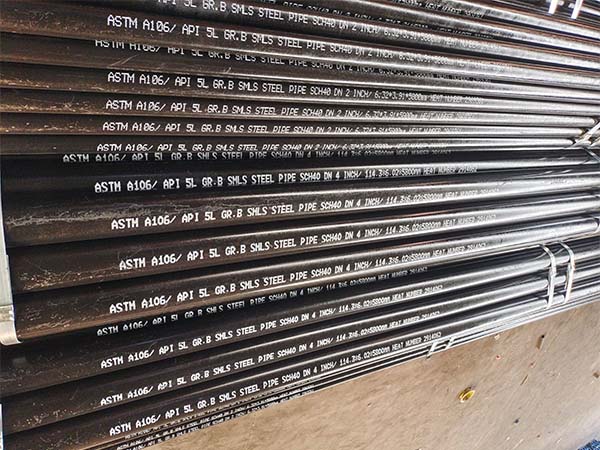
Seamless steel pipe, also known as SMLS, is a type of steel pipe without any welds or joints. Because it lacks welds, seamless steel pipe has high strength and can withstand high pressure and high temperature. Unlike welded steel pipe, which is made by rolling steel plates and welding the edges, seamless steel pipe is made by extruding or drawing solid steel billets.
How is Seamless Steel Pipe Manufactured?
The manufacturing process of seamless steel pipes fundamentally determines the final performance and dimensional tolerances of the pipe. The production processes for seamless steel pipes are generally divided into two main categories:
1.
Hot Rolling Process: This is the most commonly used method for producing large-diameter, thick-walled seamless steel pipes. The main process involves heating a solid cylindrical steel billet to extremely high temperatures and then pushing or drawing it through a punching rod (mandrel) to form a hollow tube shell. This method is suitable for producing thick-walled steel pipes with high structural integrity requirements. After punching, the steel pipe needs to undergo multiple rolling processes to achieve the final outer diameter and wall thickness.
2. Cold Drawing or
Cold Rolling Process
When applications require extremely high dimensional tolerances, smooth surfaces, or smaller diameters, cold working of the steel pipe is necessary. This process significantly improves surface quality, yield strength, and dimensional accuracy, making it ideal for precision mechanical parts and instrument tubing.
Common Types and Material Grades
Seamless steel pipes are mainly classified according to their material composition, which determines their pressure resistance, temperature resistance, and corrosion resistance:
Carbon steel seamless pipes: Widely used for general structural applications and fluid transportation. Common grades include ASTM A106 Gr.B/C (high temperature), ASTM A53 Gr.B, API 5L Gr.B, and X42-X70.
Alloy steel seamless pipes: Alloy steel seamless pipes contain elements such as chromium, molybdenum, and nickel to withstand extreme environments. Commonly used grades are ASTM A335 P11, P22, P91; 15CrMoG, 12Cr1MoVG. These are standard steels for high-temperature, high-pressure power plant environments.
Stainless steel seamless pipe: Offers excellent corrosion resistance and hygienic properties. Common models include ASTM A312 TP304/304L and TP316/316L.
Why choose seamless pipe?
The structural integrity of seamless steel pipes gives them several significant advantages over welded steel pipes in engineering:
Superior pressure resistance: Without longitudinal welds, seamless pipes eliminate the risk of stress concentration and weld failure. Typically, they can withstand 20% higher operating pressures than welded steel pipes of the same material and size.
Uniformity and strength: The continuous internal structure provides uniform mechanical properties throughout the circumference, resulting in high reliability under severe torsional and bending stresses.
Corrosion resistance: Welds are often the starting point for localized corrosion or cracking. Due to the absence of welds, seamless pipes inherently possess stronger resistance to chemical corrosion. High-Temperature Stability: Especially in alloys and stainless steel, the continuous grain structure gives it excellent high-temperature resistance. High-Pressure Boilers and Heat Exchangers: Seamless alloy tubes are crucial for power plants transporting superheated steam and water, as they must withstand harsh thermal cycling.
Comparison of Pipe Manufacturing Methods
|
Feature / Category
|
Seamless (SMLS)
|
ERW (Electric Resistance Welded)
|
LSAW (Longitudinal Submerged Arc)
|
SSAW (Spiral Submerged Arc)
|
|
Manufacturing
|
Billet piercing, hot rolling, or cold drawing
|
Steel coil forming + high-frequency induction welding
|
Steel plate JCOE forming + double-sided SAW
|
Spiral steel coil forming + submerged arc welding
|
|
Weld Seam
|
None (Integral)
|
Straight seam (often invisible after processing)
|
Single or double straight seam
|
Long spiral-shaped seam
|
|
OD Range
|
Smaller (Typically 1/8" - 26")
|
Small to Medium (1/2" - 24")
|
Large (Typically 16" - 60")
|
Large (Typically 8" - 120")
|
|
Wall Thickness
|
Extremely Thick (Up to Sch 160/XXS)
|
Thin to Medium
|
Excellent heavy-wall capability
|
Medium wall thickness
|
|
Pressure Rating
|
Highest; no risk of seam failure
|
Medium; dependent on weld quality
|
High (ideal for large-diameter high pressure)
|
Medium
|
|
Precision
|
Low (Hot Rolled) / High (Cold Drawn)
|
High (Excellent wall uniformity)
|
High
|
Low (Difficult to control ovality)
|
|
Production Cost
|
High (Complex process, lower yield)
|
Low (High automation and speed)
|
High (Slower single-piece production)
|
Lowest (Mass production for large pipes)
|
|
Core Applications
|
High-pressure boilers, OCTG, Petrochemical
|
Low-medium pressure fluid, structures, fencing
|
Main oil/gas pipelines, offshore projects
|
Water transport, piling, low-pressure gas
|
Frequently Asked Questions (FAQ)
Can seamless pipes replace welded pipes?
Yes. Seamless pipes can almost always replace welded tubes because their pressure and structural ratings are higher.
Are there any size limitations for seamless steel pipes?
There are size limitations for seamless steel pipes. Because the manufacturing process requires piercing solid steel billets, the outer diameter of seamless steel pipes is generally limited compared to welded steel pipes (LSAW/SSAW). Extra-large diameter tubes are typically manufactured using welding processes.
Summary
Seamless steel pipes manufactured using hot piercing and cold drawing processes offer unparalleled structural integrity, uniform mechanical properties, and excellent pressure and temperature resistance.
 Central Steel


 Language
 English
 Español
 بالعربية
 sales@central-steels.com
 0086-731-8865-5017