 Central Steel
Central Steel
Central Steel
Central Steel
Central Steel
Schedule 40 indicates a medium wall thickness, offering a balanced combination of mechanical strength, pressure resistance, and cost efficiency. As a result, ASTM A106 Schedule 40 seamless carbon steel pipe is commonly applied in fluid transportation systems involving water, oil, natural gas, and slurry, and plays a critical role in industries such as oil & gas, mining, power generation, and chemical processing.
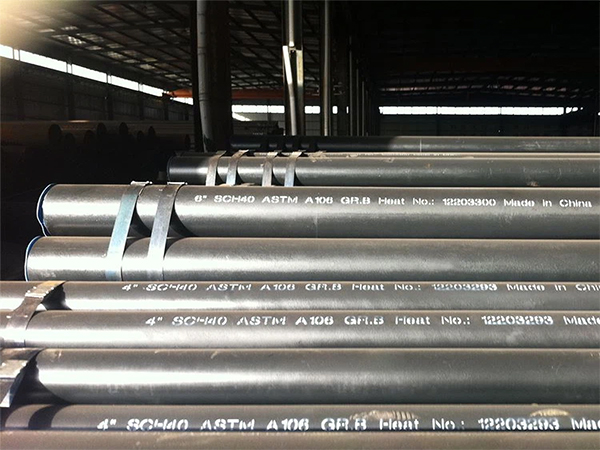
Features and Advantages of ASTM A106 Schedule 40 Seamless Pipe
1. Material Grades and Mechanical Performance
ASTM A106 seamless steel pipes are manufactured in Grade A, Grade B, and Grade C, with Grade B being the most widely specified due to its excellent balance of strength and ductility.
Grade A: Lower tensile strength, good ductility, suitable for low-stress and general service applications.
Grade B: Moderate tensile and yield strength with reliable pressure resistance, extensively used across industrial piping systems.
Grade C: Highest strength level, ideal for high-pressure and high-load operating environments.
2. Excellent High-Temperature Resistance
ASTM A106 pipes are engineered for elevated temperature service, making them particularly suitable for boilers, heat exchangers, and high-pressure steam pipelines where thermal stability is essential.
3. Superior Mechanical Properties
With high tensile strength and yield strength, ASTM A106 Schedule 40 pipes can withstand increased internal pressure while maintaining structural integrity and long-term service reliability.
4. Seamless Manufacturing Process
The seamless construction eliminates weld seams, significantly reducing the risk of weld-related defects. This ensures uniform wall thickness, improved pressure-bearing capability, and enhanced overall pipeline safety.
Typical Applications of ASTM A106 Schedule 40 Carbon Steel Pipe
Grade and chemical composition:
|
Grade |
C≤ |
Mn |
P≤ |
S≤ |
Si≥ |
Cr≤ |
Cu≤ |
Mo≤ |
Ni≤ |
V≤ |
|
A |
0.25 |
0.27-0.93 |
0.035 |
0.035 |
0.10 |
0.40 |
0.40 |
0.15 |
0.40 |
0.08 |
|
B |
0.30 |
0.29-1.06 |
0.035 |
0.035 |
0.10 |
0.40 |
0.40 |
0.15 |
0.40 |
0.08 |
|
C |
0.35 |
0.29-1.06 |
0.035 |
0.035 |
0.10 |
0.40 |
0.40 |
0.15 |
0.40 |
0.08 |
Size range:
|
NPS |
OD |
WT |
|
INCH |
MM |
SCH40 |
|
1/2″ |
21.3 |
2.77 |
|
3/4″ |
26.7 |
2.87 |
|
1″ |
33.4 |
3.38 |
|
1.1/4″ |
42.2 |
3.56 |
|
1.1/2″ |
48.3 |
3.68 |
|
2″ |
60.3 |
3.91 |
|
2.1/2″ |
73 |
5.16 |
|
3″ |
88.9 |
5.49 |
|
3.1/2″ |
101.6 |
5.74 |
|
4″ |
114.3 |
6.02 |
|
5″ |
141.3 |
6.55 |
|
6″ |
168.3 |
7.11 |
|
8″ |
219.1 |
8.18 |
|
10″ |
273 |
9.27 |
|
12″ |
323.8 |
10.31 |
|
14″ |
355.6 |
11.13 |
|
16″ |
406.4 |
12.7 |
|
18″ |
457.2 |
14.27 |
|
20″ |
508 |
15.09 |
|
22″ |
558.8 |
|
|
24″ |
609.6 |
17.48 |
|
26″ |
660.4 |
|
|
28″ |
711.2 |
|
Mechanical properties:
|
|
Grade A |
Grade B |
Grade C |
|
Tensile Strength, min., psi |
48,000 |
60,000 |
70,000 |
|
Yield Strength, min., psi |
30,000 |
35,000 |
40,000 |
Frequently Asked Questions (FAQ) Regarding ASTM A106 Standard
1. What is the scope of ASTM A106?
This standard primarily applies to seamless carbon steel tubing with nominal sizes between 1/8 inch and 48 inches (DN6 to DN1200). It is specifically designed for fluid transport in high-temperature and high-pressure environments.
2. What is the relationship between ASTM A106 and ASME standards?
ASTM A106 focuses on material manufacturing and testing standards. In practical applications for pressure vessels and boiler piping systems, it is adopted by ASME (American Society of Mechanical Engineers) and included in Section II of the ASME Boiler and Pressure Vessel Code (BPVC), namely ASME SA-106. This means that steel tubing conforming to ASME SA-106 can be directly used in demanding pressure systems governed by ASME.
3. What is the difference between ASTM A106 and ASTM A53?
The main difference between ASTM A106 and ASTM A53 is that A106 is designed specifically for seamless tubing and is primarily used in high-temperature and high-pressure environments. A53 can be either seamless or welded tubing, and is primarily used for low-pressure fluid transport in mechanical and general applications.
Summary
ASTM A106 Schedule 40 seamless carbon steel pipe is designed for high-temperature and high-pressure service. Its seamless structure ensures uniform strength, reliable pressure resistance, and long-term durability. Commonly supplied in Grades A, B, and C—especially Grade B—it is widely used in oil and gas pipelines, boilers, chemical processing, power plants, and structural applications.
Read more: What is ASTM A106 Grade B seamless pipe or What is seamless steel pipe?


 Language
 English
 Español
 بالعربية
 sales@central-steels.com
 0086-731-8865-5017