Welded steel pipe specifications and standards are the technical backbone of safe infrastructure. They go beyond simply listing requirements; they ensure product consistency, operational safety, and suitability for complex engineering environments.
Understanding these standards is crucial for stakeholders in the construction, infrastructure, and energy industries. Inconsistencies between application requirements and pipe specifications can lead to regulatory non-compliance and even more serious consequences—premature pipe failure.
This article details the main international standards for welded steel pipes, key technical parameters, and how to integrate specifications with practical applications.
The Role of Specifications in Pipe Selection
Specifications define the "DNA" of a pipe: its material grade, manufacturing process, dimensional tolerances, and inspection procedures. Applications define where the pipe will be used, while specifications confirm its ability to withstand the corresponding stresses. When selecting pipes, it is essential to determine the operating loads and then refer to standards to confirm technical compatibility. This process is the foundation of
how to choose welded steel pipes effectively
Common International Standards for Welded Steel Pipes
Standards vary significantly across industries. The specifications for high-pressure gas pipelines and structural pile foundations differ drastically. Globally recognized standard frameworks include API, ASTM, and EN.
1. API Standard: The Benchmark for the Energy Industry
In the oil and gas industry, API 5L is the mainstream standard for gas pipelines. It imposes stringent requirements on chemical composition and weld integrity to ensure pipelines can withstand high-pressure and corrosive environments.
Key features of API 5L:
Product Specification Level (PSL): Differentiates between Standard Quality (PSL1) and Demand Quality (PSL2), the latter having more stringent testing requirements for chemical composition and fracture toughness.
Yield Strength Grade: From Grade B to high-strength grades, such as X42, X52, X60, and X70.
Mandatory Inspection: Requires non-destructive testing (NDT) to ensure defect-free welds.
These stringent standards make API 5L the preferred standard for
welded steel pipes used in oil and gas transportation.
2. ASTM Standard: Building and Infrastructure
ASTM standards focus on the physical properties and dimensions of general building construction, fluid transport, and structural supports. They focus less on high-pressure transmission and more on structural integrity and workability.
Core ASTM Specifications:
ASTM A53: Standard specification for black and hot-dip galvanized steel pipe (welded and seamless). Used for mechanical and pressure applications (steam, water, air).
ASTM A252: Specifically for the design of welded and seamless steel pipe piles. It emphasizes the ability of steel pipe as a permanent load-bearing member.
ASTM A500: Standard for round and irregularly shaped cold-bent welded and seamless carbon steel structural pipe.
Understanding these differences helps engineers address the various applications of welded steel pipe in construction.
3. EN Standards: European Infrastructure
EN standards (such as EN 10219 for structural profiles or EN 10217 for pressure profiles) are crucial for projects in Europe and many international infrastructure developments. These standards place a high value on material traceability and precise dimensional tolerances.
Matching Manufacturing Processes with Standards
Specifications typically specify (or strongly imply) manufacturing methods. Welding techniques determine the potential diameter and wall thickness of the pipe.
Resistance Welded (ERW) Steel Pipe: Typically used for small to medium diameter pipes (maximum 24 inches). It has tight dimensional tolerances and is cost-effective for applications conforming to ASTM A53 or API 5L PSL1 standards.
Longitudinal Submerged Arc Welded (LSAW) Steel Pipe: The preferred method for high-pressure, thick-walled applications. It is typically used for API 5L X60 and higher grades, where weld integrity is critical.
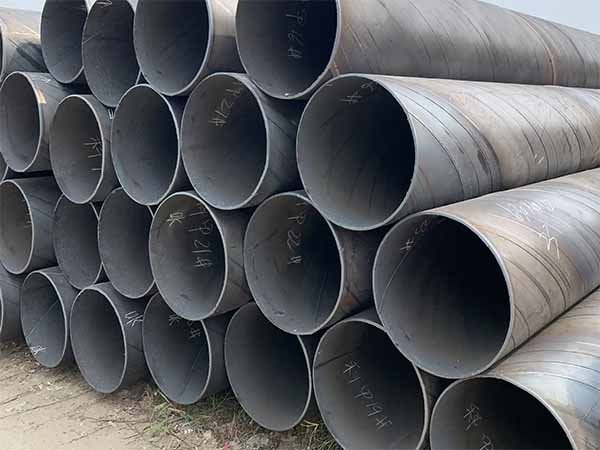
Spiral Welded Steel Pipe (SSAW): Ideal for large-diameter water conveyance and piling projects (conforming to ASTM A252 standards). Spiral welds allow for flexible diameter adjustments and are cost-effective for bulk pipeline transport.
Seamless vs. Welded: The Specification Impact
Specifications are the deciding factor between welded steel pipe and seamless steel pipe. While seamless steel pipe is more popular in high-pressure applications, modern LSAW and ERW specifications now offer equivalent strength and reliability for many applications at a lower cost. Welded steel pipes conforming to standards such as API 5L and PSL2 can replace seamless steel pipes in increasingly critical applications.
Conclusion
Welded steel pipe specifications serve as a bridge between raw steel materials and reliable engineering. By understanding the nuances of API, ASTM, and EN standards and combining them with proper manufacturing processes, costs can be optimized without compromising safety.
 Central Steel


 Language
 English
 Español
 بالعربية
 sales@central-steels.com
 0086-731-8865-5017