 Central Steel
Central Steel
Central Steel
Central Steel
Central Steel
The key differences between straight-seam steel pipes and seamless steel pipes lie in their manufacturing processes (presence or absence of a weld seam), pressure-bearing and mechanical properties, production costs, and application scenarios. In short, seamless steel pipes are formed via integral extrusion and lack any weld seams, offering superior resistance to high pressure, high temperatures, and corrosion, albeit at a higher cost; conversely, straight-seam steel pipes (such as ERW or LSAW) are produced by rolling and welding steel plates—while the pressure-bearing capacity at the weld seam is slightly lower than that of the pipe body, they offer advantages such as high production efficiency, a wide range of available sizes, and greater cost-effectiveness.
| Comparison Metrics | Straight Seam Steel Pipe (Welded - ERW/LSAW) | Seamless Steel Pipe (SMLS) |
| Manufacturing Process | Rolled steel plates/coils welded longitudinally. | Solid billet pierced, then hot-rolled or cold-drawn. |
| Seam/Weld | Features a visible longitudinal weld seam. | 100% seam-free, completely uniform structure. |
| Pressure Capacity | Excellent for low-to-medium pressure applications. | Exceptional resistance to high pressure and stress. |
| Cost & Efficiency | Lower production cost, high efficiency, budget-friendly. | Complex process, longer cycle, higher market price. |
| Key Applications | Water/gas distribution, structural piling, scaffolding. | Oil & gas drilling (OCTG), high-pressure boilers, chemical plants. |
Straight Seam Steel Pipe: Plate Rolling & Welding
Straight seam steel pipe is manufactured by bending a hot-rolled steel plate or strip into a cylinder and joining the edges together using a longitudinal welding process. Depending on the specific welding technology used, they are categorized into two main types:
ERW (Electric Resistance Welded): Uses high-frequency electrical currents to heat the edges of the steel coil before pressing them together to form a solid seam.
LSAW (Longitudinal Submerged Arc Welding): Uses a heavy steel plate as raw material, formed through specialized JCOE or UOE molding presses, and welded using submerged arc technology. This method is ideal for heavy-wall and large-diameter pipes.
Seamless Steel Pipe: One-Piece Extrusion
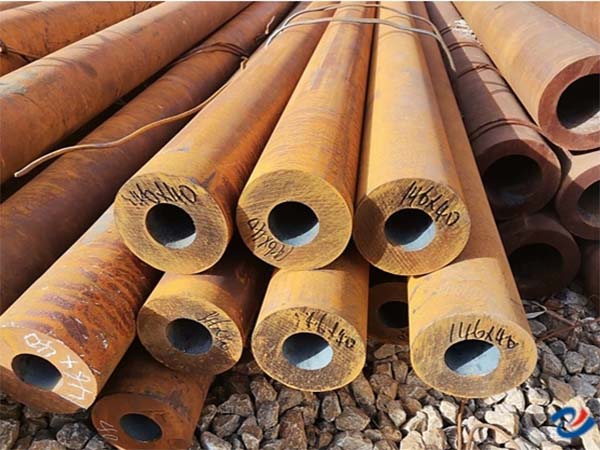
Seamless steel pipe features a completely continuous, solid body with no joints or welds. The production begins with a solid round steel billet. This billet is heated to extreme temperatures and pierced through its center with a mandrel. It then undergoes multiple rounds of hot rolling, cold rolling, or cold drawing to achieve precise dimensional accuracy and uniform wall thickness. Because there is no thermal stress from welding, the internal crystalline structure remains perfectly uniform.
Straight Seam Steel Pipe: Cost-Effective & Dimensionally Stable
The Weld Line Variable: While modern non-destructive testing (NDT)—such as ultrasonic and X-ray inspection—ensures that weld seam strength closely approaches that of the base metal, the seam remains a theoretical point of vulnerability under extreme operating pressures or cyclic loading.
Dimensional Advantage: For non-critical pressure zones, straight seam pipes offer excellent dimensional tolerances, uniform wall thicknesses, and unmatched cost-to-performance ratios.
Seamless Steel Pipe: Maximum Safety Margin
Homogeneous Strength: Without a weld seam, a seamless pipe boasts uniform mechanical properties throughout its entire circumference. It eliminates the risk of weak points, providing ultimate reliability against bursting, bending, and twisting under immense internal or external loads.
Extreme Resistance: It performs flawlessly in severe environments, offering superior longevity against corrosion and thermal fatigue in high-temperature or highly acidic applications.
Where Straight Seam Steel Pipe Excels:
Driven by high-volume production and economical pricing, straight seam pipes are widely utilized in municipal infrastructure and structural engineering:
Low-to-Medium Pressure Fluid Transport: Municipal water supply lines, low-pressure natural gas networks, compressed air systems, and civil oil transport.
Structural & Construction Projects: High-rise steel structures, bridge supports, foundation piling pipes, and scaffolding.
Where Seamless Steel Pipe is Mandatory:
Because safety and zero-leakage are critical in high-risk environments, seamless steel pipe is the default choice for heavy industry:
Oil & Gas Sector: Oil Country Tubular Goods (OCTG) including drill pipes, well casings, tubings, and high-pressure subsea pipelines.
Power Generation & Chemical Processing: High-pressure steam boiler tubes, chemical refinery cracking units, and high-pressure vessels.
Mechanical Components: Hydraulic cylinders, automotive drive shafts, and precision machinery parts requiring high torque resistance.
In general, the difference between straight steel pipes and seamless steel pipes is mainly in the manufacturing process, because of the difference in their production process, making their performance different. Straight steel pipes are suitable for working in medium and low pressure and non-high temperature environments, while seamless pipes are suitable for use in high temperature and high pressure or harsh environments. In the selection of materials, the pressure, temperature, environment and other factors should be considered comprehensively, and the appropriate pipe should be applied to cope with the corresponding environment.
Read more : What is seamless steel pipe?


 Language
 English
 Español
 بالعربية
 sales@central-steels.com
 0086-731-8865-5017