Sheet piles are widely used in modern construction engineering for retaining walls, foundation pit support, and complex hydraulic systems. Sheet piles interlock to form a continuous, impermeable wall, effectively preventing ground subsidence and soil erosion.
This article introduces commonly used types of steel sheet piles in construction engineering and classifies them according to material,
structural shape, and application to help users select the appropriate sheet piles.
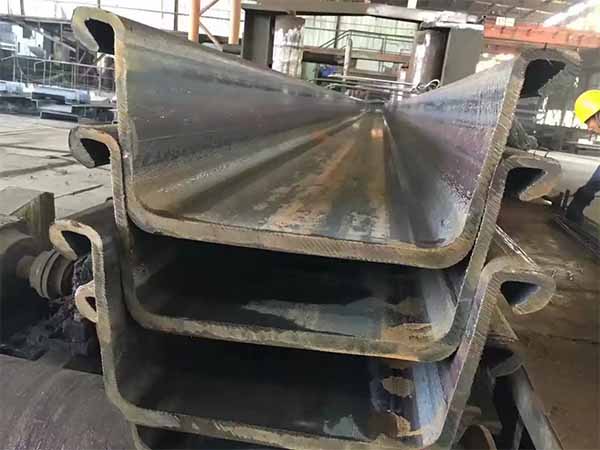
1. Classification by Material
The material determines the strength, service life, and environmental suitability of sheet piles.
Steel Sheet Piles: Steel is the mainstream material in the industry due to its excellent strength-to-weight ratio and toughness. Steel sheet piles are typically made from hot-rolled or cold-formed steel, possessing excellent interlocking tightness and high bending strength. Steel sheet piles are particularly favored for their repeatability; the steel can be driven in or pulled out and reused in multiple projects, making it an economical choice for temporary works.
Main Applications: Steel sheet piles are standard in high-load environments, including deep foundation pits, marine cofferdams, and port structures, where resisting immense earth and water pressures is crucial.
Polyvinyl Chloride (PVC) Sheet Piles: PVC sheet piles are popular due to their lightweight and environmentally friendly properties, making them particularly suitable for corrosive environments. Unlike steel, PVC does not rust, corrode in seawater, or chemically degrade, significantly reducing long-term maintenance costs. While their load-bearing capacity is not as high as steel, they are very durable under suitable conditions.
Main Applications: They are ideal for environmental conservation, riverbank protection, and lightweight retaining walls in locations with moderate structural loads but continuous exposure to water or chemicals.
Concrete Sheet Piles: Concrete sheet piles are designed for permanent installations and to withstand large axial loads. They are typically precast and reinforced (usually prestressed), possessing extremely high compressive strength and a service life exceeding that of most other materials without performance degradation. However, they are heavier than lighter alternatives, making installation more complex and costly.
Concrete Sheet Piles: Main Applications: They are best suited for permanent structures such as large wharf walls, flood control dikes, and permanent retaining systems, which are immovable once installed.
Sheet Piles: Sheet piles are among the oldest types of pile foundations. While wood has limited load-bearing capacity and is prone to rot if untreated, they are economical and can be easily moved without heavy machinery.
2. Classification by Structure
The cross-sectional shape of a pile determines its section modulus and bending moment capacity.
Z-Type Sheet Piles: Z-type sheet piles are designed for maximum structural efficiency. Their continuous web structure allows interlocking points to be symmetrically distributed on both sides of the neutral axis, significantly increasing the ratio of section modulus (bending strength) to steel weight. This makes them the most economical choice for high-stress engineering.
U-Type Sheet Piles: U-type sheet piles have a symmetrical cross-section widely accepted in general construction. While their strength-to-weight ratio may be lower compared to Z-type sheet piles, they offer excellent driving performance and a good application record. They are often reusable and provide reliable waterproofing.
Sheet piles: Unlike U- or Z-type piles, sheet piles are not designed to withstand high bending strength. Instead, their circular interlocking design allows rotation, forming flexible units. Their primary function is tensile strength, not bending strength.
How to Choose Sheet Piles (Temporary or Permanent)
Sheet piles are classified according to their lifespan within a project. Temporary sheet piles are used during construction as safety measures, such as supporting trenches or cofferdams, and are removed after the main structure is completed. In contrast, permanent sheet piles are part of the final structure (such as basement walls, seawalls, or flood barriers), buried underground for a long period, and typically require higher-grade materials to resist long-term corrosion.
Summary
From robust and durable steel Z-type sheet piles to corrosion-resistant vinyl sheet piles, understanding the nuances of sheet pile types is key to successful project implementation.
 Central Steel


 Language
 English
 Español
 بالعربية
 sales@central-steels.com
 0086-731-8865-5017