Steel pile is a kind of load bearing or protection building material used in foundation engineering. Because of its advantages of high strength, good durability and convenient construction, it is widely used in construction, bridge, wharf and other fields. According to its use, shape and construction methods, steel piles are mainly divided into the following categories, each steel pile has its own unique characteristics and trial scenarios.
The main classification of steel piles
Steel pipe piles are usually round steel pipes, made of low carbon steel or low alloy steel, with high strength and good durability. It is a type of steel pile used to carry or support the structure by inserting the steel pipe into the foundation soil. Because of its simple structure and strong adaptability, it is widely used in all kinds of foundation projects.
Compared with other steel piles, steel pipe piles have their unique advantages in many aspects. For example, it has high compressive, flexural and tensile strength, can withstand large longitudinal and transverse loads, and has strong single pile bearing capacity.
Steel pipe piles are mostly made of welded steel pipes or seamless steel pipes, which can be cut, spliced or reinforced according to design requirements. It has a wide range of application scenarios, such as bridge engineering, ocean engineering and other fields that need to be carried.
2. Steel sheet piles
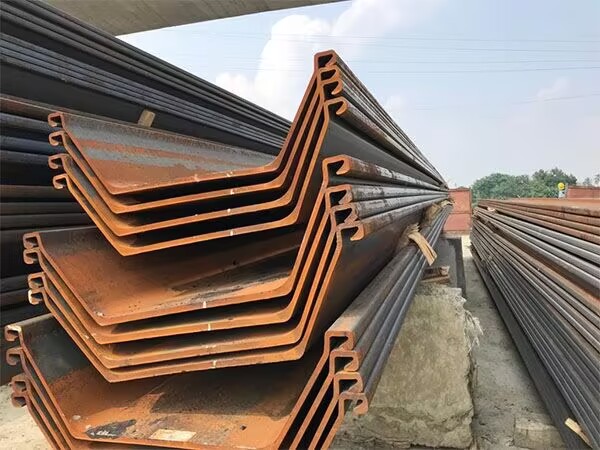
Steel sheet pile is a steel member with a lock edge, with a variety of forms, the common steel sheet pile
U-shaped steel sheet pile and Z-shaped steel sheet pile. Among them, U-shaped steel sheet pile has high strength and convenient construction, which is suitable for narrow space, and Z-shaped steel sheet pile has stronger bearing capacity, which is suitable for wider retaining wall engineering.
Steel sheet pile can form a continuous retaining wall or waterproof structure through the interlocking of the lock, which is an important material for water conservancy and underground engineering. It is widely used in hydraulic engineering and underground engineering, used to prevent collapse or soil erosion in the construction of deep foundation pit, and can also be used in the construction of ports, docks and revetment structures.
The characteristics of steel sheet pile: good waterproof performance, steel sheet pile can effectively prevent water penetration after connection, especially suitable for underground or underwater projects, and steel sheet pile can be used repeatedly, reducing the cost of construction, convenient installation, and rapid construction.
Common Types of Steel Sheet Piles
The most common steel sheet pile profiles include:
U-shaped steel sheet piles
Z-shaped steel sheet piles
Flat or straight-web sheet piles
Other specialized sheet pile profiles
U-Shaped Steel Sheet Piles
U-shaped sheet piles have a U-shaped cross-section and interlocks located along the edges.
Their main advantages include:
Wide range of available specifications
Good structural performance
Convenient installation
Good adaptability to different construction conditions
Can be extracted and reused in many temporary projects
U-shaped steel sheet piles are widely used for foundation pit support, cofferdams, riverbank protection, temporary retaining walls, and other civil engineering projects.
Z-Shaped Steel Sheet Piles
Z-shaped steel sheet piles have a Z-shaped cross-section. Their interlocks are positioned farther from the neutral axis, allowing the section to achieve a high section modulus and efficient bending performance.
The main characteristics of Z-shaped sheet piles include:
High bending resistance
High structural efficiency
Large section modulus
Efficient use of steel
Suitable for long retaining walls
Good performance under lateral earth and water pressure
Z-shaped sheet piles are commonly used in ports, marine structures, deep foundation pits, quay walls, and large retaining structures.
For a more detailed comparison, U-type and Z-type sheet piles can be selected according to the required section modulus, wall stiffness, installation conditions, and project design.
3. H-Piles and Other Structural Steel Piles
H-piles are structural steel piles with an H-shaped cross-section. They are primarily designed to transfer vertical and horizontal structural loads into the ground.
Compared with sheet piles, H-piles are generally used as load-bearing foundation piles rather than continuous retaining walls.
Characteristics of H-Piles
The main advantages of H-piles include:
High axial load-bearing capacity
Good bending resistance
High structural stiffness
Efficient load transfer
Suitable for driving into relatively hard soil
Available in different sizes and lengths
H-piles are commonly used in:
Building foundations
Bridge foundations
Highway and railway projects
Industrial structures
Pier and structural support systems
Projects requiring high vertical or lateral load capacity
The steel section size and pile length can be selected according to the design load, soil conditions, and required penetration depth.
Steel Pipe Piles vs Steel Sheet Piles vs H-Piles
Although all three are classified as steel piles, their primary functions are different.
|
Comparison
|
Steel Pipe Piles
|
Steel Sheet Piles
|
H-Piles
|
|
Main Function
|
Load bearing
|
Soil/water retention
|
Load bearing
|
|
Cross Section
|
Circular
|
U, Z, or other profiles
|
H-shaped
|
|
Typical Load
|
Axial + lateral loads
|
Earth/water pressure
|
Mainly axial + lateral loads
|
|
Interlocking
|
No
|
Yes
|
No
|
|
Retaining Wall Function
|
Limited
|
Excellent
|
Usually requires additional elements
|
|
Water Cutoff
|
Limited
|
Good when properly interlocked
|
Limited
|
|
Typical Applications
|
Bridges, marine structures, foundations
|
Cofferdams, retaining walls, excavation support
|
Buildings, bridges, heavy structures
|
Therefore, steel pipe piles and H-piles are generally selected when the primary requirement is structural load transfer, while steel sheet piles are mainly selected when soil retention, excavation support, or water cutoff is required.
Frequently Asked Questions About Steel Piles
1. What are the main types of steel piles?
The main types include steel pipe piles, steel sheet piles, and H-piles. Steel pipe piles and H-piles are primarily used for load-bearing foundations, while steel sheet piles are mainly used for retaining walls, cofferdams, excavation support, and water cutoff.
2. What is the difference between steel pipe piles and sheet piles?
Steel pipe piles are primarily designed to transfer structural loads into the ground, while steel sheet piles are mainly designed to retain soil and water. Steel sheet piles have interlocking edges that allow them to form a continuous wall.
3. What is the difference between U-shaped and Z-shaped steel sheet piles?
U-shaped and Z-shaped sheet piles have different cross-sectional geometries and structural characteristics. U-shaped sheet piles offer good construction adaptability and a wide range of applications, while Z-shaped sheet piles generally provide efficient bending performance and high section modulus, making them suitable for larger retaining structures.
Conclusion
The best steel pile depends on the project's load requirements, soil conditions, installation method, service environment, and structural function. Selecting the appropriate pile profile and specification can improve foundation performance while controlling material and construction costs.
 Central Steel


 Language
 English
 Español
 بالعربية
 sales@central-steels.com
 0086-731-8865-5017