Steel pipe piles are widely used in modern construction projects, especially in situations requiring high reliability and deep foundation pits. With urban development and the increasing size and weight of buildings, traditional shallow foundation pits are insufficient to meet the requirements of bearing capacity and stability. In such cases, steel pipe piles can effectively transfer structural loads to deeper, more stable soil or rock layers, ensuring the long-term stability and safety of the structure.
Overview of Steel Pipe Piles
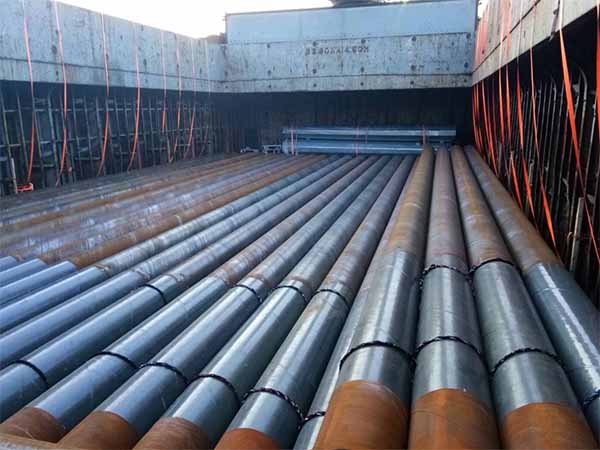
Steel pipe piles are cylindrical steel components made of carbon steel or low-alloy structural steel, typically welded directly using
straight seam welding or
spiral welding. Depending on different project requirements, steel pipe piles can be produced in large diameters, with varying wall thicknesses and extended lengths. Their hollow cross-section not only reduces material weight but also allows for further reinforcement methods such as concrete infill, further improving the structure's bearing capacity.
In construction engineering, steel pipe piles are highly favored due to their stable mechanical properties, dimensional accuracy, and compatibility with international standards such as ASTM, EN, and JIS.
Structural Applications of Steel Pipe Piles in Building Construction
Deep Foundation Systems
One of the main applications of steel pipe piles in building construction is providing deep foundation support for structures bearing heavy loads. In areas with soft clay, loose sand, or reclaimed land, the surface soil often lacks sufficient bearing capacity to safely support buildings. Steel pipe piles can penetrate weak soil layers, transferring loads to deeper, more stable soil layers, thereby effectively controlling settlement and improving foundation reliability.
Bridges and Transportation Infrastructure
Because steel pipe piles can withstand both static and dynamic loads, they are widely used in bridge construction and transportation infrastructure. Bridges, viaducts, and railway structures are subject to continuous vibrations, traffic impacts, and seismic forces in some areas. The high strength and ductility of steel pipe piles enable them to operate reliably under such harsh conditions.
Marine and Coastal Engineering
In marine and coastal environments, steel pipe piles are commonly used in areas exposed to water, waves, and various load conditions. They are widely used in ports, docks, breakwaters, piers, and offshore structures, where these foundation components can withstand vertical loads and lateral forces. With appropriate corrosion protection measures, such as coating protection, cathodic protection, or concrete filling, steel pipe piles can achieve a long service life even in corrosive seawater environments.
Retaining Structures and Soil Support Systems
Steel pipe piles are also widely used in retaining structures and soil support systems, especially in deep foundation excavation or slope stabilization projects. When used in conjunction with retaining sheet piles or steel sheet piles, steel pipe piles provide strong lateral resistance and structural stability.
In temporary works such as cofferdams and foundation pit support systems, steel pipe piles offer the advantages of being detachable and reusable, contributing to improved cost-effectiveness and construction flexibility.
Conclusion
Steel pipe piles remain one of the most reliable foundation solutions in building engineering, offering high load-bearing capacity, strong structural stability, and adaptability to complex soil conditions. Their wide range of structural applications, coupled with proven durability and installation flexibility, make them suitable for a variety of applications, from buildings and bridges to marine and energy infrastructure.
 Central Steel


 Language
 English
 Español
 بالعربية
 sales@central-steels.com
 0086-731-8865-5017