 Central Steel
Central Steel
Central Steel
Central Steel
Central Steel
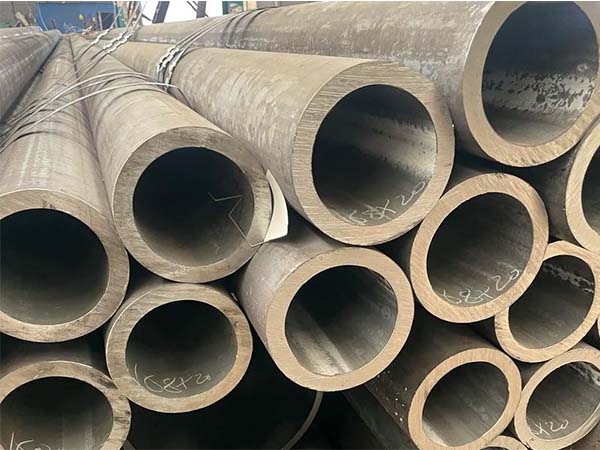
Seamless alloy pipes are manufactured from solid alloy steel billets through a series of controlled processes, including billet inspection, heating, piercing, rolling or extrusion, sizing, heat treatment, finishing, and inspection. Unlike welded pipes, seamless alloy pipes are formed without a longitudinal weld seam, making them suitable for high-pressure, high-temperature, and other demanding applications. The final performance of the pipe depends not only on its alloy composition but also on precise control of piercing, deformation, heat treatment, dimensional accuracy, and quality testing.
This guide explains the seamless alloy pipe manufacturing process, including the major production steps, heat treatment methods, quality control procedures, and common standards used for alloy seamless pipes.
What is a Seamless Alloy Pipe?
A seamless alloy pipe is a tubular steel product manufactured from a solid steel billet without welding a plate or strip into a tube. Alloying elements such as chromium, molybdenum, nickel, manganese, and vanadium can be added to improve the pipe's strength, toughness, corrosion resistance, creep resistance, and high-temperature performance.
Common seamless alloy pipe grades include ASTM A335 P5, P9, P11, P22, and P91, which are widely used in power generation, petrochemical processing, refineries, boilers, and high-temperature piping systems.
The manufacturing process is especially important for these applications because improper forming or heat treatment can negatively affect the pipe's mechanical properties and long-term service performance.
Seamless Alloy Pipe Manufacturing Process
The typical manufacturing process for seamless alloy steel pipes is:
Steel Billet → Billet Inspection → Heating → Piercing → Rolling/Elongation → Sizing → Heat Treatment → Surface Finishing → Cold Working (if required) → Straightening → Cutting → Inspection & Testing → Marking & Packaging
The exact process may vary depending on the alloy grade, pipe dimensions, manufacturing method, applicable standard, and required mechanical properties.
|
Manufacturing Stage |
Main Process |
Purpose / Key Control |
|
1. Billet Preparation |
Cutting and inspection of solid alloy steel billet |
Ensures correct grade, dimensions, and surface quality |
|
2. Heating |
Uniform heating in a controlled furnace |
Makes the billet suitable for plastic deformation |
|
3. Piercing |
Rotary piercing or similar process |
Creates the hollow tube from the solid billet |
|
4. Rolling / Elongation |
Mandrel rolling, plug rolling, or extrusion |
Reduces wall thickness and increases pipe length |
|
5. Sizing |
Sizing or reducing |
Controls outside diameter and dimensional accuracy |
|
6. Heat Treatment |
Normalizing, annealing, quenching and tempering |
Establishes the required microstructure and mechanical properties |
|
7. Surface Finishing |
Descaling, grinding, shot blasting, etc. |
Removes scale and surface imperfections |
|
8. Cold Working |
Cold drawing or cold sizing when required |
Improves dimensional accuracy and surface finish |
|
9. Straightening & Cutting |
Straightening and cutting to length |
Meets straightness and length requirements |
|
10. Inspection & Testing |
UT, tensile, hardness, impact, hydrostatic testing, etc. |
Verifies product quality and compliance |
|
11. Marking & Packaging |
Marking and bundling |
Provides traceability and protects the pipes during transportation |
Normalizing
Normalizing is the most common heat treatment method. It involves heating the pipe above its critical temperature, holding it at that temperature, and then cooling it in air. This method refines the grain structure and improves the toughness of the steel pipe. It is often used as the final heat treatment for low-alloy steel or as a pretreatment for high-alloy steel.
Annealing
Annealing is typically used before cold drawing. It is divided into full annealing and annealing. It usually involves heating the steel above its critical point and then slowly cooling it. This softens the material and significantly improves the machinability of the steel pipe.
Tempering
Tempering immediately after quenching involves reheating the steel to a specific temperature below its critical temperature.


 Language
 English
 Español
 بالعربية
 sales@central-steels.com
 0086-731-8865-5017