Among various types of steel pipes,
spiral welded pipes (typically referring to SSAW spiral double-sided submerged arc welded pipes) have become the most commonly used steel pipes in construction and water transportation due to their unique manufacturing process and extremely high cost-effectiveness.
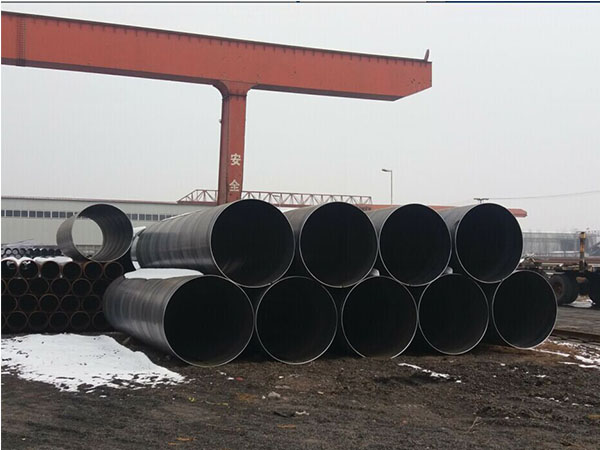
What are Spiral Welded Pipes?
Spiral welded pipes are steel pipes with a spiral seam, made from strip steel coils as raw material, formed by cold extrusion, and welded using an automatic double-sided submerged arc welding process. Simply put, it involves spirally coiling and welding steel strips like a paper roll. This unique forming method gives spiral welded pipes different physical properties and application scenarios compared to seamless pipes and straight seam welded pipes (LSAW/ERW).
Main Advantages of Spiral Welded Pipes
1. Low production cost and extremely high cost-effectiveness
This is the most significant advantage of spiral welded pipes. Because it uses coiled steel strips as raw material, continuous production is possible. 1. **High Dimensional Flexibility:** Compared to the thick steel plates required for manufacturing large-diameter straight seam steel pipes, steel strips are cheaper to procure and easier to transport and store. Therefore, for the same diameter, spiral welded pipes are generally cheaper than straight seam welded pipes and seamless steel pipes.
2. High Dimensional Flexibility
The manufacturing process for spiral welded pipes is highly flexible. Using steel strips of the same width, different diameter pipes can be produced simply by adjusting the forming angle. Conversely, steel strips of different widths can also produce pipes of the same diameter. This flexibility allows manufacturers to avoid frequent mold changes, greatly satisfying customers' customization needs for non-standard sizes.
3. Uniform Weld Stress and Strong Compressive Resistance
Although spiral welded pipes have longer weld seams, due to the spiral distribution of the weld seams, when the pipe is subjected to internal fluid pressure, the radial stress (principal stress) borne by the spiral weld seam is only 60% to 85% of the stress borne by the weld seam of straight seam steel pipes. This means that under the same working pressure and pipe diameter, spiral welded pipes can use thinner walls than straight seam steel pipes, thereby further reducing material costs.
4. High Continuous Production Efficiency
As long as the steel coil is continuous, spiral welded pipes can achieve uninterrupted continuous production. This high-efficiency production mode is very suitable for large-scale long-distance pipeline projects requiring large-volume supply, such as transnational water and gas transmission projects.
Main Disadvantages of Spiral Welded Pipes
1. Longer Weld Seam, Relatively Higher Defect Probability
Due to the process characteristics, the weld seam length of spiral welded pipes is typically 1.3 to 2.1 times that of straight seam pipes of the same length. The longer the weld seam, the higher the statistical probability of welding defects such as porosity, slag inclusions, and cracks. Therefore, spiral welded pipes must undergo extremely rigorous non-destructive testing (such as X-ray inspection and ultrasonic testing) before leaving the factory.
2. Slightly Inferior Dimensional Accuracy and Surface Quality
Due to internal stress during the strip coiling process, and because forming and welding are performed simultaneously, spiral welded pipes generally have lower dimensional accuracy than large-diameter straight-seam welded pipes, particularly in terms of roundness, end flatness, and overall straightness. Furthermore, the surface smoothness of the pipe may also be slightly rougher.
3. Limited Use in Extremely High-Pressure/High-Risk Environments
While spiral welds offer advantages in stress resistance, the aforementioned "high defect rate risk due to long welds" means that in harsh environments with zero tolerance, such as core pipelines in nuclear power plants and deep-sea extremely high-pressure oil and gas pipelines, engineers typically prioritize seamless steel pipes or thick-walled straight-seam submerged arc welded pipes over spiral welded pipes.
Common Application Areas of Spiral Welded Pipes
Considering its advantages and disadvantages, spiral welded pipes are best suited for cost-sensitive long-distance transportation projects with moderate pressure requirements. Main applications include:
Water Conservancy Projects: Urban water supply networks, agricultural irrigation, and sewage treatment and transportation.
Conventional Oil and Gas Transportation: Long-distance pipelines for medium- and low-pressure oil and natural gas.
Infrastructure Construction: Bridge piling pipes, dock steel pipe piles, steel structure supports for large stadiums or airports.
Chemical and Thermal Power: Central heating networks, chemical fluid transportation.
Summary
Spiral welded pipes, with their absolute advantages of large diameter, low cost, and flexible production, are widely used in water conservancy construction and infrastructure construction; however, careful selection is required when facing ultra-high pressure environments or environments with extremely stringent weld quality requirements.
 Central Steel


 Language
 English
 Español
 بالعربية
 sales@central-steels.com
 0086-731-8865-5017