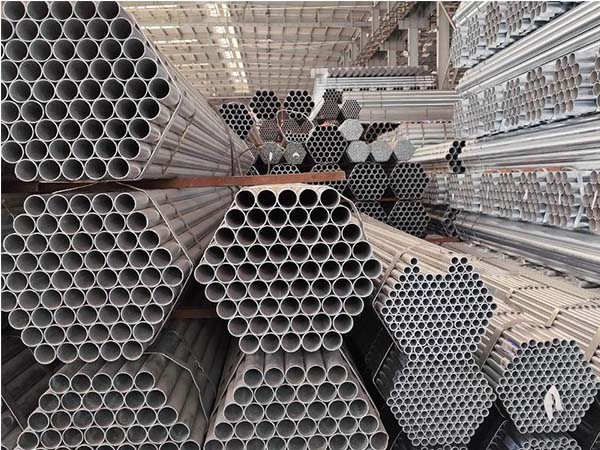
Seamless carbon steel pipes are widely used in pipeline engineering and industrial manufacturing due to their high strength and pressure resistance. However, carbon steel itself has poor corrosion resistance and is prone to rusting. To extend their service life, hot-dip galvanizing has become the most mainstream and efficient anti-corrosion method.
The final quality of
galvanizing seamless pipes is often determined before they even enter the zinc bath. Before galvanizing, we need to pay special attention to the following core issues:
1. Strict Control of Surface Condition
Incomplete Degreasing and Rust Removal: During rolling and transportation, grease, scale, and rust adhere to the surface of seamless pipes. If pickling and degreasing are incomplete, the zinc liquid will not be able to alloy with the steel pipe substrate, directly leading to "incomplete galvanizing."
Scratches and Indentations: Galvanizing cannot cover deep scratches or physical defects on the steel pipe surface; on the contrary, the accumulation of zinc may make the defects more obvious. Strict surface appearance inspection is required before entering the factory.
2. Internal Stress and Deformation Risks of Steel Pipes
Stress Release: Carbon steel seamless pipes may retain residual internal stress after cold drawing or hot rolling. In molten zinc at temperatures reaching approximately 450°C, the high temperature can cause instantaneous stress release, easily leading to bending deformation of the steel pipe.
Prevention Recommendations: For seamless pipes with extremely high aspect ratios or extremely thin walls, it is recommended to perform appropriate stress-relief annealing treatment before galvanizing, and control the tilt angle and sinking speed when placing them in the zinc bath.
3. Preventing Over-Pickling and Hydrogen Embrittlement
Prolonged residence time in the pickling tank not only degrades the base metal, leading to thinner pipe walls and a rougher surface, but may also trigger hydrogen embrittlement, severely reducing the mechanical properties of the seamless pipe. The concentration, temperature, and immersion time of the pickling solution must be strictly controlled.
Hot-Dip Galvanizing Process Flow for Carbon Steel Seamless Pipes
The standard hot-dip galvanizing process for carbon steel seamless pipes typically includes the following steps:
Degreasing (Alkaline Washing): Removing machine oil, grease, and lubricants from the surface.
Water washing: Washes away residual alkaline solution.
Pickling: Usually uses hydrochloric acid or sulfuric acid to remove surface oxide scale and rust, exposing the pure steel substrate.
Water washing: Rinses away acid and adhering substances.
Solution immersion (fluxing): Immerses the steel pipe in a mixed aqueous solution of zinc chloride and ammonium chloride to prevent re-oxidation before drying and enhance the adhesion of the zinc bath.
Drying preheating: Evaporates surface moisture to prevent "zinc splattering" (zinc splattering) when entering the zinc bath.
Hot-dip galvanizing: Immerses the steel pipe in molten zinc at 440°C-460°C. Iron and zinc react to form a dense iron-zinc alloy layer and a pure zinc layer.
Extraction and external/internal blowing: Removes the steel pipe from the zinc bath and uses compressed air or steam to blow away excess zinc from the inner and outer surfaces, controlling the zinc layer thickness and ensuring a smooth surface.
Cooling and Passivation: Rapid water cooling followed by passivation treatment (such as chromate or chromium-free passivation) improves the surface's resistance to white rust.
Common Problems and Remedial Measures After Galvanizing
Even with strict controls, imperfections are inevitable in actual production. Discovering problems is not the problem; the key is how to remedy them using methods that comply with industry standards (such as GB/T 13912 or ASTM A53).
1. Incomplete Galvanizing (Black spots on the surface where no zinc has adhered)
Causes: Inadequate surface pretreatment, ineffective flux, or slag adhering to the zinc bath.
Remedial Measures: If the incomplete galvanizing area is small (generally, a single spot should not exceed 10 cm², and the total area should not exceed 0.5% of the surface area), first use a wire brush or grinding wheel to polish the incomplete area until a metallic luster is exposed, then apply a zinc-rich primer (dry film zinc content should ideally be above 90%) or repair using a thermal spray zinc process. If the area is too large, the galvanizing must be removed and the process redone.
2. Zinc Nodules and Burrs (Rough Surface, Zinc Droplets Condensed)
Causes: Excessive draw-out speed, low zinc liquid temperature, or insufficient external air pressure causing excess zinc liquid to fail to cool and condense in time.
Remedial Measures: This type of defect mainly affects the connection or appearance of the pipe thread. Use a file or specialized mechanical grinding tool to gently smooth the zinc nodules and burrs. Be careful not to damage the underlying iron-zinc alloy layer; grind until flush with the surrounding zinc layer.
3. Post-Glazing Pipe Bending and Deformation
Causes: High-temperature stress release, uneven lifting force, or inconsistent cooling shrinkage.
Remedial Measures: Cold straightening is required on a specialized pipe straightening machine. During straightening, soft materials (such as nylon blocks or wooden blocks) should be used as padding to prevent damage to the pure zinc layer. If the deformation is extremely severe and cold straightening is not possible, the pipe must be scrapped or downgraded.
Frequently Asked Questions (FAQs) about the Galvanized Coating of Seamless Steel Pipes
Q1: Why is the galvanized coating of some seamless steel pipes black or gray instead of silvery-white?
A: This is known in the industry as the "Sandelin Effect." It is usually related to the chemical composition of the carbon steel seamless steel pipe matrix (especially the content of silicon (Si) and phosphorus (P)). When the silicon content in the steel pipe is within a specific range (e.g., 0.03%~0.12% or greater than 0.3%), the reaction of the iron-zinc alloy becomes abnormally vigorous, causing the alloy layer to grow rapidly, breaking through the pure zinc layer to reach the surface. Because the iron-zinc alloy is dark gray, the surface of the galvanized pipe will appear gray or black.
Q2: What should the thickness of the galvanized coating be for carbon steel seamless steel pipes?
A: The thickness of the zinc coating mainly depends on the wall thickness of the steel pipe and the specific application standards. Generally, for steel pipes with a wall thickness less than 3mm, the local thickness should be no less than 45μm, and the average thickness no less than 55μm; for steel pipes with a wall thickness between 3mm and 6mm, the local thickness should be no less than 55μm, and the average thickness no less than 70μm.
Q3: Will the high temperature of hot-dip galvanizing reduce the mechanical properties of seamless pipes?
A: Generally not. The hot-dip galvanizing temperature is around 450°C, which is lower than the phase transformation temperature of carbon steel and will not change the internal crystal structure of the pipe. Therefore, it has a negligible impact on the tensile strength and yield strength of conventional carbon steel seamless pipes. However, in some high-strength alloy steels or steel pipes with severe cold work hardening, the high temperature may cause a slight annealing effect, and a margin should be allowed in the design.
Summary
Hot-dip galvanizing of carbon steel seamless pipes is a systematic engineering process combining chemistry and physics. Only by conducting rigorous substrate screening and pretreatment before galvanizing, controlling temperature and time during the process, and implementing standardized inspection and remedial measures after galvanizing, can we ensure that every steel pipe leaving the factory has excellent corrosion resistance and reliable engineering quality.
Read more : Schedule 10 vs schedule 40 steel pipe
 Central Steel


 Language
 English
 Español
 بالعربية
 sales@central-steels.com
 0086-731-8865-5017