In the field of
welded steel pipes,
spiral welded pipe and straight seam welded pipe are two of the most common and easily compared product types. Although both belong to welded steel pipes, they differ significantly in forming methods, weld seam orientation, stress mechanisms, and manufacturing processes, resulting in substantial differences in their pressure-bearing capacity, applicable scenarios, and cost structures. This article will compare spiral welded pipe (SSAW pipe) and straight seam welded pipe (LSAW/ERW pipe) from multiple perspectives, including manufacturing methods, mechanical properties, load-bearing capacity, and industry applications.
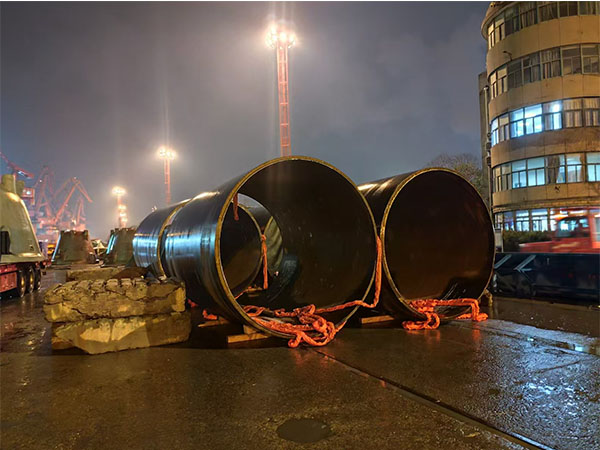
1. Spiral Welded Pipe vs. Straight Seam Welded Pipe Manufacturing Process
What is a Spiral Welded Pipe?
A spiral welded pipe, also known as SSAW pipe (spiral submerged arc welded pipe), is made by continuously forming steel coils into a cylindrical shape with a predetermined spiral angle and then welding them using submerged arc welding technology. Unlike straight seam pipes, its weld seam does not extend straight along the length of the steel pipe, but rather is distributed spirally around the pipe body. Therefore, spiral welded pipes have longer weld seams and a more flexible forming process, making them suitable for manufacturing large-diameter steel pipes.
What is a straight seam welded pipe?
A straight seam welded pipe is made by bending steel plates or strips into a cylindrical shape and then welding them longitudinally along the pipe's axis.
Common straight seam welded pipes include:
ERW pipe (Electric Resistance Welded Pipe): Commonly used for small to medium diameter pipelines;
LSAW pipe (Longitudinal Submerged Arc Welded Pipe): Commonly used for high-pressure, long-distance pipelines;
High-frequency welded straight seam steel pipes, etc.
In terms of categories, spiral welded pipes are more suited to large-diameter, continuously formed, and cost-efficient products; while straight seam welded pipes are more suited to high-precision, high-pressure applications or applications requiring higher weld seam control.
2. Strength Characteristics and Stress Analysis
Stress Changes in Steel Pipes Under Internal Pressure
When the interior of a steel pipe is filled with liquid and neutralized gas, the pipe wall will bear circumferential stress from the inside, also known as peripheral stress.
For thin-walled steel pipes, internal pressure mainly affects circumferential and axial stress. Whether a steel pipe can withstand high internal pressure depends on the material strength, wall thickness, weld quality, and the rationality of stress distribution.
Stress Changes in Steel Pipes Under External Pressure
When a steel pipe is subjected to external pressure, such as burial pressure, soil load, seawater pressure, or structural compression, it is more prone to ellipticization, local buckling, or even instability.
Under external pressure conditions, the instability resistance of a steel pipe depends not only on material strength but also on the pipe diameter to wall thickness ratio, weld distribution, roundness accuracy, manufacturing residual stress, and construction and installation conditions.
Which Steel Pipe Has Stronger Pressure Bearing Capacity?
From the perspective of high pressure, long distance, and high engineering safety requirements, straight seam welded pipes, especially LSAW pipes, are generally more suitable for high-pressure pipelines. The main reasons are as follows:
1. Shorter weld seam, more direct defect control: The welding path of straight seam welding is shorter, making the weld area easier to inspect and control for quality.
2. Clearer stress path in the weld seam: In some high-pressure designs, the structural behavior of straight seam pipes is easier to standardize and analyze.
3. Suitable for higher-level pipeline standards: Straight seam submerged arc welded steel pipes are widely used in oil, gas, and high-pressure transmission pipelines.
Since the weld seam of a spiral welded pipe is obliquely distributed, the circumferential stress generated by internal pressure does not act perpendicularly on the weld seam, resulting in more dispersed stress. Therefore, it can be used in many water transmission and low-to-medium pressure large-diameter projects.
Spiral Welded Pipe vs Straight Seam Welded Pipe: Application
Both spiral welded pipes and straight seam welded pipes belong to welded steel pipes, and therefore they share some common application areas. For example, water pipelines, pile foundation engineering, structural supports, bridge and dock engineering.
Main Applications of Spiral Welded Pipe
Spiral welded pipe offers advantages such as large diameter, continuous production, and good cost efficiency, making it commonly used in:
Long-distance water transmission projects
Municipal water supply and drainage
Seawater transmission
Pile pipes
Infrastructure projects
General low-to-medium pressure fluid transmission
It is particularly suitable for projects requiring large pipe diameters, long lengths, and high economic efficiency. Spiral welded pipe is a very common choice for many water conservancy and infrastructure projects.
Main Applications of Straight Seam Welded Pipe
Straight seam welded pipe is more suitable for projects with higher requirements for strength, precision, and weld quality, such as:
Long-distance oil and gas pipelines
High-pressure transmission pipelines
Structural steel pipes
Machinery pipes
High-requirement industrial pipelines
LSAW pipe is particularly common in high-pressure, large-diameter, long-distance transmission scenarios and is one of the important materials for engineering piping systems.
Frequently Asked Questions (FAQ)
Why is spiral welded pipe usually cheaper?
Spiral welded pipes are manufactured from steel coils, which provide higher material utilization and lower production costs compared with steel plate-based LSAW pipes.
Is spiral welded pipe suitable for oil and gas transportation?
Yes. Spiral welded pipe manufactured according to API 5L standards can be used for oil and gas transportation, although many high-pressure transmission projects prefer LSAW pipe.
Which pipe is better for water transmission?
Spiral welded pipe is often considered the most economical solution for large-diameter water transmission pipelines due to its combination of strength, availability, and cost efficiency.
Summary
For large-diameter water transmission, pile foundation, and infrastructure projects, spiral welded steel pipes offer excellent economic and reliable performance. For high-pressure oil and gas pipelines, offshore systems, and critical industrial applications, straight seam welded pipes (especially LSAW pipes) remain the preferred solution due to their superior weld quality control and pressure resistance.
 Central Steel


 Language
 English
 Español
 بالعربية
 sales@central-steels.com
 0086-731-8865-5017