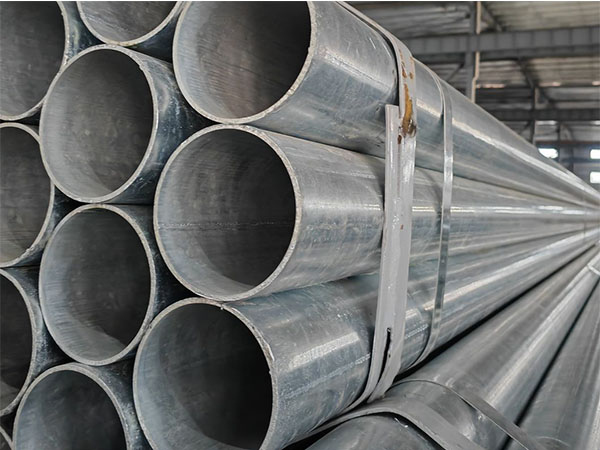
Galvanized welded steel pipe refers to
welded steel pipe that has undergone a galvanizing process, resulting in a dense zinc layer on its surface.
Stainless welded steel pipe, on the other hand, is made by rolling flat stainless steel sheets or coils into cylindrical shapes and then welding them. This article will detail the differences between galvanized and stainless steel welded pipes, helping you distinguish their performance and characteristics.
What is Galvanized Welded Steel Pipe?
Galvanized welded steel pipe uses steel plates or strips as raw materials. These are precisely processed and shaped, then joined together using advanced welding techniques (such as resistance welding or submerged arc welding). After welding, the welded pipe is galvanized.
There are two main methods of galvanizing: electro-galvanizing and
hot-dip galvanizing.
Electro-galvanizing utilizes the principle of an electrolytic cell, immersing the welded pipe (as the cathode) and the zinc plate (as the anode) in an electrolyte containing zinc salts. Under the influence of direct current, zinc at the anode loses electrons and transforms into zinc ions. These ions then migrate towards the cathode under the influence of an electric field and are reduced on the surface of the welded pipe, forming a pure zinc protective layer.
Hot-dip galvanizing, also known as hot-dip zinc plating, involves immersing the welded pipe to be galvanized into molten zinc at 450°C, forming a dense iron-zinc alloy and pure zinc protective layer on its surface. Before hot-dip galvanizing, the steel needs surface treatment and fluxing treatment to improve the wettability of the zinc solution and the adhesion of the coating.
Hot-dip galvanizing offers good coverage, a dense coating, and is free of contaminants. It boasts advantages such as uniform coating, strong adhesion, and long service life. Hot-dip galvanizing provides better atmospheric corrosion resistance to the base metal iron than electroplating.
Electroplating produces galvanized steel sheets with good processing performance, but the coating is thinner and less corrosion-resistant than hot-dip galvanizing. Electroplated galvanized sheets have a very small amount of zinc adhering to them, only coating the outer wall, while hot-dip galvanizing coats both the inner and outer surfaces.
What are stainless steel welded pipes? Stainless steel welded pipes are made by rolling stainless steel plates or strips into the desired hollow shape, and then connecting the edges of the pipe using various welding techniques. Common welding techniques include resistance welding and submerged arc welding. After welding, the pipes require heat treatment, pickling, and passivation to relieve stress, improve corrosion resistance, and enhance surface finish.
Galvanized welded steel pipe VS Stainless welded steel pipe
1. Appearance differences
|
Item
|
Galvanized Welded Steel Pipe
|
Stainless Welded Steel Pipe
|
|
Surface Color
|
Silver-gray
|
Bright silver or mirror-like
|
|
Surface Texture
|
Zinc crystal (spangle) may be visible
|
Smooth and uniform
|
|
Gloss
|
Relatively low
|
Higher metallic luster
|
|
Surface Finish
|
Hot-dip galvanized coating
|
Polished, pickled, or brushed finish
|
|
Weld Visibility
|
Usually visible after galvanizing
|
Often nearly invisible after polishing
|
2. Material differences
Galvanized welded pipes are essentially carbon steel welded pipes. Their corrosion resistance mainly relies on the outer zinc layer. When the zinc layer is worn or corroded, the internal carbon steel may begin to rust.
Stainless steel welded pipes, on the other hand, are made of chromium-containing stainless steel, with a core characteristic of a chromium content of at least 10.5%. The corrosion resistance of stainless steel welded pipes comes from the material itself, not the surface coating. Even if the surface is damaged or scratched, it can still achieve self-protection through an oxide film.
3. Application Differences
Galvanized welded pipes are generally suitable for general industrial and construction applications, such as scaffolding systems, water supply pipelines, and building structures. Stainless steel welded pipes are commonly used in coastal construction railings, chemical equipment, food processing, and other industries, suitable for environments with high corrosion and hygiene requirements.
4. Price Differences
|
Cost Factor
|
Galvanized Welded Steel Pipe
|
Stainless Welded Steel Pipe
|
|
Raw Material Cost
|
Low
|
High
|
|
Manufacturing Cost
|
Low
|
High
|
|
Initial Purchase Cost
|
Lower
|
Higher
|
|
Installation Cost
|
Lower
|
Moderate
|
|
Maintenance Cost
|
Higher
|
Lower
|
|
Life Cycle Cost
|
Moderate
|
Lower in long-term projects
|
Why Galvanized Pipes Are Cheaper
The main reason is the lower price of carbon steel raw materials, mature manufacturing processes, and high production efficiency. Typically, the price of galvanized steel pipes is about 30% to 60% of that of 304 stainless steel pipes, while the price of 316L stainless steel pipes can be 3 to 6 times that of galvanized steel pipes.
5. Maintenance Differences
The subsequent maintenance of steel pipes often determines the long-term operating costs of a project. Although galvanized welded steel pipes have lower costs, the outer zinc coating is easily scratched or peeled off, requiring regular inspection of the zinc coating's condition, and timely repair of any damage.
The corrosion resistance of stainless steel welded pipes comes from the steel pipe itself. They typically do not require additional zinc replenishment or regular anti-corrosion coating; usually, only regular surface cleaning is needed to prevent the long-term accumulation of chloride ions.
In summary
Galvanized welded pipes and stainless steel welded pipes differ in appearance, material, application, price, and maintenance. If a project has a limited budget, operates in a relatively ordinary environment, and does not require high corrosion resistance, galvanized welded steel pipes are typically the preferred choice.
However, if a project requires long-term operation in a corrosive environment, or involves high-standard industries such as food, pharmaceuticals, or chemicals, stainless steel welded pipes, with their superior corrosion resistance, longer service life, and lower maintenance costs, often offer a higher long-term return on investment.
 Central Steel


 Language
 English
 Español
 بالعربية
 sales@central-steels.com
 0086-731-8865-5017