The production of
spiral welded pipes employs a continuous forming and welding process. Spiral welded pipes are formed from narrower sheets and hot-rolled coils, enabling the manufacture of large-diameter steel pipes with flexible dimensions. From a manufacturing perspective, spiral welded pipes offer advantages such as high material utilization, stable welding quality, and suitability for structural and piping applications. This article provides a detailed overview of the industrial manufacturing process for spiral welded pipes to help you better understand them.
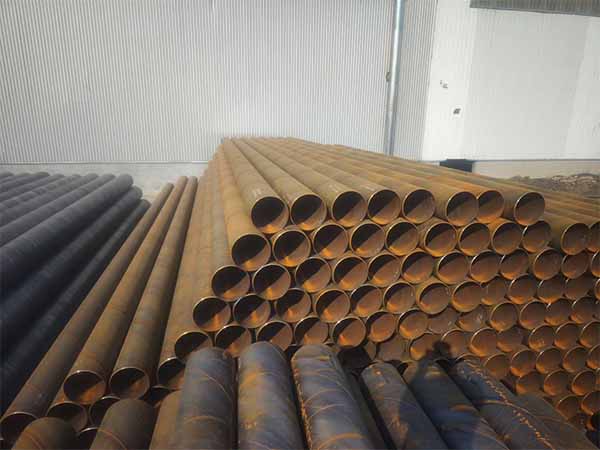
1. Raw Material Preparation
Hot-rolled steel coils are the primary raw material for manufacturing spiral welded pipes. The selection of the steel coil depends on applicable standards, required mechanical properties, and the intended use of the pipe. Before forming the pipe, the surface condition, thickness uniformity, and edge quality of the steel strip must be inspected to avoid defects affecting the quality of the formed pipe.
2. Spiral Forming Process
During the forming process, the steel strip is fed into the forming unit at a specific angle relative to the pipe axis. Through continuous bending, the steel strip is formed into a cylinder with a spiral weld seam.
This spiral forming method offers the following advantages: flexible adjustment of pipe diameter within the same strip width; efficient production of large-diameter pipes; stable forming geometry for long-diameter pipes; and precise control of forming angle and feed speed to ensure dimensional accuracy and roundness of the pipe body.
3. Welding Process and Weld Formation
After pipe forming, a spiral weld is performed using a combination of internal and external welding. Submerged arc welding is widely used due to its advantages such as deep penetration and stable weld quality.
The welding process aims to ensure complete weld fusion, uniform weld geometry, and consistent mechanical properties throughout the pipe. Because the weld is spiral-shaped, the stress distribution is more uniform compared to straight-seam pipes, which is particularly advantageous for large-diameter applications.
4. Weld Inspection and Quality Control
Weld quality is a critical control point in spiral pipe manufacturing. After welding, the weld needs to be inspected to verify its integrity and consistency.
Typical weld inspection methods include:
(1) Visual inspection of weld appearance: Using the naked eye and a magnifying glass to check the weld surface for defects such as porosity, cracks, incomplete penetration, and undercut.
(2) Non-destructive testing: Ultrasonic testing, X-ray testing, magnetic particle testing, and penetrant testing.
Quality control mainly includes the following:
(1) Weld alignment dimension verification: Inspection requirements vary depending on the purpose of the pipeline (structural or service), but the consistency of weld quality is always a core manufacturing objective.
(2) Pipeline dimension correction and straightening: After welding, the pipeline needs to be dimensionally corrected and straightened to achieve the required dimensional tolerances. Correct dimension correction is crucial for downstream processes (e.g., coating, handling, and installation), especially in pile foundations and pipeline engineering.
(3) Cutting, length control, and end processing: Spiral welded pipelines are cut to specified lengths according to project requirements. Length control is particularly important for large construction projects because installation efficiency depends on the consistency of pipeline dimensions. Pipe ends can be pre-treated by squarening, chamfering, and end-face finishing. These processes ensure compatibility with field welding, piling, or joint connection requirements.
(4) Hydrostatic Testing and Final Inspection: For pipes used to transport fluids, a hydrostatic test is performed to verify their pressure resistance. This step confirms that the pipe body and weld can withstand the specified internal pressure without leakage.
5. Manufacturing Flexibility of Spiral Welded Pipes
One of the key advantages of the spiral welded pipe manufacturing process is its adaptability. By adjusting the forming angle, strip size, and welding parameters, manufacturers can use the same production line to produce pipes of various diameters, wall thicknesses, and lengths.
This flexibility makes spiral welded pipes suitable for a wide range of applications conforming to standards such as ASTM and API, covering structural and piping requirements.
Summary
The spiral welded pipe manufacturing process is a continuous and controlled operation that combines material preparation, spiral forming, welding, inspection, and finishing steps. This process offers advantages such as dimensional flexibility, stable welding performance, and high efficiency in producing large-diameter pipes.
Read more: Spiral Welded Pipe Standards: ASTM A252 vs API 5L
 Central Steel


 Language
 English
 Español
 بالعربية
 sales@central-steels.com
 0086-731-8865-5017