In the modern steel pipe manufacturing field,
ERW steel pipe (Electric Resistance Welded Pipe, straight seam resistance welded steel pipe) is increasingly replacing seamless steel pipes in medium and low pressure and structural applications due to its uniform wall thickness, good surface quality, high production efficiency, and cost advantages.
ERW pipe is produced by cold bending hot-rolled coils, then using the skin effect and proximity effect of high-frequency current to heat and melt the edges of the pipe blank and extrude and weld it, without adding any filler metal.
This article will analyze the classification system of ERW steel pipes and their corresponding international authoritative standards from four dimensions: welding process, shape, material, and core applications.
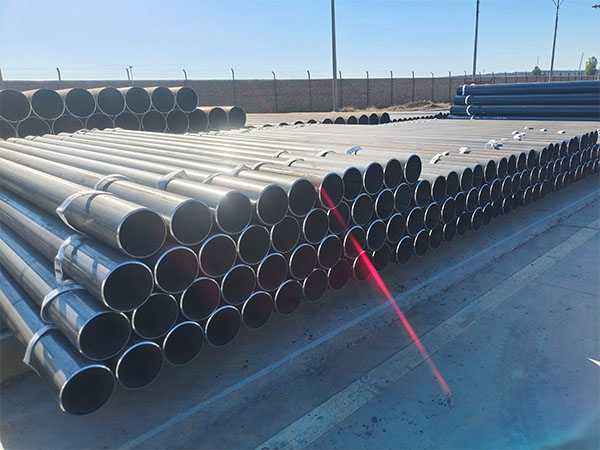
I. Classification by Welding Process Frequency: The Key to Weld Quality
Although collectively referred to as ERW, their inherent quality varies significantly depending on the frequency of the welding current. Currently, high-frequency welding is the mainstream method used in industry.
High-Frequency Straight Seam Welded Pipe (HFW - High Frequency Welding)
Process Characteristics: Uses high-frequency current from 70kHz to 400kHz. Minimal heat-affected zone (HAZ), fast welding speed, and extremely high weld quality. Almost all modern high-quality ERW pipes are HFW pipes.
HFW process typically requires online weld heat treatment (PWHT) to eliminate welding stress and ensure the weld microstructure is consistent with the base material, thus significantly reducing the risk of cracking.
Low/Medium Frequency Resistance Welded Pipes (LFW/MFW)
Process characteristics: Early technology, lower frequency (typically below 10kHz). Wider heat-affected zone, prone to burrs and inclusions in the weld. Due to lower weld reliability, this process is now largely obsolete and is only occasionally seen in a few low-end non-pressure civil piping products.
II. Classification by Product Shape
Round ERW Pipe
Complies with most pipeline and fluid standards such as API 5L / ASTM A53. Widely used in fluid transportation (water, natural gas, oil), fire-fighting pipelines, and general mechanical shaft parts.
Structural Hollow Sections (SHS/RHS - Square & Rectangular Hollow Sections)
Corresponding Standards: ASTM A500 (American Standard Cold-Formed Square and Rectangular Tubes) / EN 10219 (European Standard Cold-Formed Welded Structural Hollow Sections). These shaped tubes possess extremely high flexural section modulus, significantly saving steel. They are commonly used in steel structure building frames, bridges, airport terminals, and heavy machinery bases.
III. Classification by Application (The Core Dimension)
The application classification of ERW tubes and their corresponding standards are the most critical indicators in procurement specifications.
1. Structural ERW Tubing
Structural ERW tubes are commonly used in building curtain walls, steel structure factories, stadium trusses, and billboard supports. Emphasis is placed on overall tensile strength, yield strength, and dimensional straightness; the fluid sealing requirements for internal welds are not high.
Common standards include ASTM A500 (American Standard) / EN 10219 (European Standard). ASTM A500 is divided into four grades: A, B, C, and D. Grade B and Grade C are the most commonly used. This standard clearly specifies the corner radius and wall thickness tolerances for square and rectangular tubes to ensure fit and load-bearing capacity during welding at building joints.
2. Low-Pressure Fluid Transmission Pipes
These are commonly used in urban water supply networks, fire sprinkler systems, low-pressure gas pipelines, and HVAC water pipes. Therefore, it is essential to ensure leak-proof welds, requiring online eddy current testing (ET) or hydrostatic testing, and usually necessitating the removal of internal weld burrs.
Corresponding standard: ASTM A53 Grade A/B (American Standard). Type E (ERW) of ASTM A53 is the cornerstone of fluid pipes worldwide. Grade B has superior mechanical properties compared to Grade A. The standard mandates non-destructive testing of welds, and if the pipes are galvanized, they must meet the relevant zinc layer weight requirements for hot-dip galvanizing.
3. Oil and Gas Pipeline Pipes
Commonly used in onshore oil and gas gathering and transportation pipelines, and long-distance natural gas transmission networks. They possess extremely high weld toughness, resistance to hydrogen sulfide (H2S) corrosion, and excellent low-temperature impact resistance.
Corresponding standard: API SPEC 5L, which further classifies ERW pipes into two specification levels: PSL1 and PSL2. For harsh environments (such as high-pressure natural gas), PSL2 grade HFW steel pipes must be used, typically involving high-strength steel grades such as X42, X52, X65, and even X70. The standard has extremely stringent requirements for carbon equivalent (CEV) and non-destructive testing of welds.
4. Oil Casing and Tubing (OCTG)
Used for wellbore support (casing) and oil/gas extraction channels (tubing) during drilling. Capable of withstanding extreme external compressive and internal tensile forces.
The corresponding standard is API SPEC 5CT. With advancements in HFW technology, higher-grade ERW tubing (such as J55, K55 steel grades, and even some N80) is widely permitted for use in shallow and medium-deep wells. The standard requires threaded ends and appropriate couplings to ensure thread sealing during downhole operation.
5. Mechanical Tubing
Variously used in automotive drive shafts, shock absorbers, roller conveyor rollers, and fitness equipment. Extremely high dimensional tolerances are required for outer diameter and wall thickness. Smooth surfaces are essential for easy subsequent turning or cold drawing.
ASTM A513 is a commonly used standard, covering resistance-welded mechanical tubing in carbon steel and alloy steel. It is classified into several types (Type 1 to Type 6) based on different post-processing states (e.g., hot-rolled and welded, cold-rolled and welded, and cold-drawn DOM after welding). Among them, ERW tubes in the DOM (Drawn Over Mandrel) state have precision and strength almost comparable to precision seamless tubes.
6. Boiler & Heat Exchanger Tubes
Commonly used in tube bundles, condensers, and air preheaters of low and medium pressure boilers. They must possess excellent heat transfer performance and withstand rigorous mechanical deformation tests such as flaring and flattening.
Corresponding standards: ASTM A178 / ASTM A214. ASTM A178 is a dedicated standard for resistance-welded carbon steel boiler tubes. It explicitly requires that the weld must undergo heat treatment and pass both the flattening test and the reverse flattening test to absolutely guarantee that the weld will not crack during boiler expansion.
In summary
Modern high-frequency welded (HFW) pipes, enhanced by online ultrasonic testing and weld heat treatment technologies, have achieved performance very close to that of seamless steel pipes.
In conventional structures, low-to-medium pressure fluid transport, and applications requiring extremely high wall thickness uniformity (such as precision automotive parts), ERW pipes are the most cost-effective choice.
However, in environments with ultra-high pressure, ultra-high temperature, or extreme corrosion (such as deep-sea oil and gas, and critical high-pressure boilers), seamless steel pipes retain their irreplaceable safety.
Read more : Complete guide to ERW steel pipes
 Central Steel


 Language
 English
 Español
 بالعربية
 sales@central-steels.com
 0086-731-8865-5017