In modern industrial infrastructure,
welded steel pipe plays an essential role. From long-distance oil and gas pipelines to structural frameworks in buildings and bridges, welded pipes provide a combination of strength, versatility, and cost efficiency.
With advances in welding technology, the performance of welded pipes has improved significantly. Today, welded carbon steel pipes are widely used in construction, energy transportation, municipal engineering, and industrial manufacturing.
Understanding the types and uses of welded steel pipe helps engineers and contractors select the most suitable piping solution for their projects.
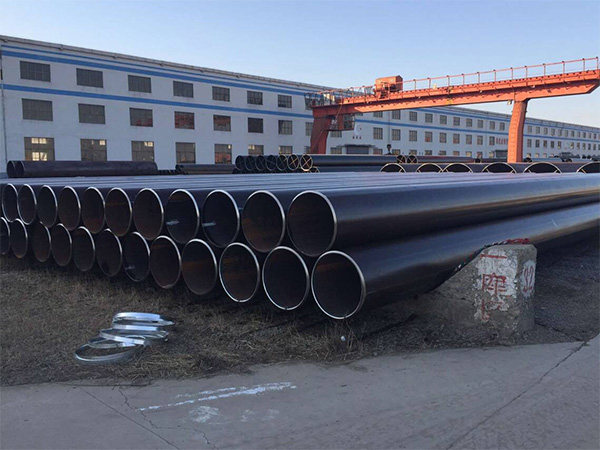
What Is a Welded Steel Pipe?
A welded steel pipe is produced by forming steel plates or strips into a tubular shape and joining the edges through welding processes.
Unlike seamless steel pipes, which are made from solid billets, welded pipes are manufactured by rolling and welding steel coils or plates, creating either a longitudinal or spiral seam. Thanks to modern welding technologies such as electric resistance welding and submerged arc welding, welded pipes can achieve high strength, reliable weld quality, and consistent dimensions.
Because of their efficient production process and flexible size range, welded steel pipes are widely used in both structural and fluid transportation systems.
Main Types of Welded Steel Pipe
Welded steel pipes are generally classified according to their welding methods.
1. ERW Steel Pipe (Electric Resistance Welding)
ERW steel pipes are manufactured by cold-forming a steel sheet into a cylindrical shape. Current is then passed between the two edges of the steel to heat it to a point where the edges are forced together to form a bond without the need for welding filler material.
Best for: Low to medium pressure applications.
Advantages: High dimensional accuracy, uniform wall thickness, and cost-efficiency.
2. LSAW Steel Pipe (Longitudinal Submerged Arc Welding)
LSAW steel pipes are produced by pressing a heavy steel plate into a "U" or "O" shape and then welding it via submerged arc welding.
Best for: High-pressure gas and oil pipelines, long-distance fluid transmission.
Key Feature: Capable of producing very thick walls and large diameters, offering high resistance to internal and external pressure.
3. SSAW Steel Pipe (Spiral Submerged Arc Welding)
Also known as spiral pipe, SSAW steel pipe is made by rolling the steel strip at a certain helical angle (forming a spiral) and then welding the seams.
Best for: Water drainage, piling projects, and low-pressure fluid transport.
Key Feature: Allows for the production of very large diameter pipes from narrower strips of steel.
Common Uses of Welded Steel Pipe
Because of their durability and versatility, welded steel pipes are widely used across many industries.
Oil and Gas Industry:Large-diameter welded pipes are commonly used as line pipes for transporting crude oil and natural gas over long distances.
Construction and Structural Engineering:Welded pipes serve as structural components in buildings, bridges, offshore platforms, and foundation piles.
Water Transmission Systems:Municipal water supply, sewage pipelines, and irrigation networks frequently use large-diameter welded pipes.
Industrial and Mechanical Applications:Small-diameter ERW pipes are widely used in automotive manufacturing, machinery structures, and conveyor systems.
Key Advantages of Using Welded Pipes
Why choose a welded steel pipe over a seamless one?
Cost-Effectiveness: Generally, welded pipes are more affordable than seamless pipes due to a simpler manufacturing process.
Availability: With faster production cycles, welded pipes are easier to source in bulk for large-scale projects.
Range of Sizes: While seamless pipes have limits on diameter, welded pipes can be manufactured to massive sizes (especially SSAW and LSAW).
Welded vs. Seamless Steel Pipe: A Quick Comparison
FeatureWelded Steel PipeSeamless Steel PipeManufacturingFrom steel strips/platesFrom solid billetsCostMore affordableHigher costWall ThicknessHighly uniformMay vary slightlyPressure RatingModerate to HighExtremely High.
Conclusion
Welded steel pipe is a vital material in modern infrastructure and industrial applications. With different manufacturing methods such as ERW, LSAW, and SSAW, welded pipes can meet a wide range of engineering requirements.
From energy transportation to structural construction and municipal water systems, welded steel pipes continue to provide reliable, economical, and scalable solutions for global industries.
 Central Steel


 Language
 English
 Español
 بالعربية
 sales@central-steels.com
 0086-731-8865-5017