Stainless welded steel pipe and seamless pipe are both widely used for corrosion-resistant piping. Seamless stainless steel pipe is generally preferred for high-pressure, high-temperature, and critical-service applications, while welded stainless steel pipe is often the more economical choice for large-diameter, low-to-medium-pressure, and general fluid-service applications. The best choice depends on operating pressure and temperature, pipe size, required standard, corrosion conditions, and project budget.
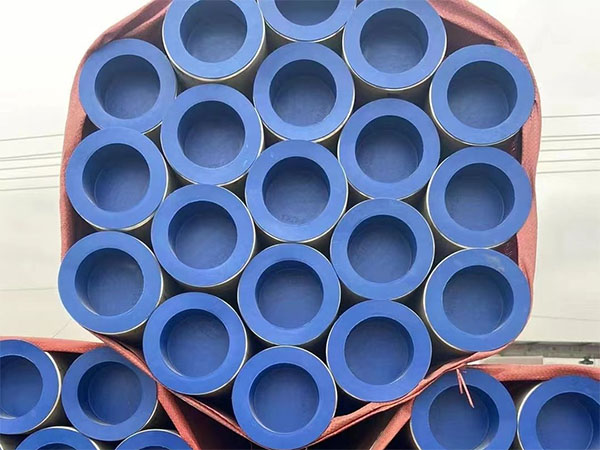
Stainless Welded Pipe vs Seamless Pipe
|
Comparison
|
Stainless Seamless Pipe
|
Stainless Welded Pipe
|
|
Manufacturing
|
Made from a solid stainless steel billet that is pierced and formed into a hollow tube
|
Made from stainless steel strip or plate formed into a tube and welded along the seam
|
|
Weld seam
|
No weld seam
|
Longitudinal weld seam or other specified weld configuration
|
|
Pressure resistance
|
Excellent, particularly for demanding high-pressure service
|
Can provide excellent pressure performance when manufactured and tested to the applicable standard
|
|
High-temperature service
|
Well suited to demanding high-temperature applications
|
Suitable when the selected grade, weld procedure, heat treatment, and standard meet service requirements
|
|
Wall thickness
|
Good overall dimensional control, but piercing may result in some variation
|
Generally very uniform because the starting material is flat strip or plate
|
|
Large diameters
|
More difficult and generally more expensive to manufacture
|
Better suited to large-diameter production
|
|
Surface finish
|
Available in hot-finished or cold-drawn conditions
|
Can provide excellent internal and external surface quality after appropriate finishing
|
|
Production efficiency
|
More complex manufacturing process
|
Generally higher production efficiency
|
|
Cost
|
Usually higher
|
Usually lower for comparable size and grade
|
|
Typical applications
|
High-pressure piping, heat exchangers, chemical processing, demanding industrial services
|
Water and fluid transport, food processing, architectural applications, general industrial piping, large-diameter systems
|
Manufacturing Process:
As the name suggests, a seamless pipe has no weld seams. It is formed by heating a solid stainless steel round bar (pipe blank), piercing it in the center, and then extruding and drawing it.
Core Advantages of Seamless Stainless Steel Pipes
Ultimate Pressure Resistance: Because there are no weld seams, a potential structural weakness, seamless pipes can withstand extremely high internal pressures and mechanical stresses.
Excellent Corrosion Resistance: The material structure is uniform and consistent, eliminating the risk of impurities or intergranular corrosion that may occur at weld seams.
Suitable for Extreme Environments: It is the preferred choice for high-temperature, high-pressure, and harsh chemical environments.
Main Disadvantages
High Cost: The complex extrusion and drawing processes result in significantly higher production costs compared to welded pipes.
Size Limitations: Manufacturing large-diameter seamless pipes is extremely difficult and expensive.
Wall Thickness Tolerance: Due to the characteristics of the piercing process, the uniformity of its wall thickness is generally less precise than that of welded pipes.
Manufacturing Process:
The starting material for welded pipes is stainless steel strip or sheet. It is rolled into a cylindrical shape using a cold bending machine, and then the edges are welded together using advanced processes such as high-frequency resistance welding (ERW), tungsten inert gas welding (TIG), or laser welding.
Main Features
Highly Cost-Effective: The production process is relatively simple and efficient, resulting in a more affordable overall purchase price.
Precise and uniform wall thickness: Made from rolled flat steel plates, welded pipes have extremely small wall thickness tolerances and excellent consistency.
Large diameter advantage: Pipes with extremely large diameters (tens or even hundreds of inches) can be easily manufactured, compensating for the shortcomings of seamless pipes.
Short delivery cycle: High production efficiency and typically more ample inventory.
Main disadvantages
Relatively lower pressure resistance: Although modern welding and non-destructive testing technologies (such as X-ray inspection) have made the strength of the weld almost indistinguishable from the base material, the weld is still theoretically a weak point under extreme pressure.
How to choose between stainless steel welded pipes and seamless pipes?
When deciding whether to use stainless steel welded pipes or seamless pipes, you can refer to the following evaluation criteria:
Assess operating pressure and temperature: If your pipeline will be used to transport high-pressure steam, highly toxic chemicals, or operate in extremely high-temperature environments, seamless pipes are the essential option for safety.
Considering Project Budget: For routine low-pressure fluid transport, decorative building structures, or the food processing industry, high-quality welded pipe is perfectly adequate and can save you significant budget.
Determining Pipe Size Requirements: If your project requires large pipes with an outer diameter exceeding 24 inches, welded pipe is often the only realistic and economical option.
Frequently Asked Questions
1. Is stainless steel seamless pipe better than welded pipe?
Not always. Seamless pipe is generally preferred for high-pressure, high-temperature, and critical applications, while welded pipe can provide excellent performance at a lower cost for many general and large-diameter applications.
2. Is stainless welded pipe weaker than seamless pipe?
Not necessarily. Welded pipe contains a welded joint, so the weld quality and applicable design requirements must be considered. Properly manufactured and tested welded stainless steel pipe can meet demanding service requirements.
3. Is seamless stainless steel pipe more corrosion resistant?
Not inherently. Both welded and seamless stainless steel pipes can have excellent corrosion resistance when the correct stainless steel grade and surface treatment are selected. For welded pipe, weld-zone treatment and surface condition can be important.
4. Which is cheaper, stainless welded or seamless pipe?
Stainless welded pipe is generally cheaper because it can be produced more efficiently from stainless steel strip, coil, or plate. Seamless pipe normally has a higher manufacturing cost.
Conclusion
Stainless welded steel pipe and seamless pipe both have important roles in industrial piping. Seamless pipe offers the advantage of a continuous pipe body without a weld seam and is commonly selected for demanding pressure and temperature conditions. Welded pipe offers excellent dimensional consistency, large-diameter availability, production efficiency, and cost advantages.
 Central Steel


 Language
 English
 Español
 بالعربية
 sales@central-steels.com
 0086-731-8865-5017