Welded steel pipes are an indispensable lifeline in modern infrastructure, energy transportation, and large-scale heavy industrial construction projects. Among various pipe materials, large-diameter straight seam submerged arc welded (LSAW) steel pipes stand out due to their superior structural strength, extremely high compressive strength, and reliable weld quality.
This article will provide you with a comprehensive analysis of the core technical specifications, standard manufacturing processes, differences from other types of steel pipes, and practical applications in various engineering fields of LSAW steel pipes.
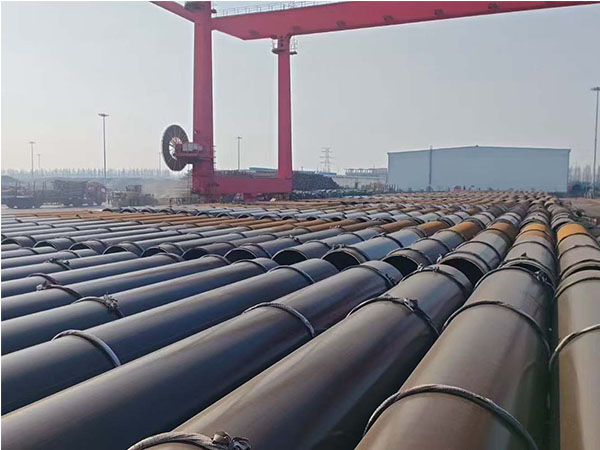
What is a Large-Diameter Straight Seam Welded Pipe?
Large-diameter straight seam welded pipe refers to
LSAW pipes with a larger diameter. LSAW is an abbreviation for Longitudinal Submerged Arc Welding.
LSAW steel pipes are made from single-sheet medium-thick steel plates, pressed (or rolled) into a cylindrical shape using molds or forming machines, and then welded using double-sided submerged arc welding technology along a straight weld seam parallel to the pipe's axis.
Three core features:
Straight seam welding: The weld seam runs longitudinally through the pipe body in a straight line, resulting in uniform stress distribution.
Single-plate forming: Manufactured using high-quality thick steel plates (not steel coils), resulting in excellent base material mechanical properties.
Designed for high pressure: Due to its deep weld penetration and high non-destructive testing pass rate, it is the first choice for ultra-large diameter, ultra-thick wall, and extremely high pressure environments.
Depth comparison: LSAW vs. ERW vs. SSAW
ERW Pipe: Uses high-frequency resistance welding, suitable for smaller diameters.
SSAW Pipe: Spiral weld, cost-effective for large diameters but lower precision.
LSAW Pipe: Best for high strength, high pressure, and large-diameter pipelines.
LSAW is the most expensive, but its safety is irreplaceable; ERW is suitable for fluid transportation of standard sizes; SSAW is suitable for ultra-large diameter projects with relatively lower pressure requirements.
Core Specifications and Standards for Large-Diameter Straight Seam Welded Pipes
1. Dimensions and Material Parameters
Outer Diameter Range (OD): Typically 406 mm (16 inches) – 1500 mm (60 inches) and above.
Wall Thickness Range (WT): 6 mm – 50 mm (or even thicker, specifically designed for deep-sea high-pressure applications).
Length: Standard lengths are 6 meters and 12 meters, but can also be customized to meet project requirements (e.g., 18 meters without circumferential seam).
Common Materials: Carbon steel, low-alloy high-strength structural steel.
Typical Steel Grades: API 5L Gr.B, X42, X52, X60, X65, X70, X80.
2. International Standards
Oil and Gas Pipelines: API 5L (Global Oil and Gas Industry Standard)
Structural and Foundation Piles: ASTM A252 (Standard for Welded and Seamless Steel Pipe Piles)
High Temperature and High Pressure Fluids: ASTM A671 / A672 (Electromylated Welded Steel Pipes for Normal and Medium Temperatures and High Pressures)
European Standards: EN 10219 (Cold-Formed Structural Pipes) / EN 10217 (Welded Pipes for Pressure Applications)
Manufacturing Process Analysis: UOE and JCOE Core Technologies
The superior quality of LSAW steel pipes stems from their complex cold forming and welding processes. The two most mainstream forming technologies in the industry are UOE and JCOE.
Steel Plate Preparation and Milling: The raw steel plates undergo 100% ultrasonic testing, followed by milling on both sides to create perfect weld bevels.
Cold Forming Processes:
UOE Process: The steel plate is first pressed into a "U" shape, then closed into an "O" shape using a giant mold, and finally mechanically expanded (E - Expansion). This process is fast, produces excellent roundness, and is suitable for mass production of single sizes.
JCOE Process: The steel plate is gradually bent into "J," "C," and "O" shapes multiple times, and finally expanded (E). This process offers flexible mold changes, is suitable for multi-specification, small-batch production, and is especially suitable for ultra-thick-walled steel pipes.
Single-sided Submerged Arc Welding (SAW): A pre-welded fixed gap is first formed, then a multi-wire submerged arc welding machine is used to weld the inner and outer sides separately. This process provides deep penetration, good protection, and eliminates porosity defects.
Finishing and Expansion: The entire steel pipe undergoes cold expansion to eliminate internal stress during forming, while significantly improving the dimensional accuracy (roundness and straightness) of the steel pipe.
Quality Control and Stringent Inspection (QA/QC)
Every LSAW steel pipe used in high-voltage trunk lines must undergo a series of destructive and non-destructive tests before leaving the factory:
Non-destructive Testing (NDT): 100% scanning of the weld seams using ultrasonic testing (UT) and X-ray testing (RT) to ensure the absence of internal cracks and inclusions.
Hydrostatic Test: The steel pipe is filled with water and pressurized to a pressure exceeding the design working pressure, maintained for a certain period, to verify the pipe's strength and leak-proof performance.
Third-Party Inspection: Many international projects require material certificates conforming to EN 10204 3.2 issued by independent organizations such as SGS, TÜV, or BV.
Typical Application Areas
With its resistance to high pressure and low-temperature deformation, LSAW steel pipes are irreplaceable in the following areas:
Oil and Gas Trunk Lines: Long-distance, high-pressure onshore pipelines; subsea oil/gas pipelines under severe stress.
Large-scale infrastructure pile foundations: Pipe piles for cross-sea bridge piers, deep-water port wharf foundations, and offshore wind power monopile foundations.
Municipal and water conservancy projects: Large-diameter main urban water supply networks and pressure steel pipes for large hydropower stations.
Petrochemical industry: High-pressure process pipelines within oil refineries.
Frequently Asked Questions (FAQ) about LSAW steel pipes
Q: What is the maximum thickness that LSAW steel pipes can achieve?
A: Thanks to the single-plate thick steel rolling process, the wall thickness of conventional LSAW steel pipes can reach 50mm. For special pressing equipment used in specific projects, it is even possible to produce extremely thick-walled pipes with wall thicknesses exceeding 60mm-100mm.
Q: Why is LSAW (spiral welded pipe) rarely used for subsea oil and gas pipelines, and is instead required?
A: Subsea pipelines withstand extremely high external water pressure and internal fluid pressure, and maintenance costs are extremely high. SSAW has a longer spiral weld seam (typically 1.5 times that of straight seam pipe), increasing the probability of weld defects. Furthermore, LSAW undergoes mechanical diameter expansion (UOE/JCOE), eliminating internal stress and resulting in significantly higher resistance to crushing than SSAW.
Q: Why is LSAW more expensive than ERW?
A: First, raw material costs are higher (thick steel plates are more expensive than hot-rolled steel coils); second, the manufacturing process is more complex and slower; third, LSAW typically uses double-sided submerged arc welding, which consumes a large amount of welding wire and flux, and subsequent flaw detection and heat treatment standards are extremely stringent, all of which increase the overall cost.
 Central Steel


 Language
 English
 Español
 بالعربية
 sales@central-steels.com
 0086-731-8865-5017