 Central Steel
Central Steel
Central Steel
Central Steel
Central Steel
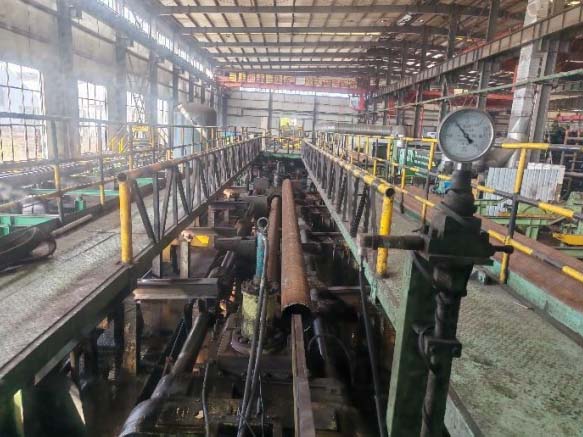
Although seamless steel pipes are integral tubes directly manufactured from steel billets through heating, piercing, rolling, and heat treatment, without welds, this does not mean they are completely free of defects. Seamless steel pipes may contain defects such as internal cracks, delamination, surface cracks, inclusions, uneven wall thickness distribution, and localized insufficient strength during the production process. Some of these defects are usually difficult to detect visually, but hydrostatic testing can clearly reveal whether the steel pipe has any defects.
Hydrostatic Testing vs. Visual Inspection
|
Inspection Method |
Main Purpose |
Detects Leakage |
Evaluates Pressure Resistance |
|
Visual inspection |
Surface appearance and defects |
Limited |
No |
|
Dimensional inspection |
OD, wall thickness, length, etc. |
No |
No |
|
Ultrasonic testing |
Internal and surface discontinuities |
No |
Indirectly |
|
Magnetic particle testing |
Surface/near-surface defects |
No |
No |
|
Hydrostatic testing |
Pressure resistance and leak tightness |
Yes |
Yes |
Therefore, hydrostatic testing should not be considered a substitute for nondestructive testing. In many applications, it is used in conjunction with other testing methods.
Seamless Pipe Hydrostatic Testing Process
The hydrostatic testing process for seamless steel pipes typically includes the following six steps:
Benefits of Seamless Pipe Hydrostatic Testing
Hydrostatic testing provides several important advantages.
1. Verifies Pressure Resistance: It provides direct evidence that the pipe can withstand the specified internal pressure.
2. Detects Through-Wall Leakage: A pipe may look acceptable externally but still contain a defect that allows fluid to pass through the wall. Hydrostatic testing can identify such defects.
3. Improves Operational Safety: Testing reduces the probability of pressure-related pipe failure during service.
4. Supports Quality Control: Hydrostatic testing provides measurable quality-control evidence for manufactured seamless pipes.
FAQ About Seamless Pipe Hydrostatic Testing
1. What is seamless pipe hydrostatic testing?
Seamless pipe hydrostatic testing is a pressure test that uses water to pressurize a seamless steel pipe and verify its pressure resistance and leak tightness.
2. Why do seamless pipes need hydrostatic testing?
Hydrostatic testing helps detect through-wall leakage and verifies that the pipe can withstand the specified internal pressure without failure.
3. Is hydrostatic testing required for every seamless steel pipe?
No. The requirement depends on the applicable product standard, pipe application, purchase order, and customer requirements. Pressure-containing applications generally have more stringent testing requirements.
Conclusion
Seamless pipe hydrostatic testing is a pressure-based quality inspection used to verify the pressure resistance and leak tightness of seamless steel pipes. The typical process involves preparing and sealing the pipe, filling it with water, removing trapped air, gradually increasing the internal pressure, holding the specified pressure, inspecting the pipe, and finally depressurizing, draining, drying, and recording the results.


 Language
 English
 Español
 بالعربية
 sales@central-steels.com
 0086-731-8865-5017