Cold-drawn seamless steel pipe (CDS) is a precision seamless steel pipe formed at room temperature by applying tension to a hot-rolled or extruded tube blank through a drawing die, shaping it into a specific die.
Unlike ordinary seamless steel pipes, cold drawing gives CDS extremely high dimensional accuracy (tolerances up to ±0.05mm), a smooth internal and external surface structure, and excellent mechanical strength, making it an indispensable performance material in modern manufacturing industries.
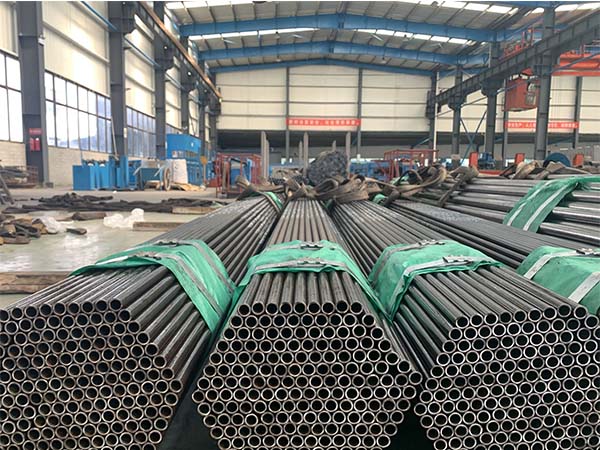
Comparison of Cold-drawn (CDS) and Hot-rolled (HRS) Seamless Pipes
|
Attribute
|
Cold Drawn Seamless (CDS)
|
Hot Rolled Seamless (HRS)
|
|
Processing Temperature
|
Room temperature (below recrystallization)
|
High temperature (above recrystallization, approx 1100℃-1250℃)
|
|
Dimensional Tolerance
|
Extremely tight (±0.5 to ±1)
|
Standard (±0.5 to ±1)
|
|
Surface Quality
|
Smooth, scale-free, high aesthetic/functional finish
|
Rough finish with mill scale
|
|
Size Capability
|
Superior for small diameters and thin walls
|
Best for medium-to-large diameters and thick walls
|
|
Mechanical Properties
|
Higher tensile strength and hardness; lower ductility (as-drawn)
|
Good ductility and toughness; balanced stress state
|
|
Production Cost
|
Higher due to multi-stage processing
|
Lower due to simpler, single-pass processing
|
Core Characteristics of Cold-Drawn Seamless Tubes
High-Precision Dimensional Control: The outer and inner diameter dimensional accuracy can reach approximately ±0.05~±0.10 mm (depending on the tube diameter, wall thickness, and manufacturing process). Wall thickness tolerance can typically be controlled within ±5%~±10%, exhibiting higher dimensional consistency compared to ordinary hot-rolled seamless tubes and significantly reducing subsequent machining allowances such as turning and honing.
Excellent Surface Quality: No significant high-temperature oxide scale is generated during cold rolling and cold drawing, resulting in smooth, clean, and low-roughness surfaces on both the inner and outer surfaces of the tube. Surface roughness can be as low as Ra 0.8~1.6 μm, suitable for applications requiring high sealing and surface precision, such as hydraulic cylinders, pneumatic cylinders, and precision mechanical parts.
Work Hardening Effect: The cold deformation process elongates the metal grains along the deformation direction, resulting in work hardening, thereby increasing the material's yield strength and tensile strength, giving cold-drawn seamless tubes better dimensional stability and load-bearing capacity.
Flexible Customization of Irregularly Shaped Tubes: Cold drawing technology boasts high cross-sectional forming capabilities, enabling the production of small-diameter, thin-walled tubes, as well as various complex cross-sections such as elliptical, hexagonal, and square seamless tubes. This meets the customized needs of fields such as machinery manufacturing, automotive parts, and precision structural components.
Manufacturing Process of Cold-Drawn Seamless Steel Tubes
1. Tube Billet Preparation and Pickling/Phosphating
High-quality hot-rolled seamless steel tubes are selected as the base tube. First, the surface oxide scale is removed by pickling, followed by phosphating and saponification (lubrication) treatment. A strong lubricating film is then formed on the tube wall to prevent the tube from sticking to or being scratched by the die during the drawing process.
2. End Shaping
The front end of the steel tube is heated and thinned to form a "head section" that can pass through the aperture of the cold drawing die, allowing the drawing machine's chuck to grip the steel tube for powerful drawing.
3. Cold Drawing
On a cold drawing machine, a clamp holds the tube end, and the steel tube is forcibly drawn through a hard alloy outer die (controlling the outer diameter) and an inner mandrel (controlling the inner diameter and wall thickness) by strong pulling force.
4. Heat Treatment
After drawing, the material undergoes work hardening. Intermediate annealing eliminates internal stress and restores plasticity to prepare for the next drawing pass; finished product annealing is used to adjust the final required mechanical properties.
5. Straightening, Inspection, and Finishing
Straightness is corrected by a multi-roll straightener, followed by non-destructive testing (ultrasonic or eddy current testing), hydrostatic testing, end cutting and marking, and rust-proof packaging.
Common Grades and International Standards
Cold-drawn seamless tubes have applications across multiple fields and must comply with different international standards:
ASTM/ASME Standards:
ASTM A519: Seamless carbon and alloy steel tubes for mechanical structures (the most common CDS mechanical tube standard, such as 1018, 1026, 4130).
ASTM A179 / A214: Cold-drawn low-carbon steel tubes for heat exchangers and condensers.
European Standard EN:
EN 10305-1: Cold-drawn seamless steel tubes for precision engineering (e.g., E235, E355).
Chinese Standard GB:
GB/T 3639: Cold-drawn or cold-rolled precision seamless steel tubes.
GB/T 8162: Seamless steel tubes for structural purposes.
Heat Treatment and Mechanical Properties
The heat treatment state directly determines the final mechanical properties of CDS. Common delivery conditions include:
Performance Notes:
Cold-worked/Hard (+C / BK): Untreated, extremely high tensile strength and hardness, but low elongation, suitable for structures that do not require subsequent bending.
Stress-relieved Annealing (+SR / BKS): Low-temperature annealing after cold working, retaining high strength while eliminating most internal stress.
Normalizing/Full Annealing (+N / BKW): Refines grain size, eliminates hardening, and achieves excellent comprehensive mechanical properties and elongation, facilitating subsequent high-strength processing (such as flaring and bending).
Main Applications
Due to its high precision and strength, CDS is widely used in demanding engineering applications:
Automotive and Transportation: Drive shafts, steering shafts, shock absorber housings, automotive oil lines.
Hydraulic and Pneumatic Systems: Hydraulic cylinders, cylinder bodies (ready to use directly after light honing).
Mechanical Manufacturing: Motor housings, bearing rings, precision mechanical structural parts.
Petrochemical and Energy: Heat exchanger tubes, condenser tubes, and high-pressure pipelines.
Frequently Asked Questions (FAQ)
Q1: What is the difference between cold-drawn and cold-rolled seamless tubes?
Both are cold-working processes, but the processing methods differ:
Cold drawing uses a tensile force, pulling the steel tube out through a die. This method is highly efficient and suitable for producing various specifications and irregular shapes of tubes.
Cold rolling uses pressure to compress the steel pipe through periodic rolling mills, resulting in better control over wall thickness uniformity. However, it requires significant equipment investment and has relatively lower efficiency.
Q2: Why are cold-drawn seamless pipes more expensive than hot-rolled seamless pipes?
The base pipe for cold-drawn pipes is already a hot-rolled seamless pipe. Additional complex processes such as pickling, phosphating, multi-pass drawing, intermediate annealing, and straightening are added, leading to higher losses and labor and energy costs. However, it saves customers a significant amount of subsequent precision machining costs.
Q3: Can cold-drawn seamless steel pipes be directly welded?
Yes, they can be welded. However, if it is an unannealed, hardened cold-drawn pipe (+C), welding the heat-affected zone may cause a sudden drop in hardness or cracks. It is recommended to assess the material condition before welding and, if necessary, use pipes in a normalized state (+N) or perform stress-relieving treatment after welding.
 Central Steel


 Language
 English
 Español
 بالعربية
 sales@central-steels.com
 0086-731-8865-5017