ASTM A690 steel sheet piles are typically high-strength low-alloy (HSLA) steel sheet piles and H-type piles manufactured according to the ASTM A690/A690M standard. The full standard name is High-Strength Low-Alloy Nickel, Copper, Phosphorus Steel H-Piles and Sheet Piling with Atmospheric Corrosion Resistance for Use in Marine Environments.
This article will explain the definition, performance, composition, corrosion resistance, applications, and differences between ASTM A690 steel sheet piles and standard sheet pile grades.
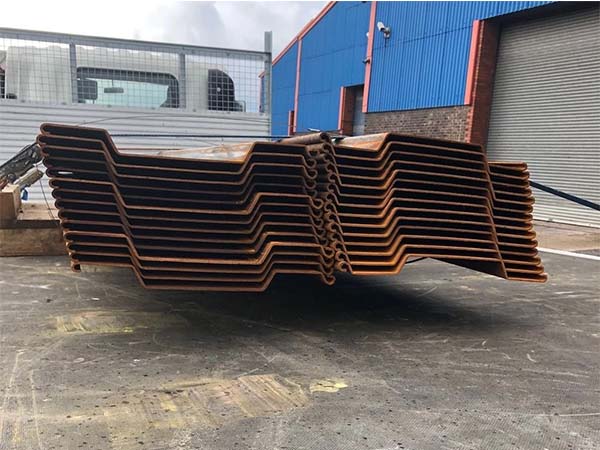
What are ASTM A690 Steel Sheet Piles?
ASTM A690 steel sheet piles are a special steel structural foundation material specifically designed for the extremely harsh marine splash zones. In port and offshore engineering, sheet piles are exposed to seawater and air for extended periods, making them highly susceptible to corrosion, potentially leading to catastrophic localized corrosion.
To address this challenge, the ASTM A690 standard refines the iron matrix and adds specific alloying elements (such as copper, nickel, and phosphorus), giving it both the excellent mechanical properties of high-strength low-alloy steel (HSLA) and extremely high corrosion resistance without relying on additional thick anti-corrosion coatings.
The Corrosion Resistance Principle of ASTM A690 Sheet Piles
In marine environments, traditional carbon steel sheet piles, under repeated seawater erosion, develop a loose and porous rust structure on their surface, unable to prevent the continued penetration of oxygen and moisture.
However, after initial corrosion by seawater, the copper (Cu) and nickel (Ni) in ASTM A690 sheet piles accumulate on the steel surface, and with the synergistic effect of phosphorus (P), form an extremely dense and highly adhesive composite amorphous oxide protective film. This dark brown protective film effectively seals the micropores on the steel surface, cutting off subsequent penetration by seawater and oxygen, making the corrosion resistance life of steel sheet piles in the splash zone 2 to 3 times that of ordinary carbon steel sheet piles.
Mechanical and Mechanical Properties of ASTM A690
As an outstanding representative of high-strength low-alloy steel (HSLA), ASTM A690 is not only corrosion-resistant but also possesses extremely high structural load-bearing capacity, capable of withstanding the enormous mechanical stress during piling and the lateral earth pressure during service.
|
Performance indicators
|
Required value
|
|
Yield Strength
|
≥ 50 ksi (345 MPa)
|
|
Tensile Strength
|
≥ 70 ksi (485 MPa)
|
|
Elongation in 8 in
|
≥ 15%
|
|
Elongation in 2 in
|
≥ 18%
|
Core Application Scenarios of ASTM A690 Steel Sheet Piles
Due to their superior resistance to harsh marine conditions, ASTM A690 steel sheet piles and H-piles are widely used in various cross-sea and port projects worldwide:
Seawalls & Bulkheads: Directly used as permanent retaining walls, enduring long-term wave splash and tidal immersion.
Breakwaters: Used to withstand the impact of hurricanes and strong waves.
Offshore Coffer Dams: Used as the core load-bearing foundation in cofferdams for temporary and permanent piers of offshore drilling platforms and cross-sea bridges.
H-Piles for Marine Foundations: A690 H-type piles used in conjunction with sheet piles, extending deep into the seabed as load-bearing friction piles for heavy structures.
FAQ (Frequently Asked Questions) about ASTM A690 Sheet Piles
1. After using ASTM A690 sheet piles, is surface anti-corrosion coating or anode/cathode protection still required?
In most standard marine atmospheres and shallow waters, the natural corrosion-resistant layer of ASTM A690 is sufficient to provide a structural life of several decades, allowing for uncoated service. However, for extremely harsh marine environments located in fully submerged zones or with severe microbial corrosion (MIC), engineering designs typically employ a triple protection strategy: ASTM A690 + external 3LPE/epoxy coating + sacrificial anode cathodic protection, aiming for a maintenance-free lifespan of 50 to 100 years.
2. What are the weldability properties of ASTM A690 sheet piles?
Although ASTM A690 contains various alloying elements such as copper, nickel, and phosphorus, its carbon equivalent (CE) is strictly controlled, resulting in excellent weldability. During on-site welding, using low-hydrogen welding materials (such as AWS-compliant E8018-W2 dissimilar steel or weathering steel electrodes) and proper preheating can yield high-quality welded joints with the same strength and corrosion resistance as the sheet pile matrix.
3. What are the common cross-sectional shapes of A690 sheet piles?
Depending on the section modulus required for the project, ASTM A690 sheet piles are often machined into
U-shape (Larssen shape) and
Z-shape.
 Central Steel


 Language
 English
 Español
 بالعربية
 sales@central-steels.com
 0086-731-8865-5017