ASTM A53 Schedule 40 seamless steel pipe is a type of carbon steel pipe manufactured according to the ASTM A53 standard and the
Schedule 40 (SCH 40) wall thickness series. It is manufactured using a seamless forming process, resulting in a seamless pipe body. Due to its excellent pressure uniformity and fatigue resistance, it plays a crucial role in medium- and low-pressure fluid transportation, structural support, and the manufacture of mechanical components.
This article will provide a comprehensive analysis of the core specifications, dimensions, weight data, and selection considerations for this type of steel pipe.
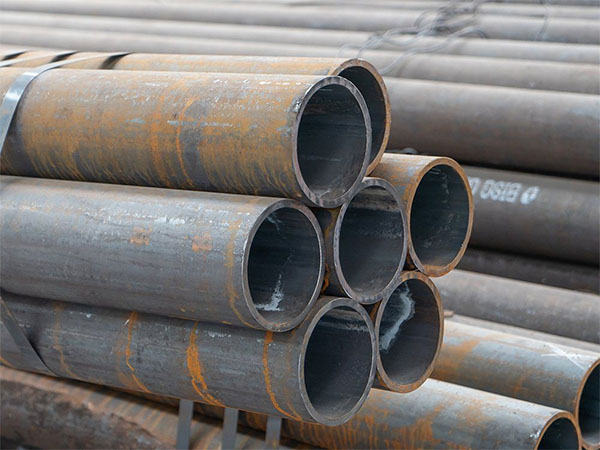
What is ASTM A53 Schedule 40 Seamless Steel Pipe?
To fully understand this type of pipe, we need to break down its three core concepts:
1. ASTM A53 Standard: This is a general industry standard for pipe manufacturing and inspection established by ASTM International (American Society for Testing and Materials). It specifies the chemical composition, mechanical properties, and testing requirements for steel pipes.
2. Schedule 40 (Sch 40): This is a pipe wall thickness numbering system defined by ASME (American Society of Mechanical Engineers). For the same nominal diameter (NPS), a Schedule represents a fixed wall thickness value. Sch 40 steel pipe wall thickness is equivalent to traditional "Standard Weight (STD)" pipe for many common sizes.
3. Seamless (Type S): This refers to pipes manufactured without any longitudinal welding, typically made by piercing, rolling, or drawing a solid heated steel billet. Compared to welded pipes, seamless steel pipes have a denser overall structure and stronger pressure resistance and bending resistance.
Material Grades and Core Technical Indicators
According to ASTM A53 specifications, pipes are classified into three manufacturing types: Type S (seamless), Type E (resistance welded), and Type F (furnace welded). The most favored carbon steel pipe specification in industry and engineering is ASTM A53 Grade B seamless pipe (Type S) because its mechanical properties are superior to Grade A, meeting more stringent engineering requirements.
ASTM A53 Grade B Typical Specifications:
Chemical Composition:
● Carbon (C): ≤ 0.30%
● Manganese (Mn): ≤ 1.20%
● Phosphorus (P): ≤ 0.05%
● Sulfur (S): ≤ 0.045%
Mechanical Properties:
● Tensile Strength: ≥ 415 MPa (60,000 psi)
● Yield Strength: ≥ 240 MPa (35,000 psi)
ASTM A53 Schedule 40 Common Dimensions and Weights Comparison Table
For engineers and purchasing personnel, obtaining accurate dimensional data is of paramount importance. The following is a table of commonly used Sch 40 steel pipe dimensions and theoretical weights, compiled according to ASME B36.10M standard:
|
Nominal Pipe Size (NPS)
|
Outside Diameter(OD) mm
|
Sch 40 Wall Thickness mm
|
Kg/m
|
|
1/2"
|
21.3
|
2.77
|
1.27
|
|
1"
|
33.4
|
3.38
|
2.50
|
|
2"
|
60.3
|
3.91
|
5.44
|
|
3"
|
88.9
|
5.49
|
11.29
|
|
4"
|
114.3
|
6.02
|
16.07
|
|
6"
|
168.3
|
7.11
|
28.26
|
|
8"
|
219.1
|
8.18
|
42.55
|
(Note: The above data are theoretical nominal values; tolerances conforming to the standard are allowed in actual production.)
Pressure Bearing Capacity and Surface Treatment
1. How to perform Sch 40 Pressure Rating Calculation?
The actual "pressure rating" of a pipe is determined not only by its wall thickness (Schedule), but also by its outer diameter, material grade (such as allowable stress for Grade B), operating temperature, and the system's corrosion allowance. In actual engineering design, engineers must refer to piping specifications such as ASME B31 for rigorous Sch 40 pressure calculations, and should never rely solely on experience for estimation.
2. Black Pipe vs. Galvanized Pipe
● Black Pipe (Uncoated): The surface retains the dark iron oxide scale formed after rolling. Economical and the first choice for oil and gas transportation and conventional indoor structural support.
● Hot-dip Galvanized Pipe: The pipe is coated with zinc both inside and out, significantly improving rust and corrosion resistance. Commonly used in outdoor exposed environments, high humidity areas, or water supply systems.
Core Differences Between ASTM A53 and ASTM A106
In carbon steel pipe procurement, people often confuse the A53 and A106 standards:
● Application Scenarios: ASTM A53 Primarily used for medium- and low-pressure fluid transport, ambient temperature pipelines, and structural components, it boasts strong versatility and excellent cost-effectiveness. ASTM A106, on the other hand, is a seamless steel pipe specifically designed for high-temperature applications (such as high-temperature steam pipelines).
●Manufacturing Process: A53 includes both seamless and welded pipes; while A106 strictly requires seamless steel pipes.
●Chemical Composition: A106 has stricter controls on carbon and silicon content, particularly with the addition of silicon (Si ≥ 0.10%) to improve the steel's high-temperature resistance and deoxidation effect.
Conclusion: For conventional water supply, gas transmission, fire protection, and scaffolding structural applications, A53 is the more economical choice; however, for high-temperature, high-pressure pipelines in chemical plants, A106 must be selected.
Frequently Asked Questions (FAQ)
Q1: What is the difference between Sch 40 and Sch 80 steel pipes?
At the same nominal pipe diameter, Sch 80 has a thicker wall than Sch 40, therefore Sch 80 has a higher pressure resistance, is heavier, and is relatively more expensive. 40 is typically used for standard pressure fluids, while Sch 80 is used for high-pressure or highly corrosive media.
Q2: Is ASTM A53 steel pipe easy to weld?
Very easy. A53 Grade B has a low carbon content (≤ 0.30%), excellent weldability, and can be used in a variety of conventional arc and gas welding processes.
Q3: Does Schedule 40 represent a specific number of millimeters?
No. Schedule is a relative proportionality, not a fixed number of millimeters. For example, a 2-inch Sch 40 pipe has a wall thickness of 3.91 mm, while a 6-inch Sch 40 pipe has a wall thickness of 7.11 mm.
Ready to start your piping project?
Whether you are planning a new fluid transport system or looking for a highly reliable steel structural support material, ASTM A53 Schedule 40 seamless steel pipe is an excellent choice that balances performance and cost.
 Central Steel


 Language
 English
 Español
 بالعربية
 sales@central-steels.com
 0086-731-8865-5017