 Central Steel
Central Steel
Central Steel
Central Steel
Central Steel
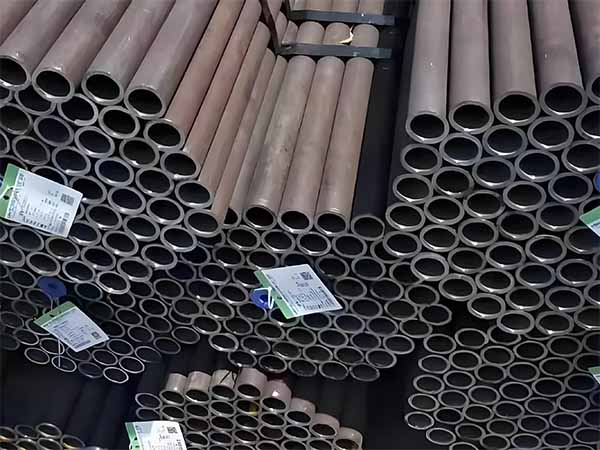
The ASTM A53 standard mainly divides steel into two grades: Grade A and Grade B. In industrial applications, Grade B is more common because it has a slightly higher carbon content and higher tensile and yield strength.
1. Chemical Composition
|
A53 Gr.B |
C |
Mn |
P |
S |
Cu |
Ni |
Cr |
Mo |
V |
|
|
0.3 |
1.2 |
0.05 |
0.045 |
0.4 |
0.4 |
0.4 |
0.15 |
0.08 |
2. Comparison of Mechanical Properties
The following is a comparison of the core mechanical properties of Grade A and Grade B.
|
Performance Specifications |
Grade A |
Grade B |
|
Tensile Strength |
≥ 330 MPa(48,000psi) |
≥ 415MPa(60,000psi) |
|
Yield Strength |
≥205MPa (30,000psi) |
≥240MPa(35,000psi) |
3. Common Dimensions and Sch40 Wall Thickness Examples
The actual wall thickness (in millimeters) of Sch40 depends on the nominal size (NPS) of the steel pipe.
|
NPS Designator |
DN Designator |
Outside Diameter |
Inside Diameter |
Wall Thickness |
Nominal Weight (Mass) per unit Length |
|
|
|
|
(mm) |
(mm) |
(mm) |
Plain End (kg/m) |
Threads & Couplings (kg/m |
|
1/8″ |
6 |
10.3 |
6.8 |
1.73 |
0.37 |
0.37 |
|
1/4″ |
8 |
13.7 |
9.2 |
2.24 |
0.63 |
0.63 |
|
3/8″ |
10 |
17.1 |
12.5 |
2.31 |
0.84 |
0.84 |
|
1/2″ |
15 |
21.3 |
15.8 |
2.77 |
1.27 |
1.27 |
|
3/4″ |
20 |
26.7 |
20.9 |
2.87 |
1.69 |
1.69 |
|
1″ |
25 |
33.4 |
26.6 |
3.38 |
2.5 |
2.5 |
|
1-1/4″ |
32 |
42.2 |
35.1 |
3.56 |
3.39 |
3.4 |
|
1-1/2″ |
40 |
48.3 |
40.9 |
3.68 |
4.05 |
4.04 |
|
2″ |
50 |
60.3 |
52.5 |
3.91 |
5.44 |
5.46 |
|
2-1/2″ |
65 |
73 |
62.7 |
5.16 |
8.63 |
8.67 |
|
3″ |
80 |
88.9 |
77.9 |
5.49 |
11.29 |
11.35 |
|
3-1/2″ |
90 |
101.6 |
90.1 |
5.74 |
13.57 |
13.71 |
|
4″ |
100 |
114.3 |
102.3 |
6.02 |
16.07 |
16.23 |
|
5″ |
125 |
141.3 |
158.2 |
6.55 |
21.77 |
22.07 |
|
6″ |
150 |
168.3 |
154.1 |
7.11 |
28.26 |
28.58 |
|
8″ |
200 |
219.1 |
202.7 |
8.18 |
42.55 |
43.73 |
|
10″ |
250 |
273 |
254.5 |
9.27 |
60.29 |
63.36 |
|
12″ |
300 |
323.8 |
304.8 |
9.52 |
73.78 |
76.21 |
Core Application Areas
ASTM A53 ERW Sch40 steel pipe is the preferred choice for many industries due to its robustness, durability, and reasonable price:
HVAC & Fire Protection Systems: Widely used in fire sprinkler systems and hot/cold water circulation systems in high-rise buildings.
Low-Pressure Fluid Transportation: Used for transporting municipal tap water, non-corrosive industrial wastewater, natural gas, and low-pressure coal gas.
Structural and Mechanical Applications: Due to its moderate wall thickness (Sch40), it is also commonly used for construction railings, scaffolding, supporting structures, or machined parts.
Compressed Air Systems: Large compressed air delivery networks within factories.
ASTM A53 ERW Steel Pipe Production and Quality Inspection
As resistance-welded pipes, the quality of the weld is paramount. ASTM A53 ERW steel pipes produced by reputable manufacturers must undergo a series of rigorous tests to ensure they will not leak or burst under high pressure:
Hydrostatic Testing: Each steel pipe must undergo a hydrostatic test at a specified pressure before leaving the factory to ensure that the pipe body and weld are leak-free.
Online Non-Destructive Testing (NDT/Eddy Current): 100% online inspection of the weld using eddy current or ultrasonic testing to eliminate internal defects.
Flattening Test: The steel pipe sample is flattened to a certain extent to check for cracks in the weld and its extensions, verifying its ductility and weld strength.
Summary
ASTM A53 ERW Sch40 steel pipe, with its uniform wall thickness, reliable weld quality, excellent mechanical strength, and high economic efficiency, has become an indispensable cornerstone of modern industrial piping networks. Whether you are planning fire protection systems for commercial buildings or designing fluid transport pipelines for factories, choosing standard-compliant A53 Sch40 steel pipe can provide long-term safety assurance for your projects.


 Language
 English
 Español
 بالعربية
 sales@central-steels.com
 0086-731-8865-5017