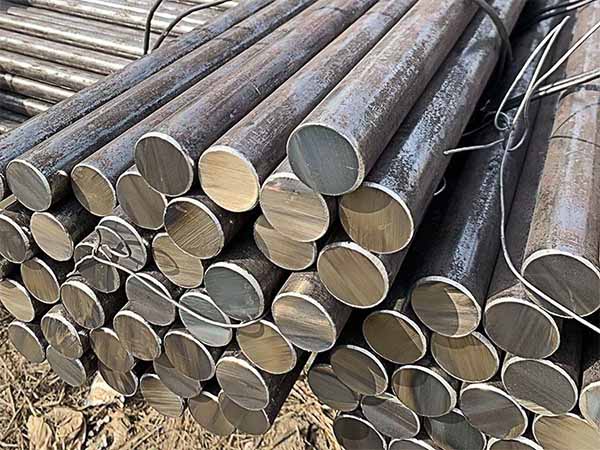
ASTM A36 round bar is a low carbon structural steel round bar produced based on ASTM A36/A36M standards with excellent weldability, good processability and moderate strength. A36 is a typical mild steel. Because of its low cost and wide range of applications, it is widely used in building structures, machinery manufacturing, support components and processed parts.
What is ASTM A36 round bar?
ASTM A36 (ASTM A36/A36M) is a common carbon steel specification for low carbon steel structures, covering various forms such as
ASTM A36 plates, profiles, and bars. Among them, "A" represents ferrous metal, and "36" represents its lowest yield strength of 36Ksi. ASTM A36 round bar is a steel material with a round bar shape produced based on the ASTM A36 standard. It is usually used for structural parts, supports, shafts and general processing parts.
Chemical composition and mechanical properties
Carbon C: approximately 0.25–0.29%;
Manganese Mn: approximately 0.60–1.03%;
Silicon Si: approximately 0.10–0.40%;
Phosphorus P, sulfur S: very low content (P ≤ 0.04%, S ≤ 0.05%);
Copper Cu: Can contain trace amounts (about 0.20%).
The combination of these ingredients jointly determines A36's low carbon, easy welding and good formability.
Common mechanical properties
Minimum yield: Typically around 250 MPa (36 ksi, hence the name A36) - small sizes or thin plates may follow slightly higher/lower limits;
Ultimate tensile strength: Approximately 400–550 MPa (58–80 ksi) range, affected by manufacturing process.
ASTM A36 round bars are often supplied in the form of hot-rolled round bars, forged round bars, and cold-drawn/cold-rolled round bars. Common diameters range from a few mm to hundreds of mm. The specific size needs to be determined according to standards and processes.
Processability, welding and heat treatment recommendations
ASTM A36 round bar has the same performance as A36 steel, and its processability, welding and heat treatment comply with A36 standards.
Processability: Low carbon makes A36 easy to turn, mill and drill, with relatively low tool wear; however, attention should be paid to cutting parameters and cooling during processing to avoid surface hardening.
Welding: Common methods such as SMAW, GMAW (MIG), and GTAW (TIG) can be used for welding. There is generally no need for complex preheating or tempering before and after welding (depending on thickness and constraints), but welding joint design and stress relief are still important.
Heat treatment: A36 is a non-alloy low carbon steel. Heat treatment (such as quenching and tempering) is not often used to significantly increase strength; if higher strength or hardness is required, corresponding alloy steel or surface treatment should be selected.
Typical application scenarios (why choose ASTM A36 round bar)
Building and bridge structural parts (supports, connectors, assembled components).
General machine manufacturing (jigs, bases, brackets, load-bearing parts).
Customized parts and welded structures (can be welded and assembled on site after processing).
Why is ASTM A36 steel so popular?
The reason why ASTM A36 steel has long dominated the global structural steel market is mainly because it achieves an excellent balance between "performance, cost and processability". As a low-carbon structural steel, A36 has good weldability, machinability and formability, and is much less difficult to process than high-carbon or alloy steel. At the same time, its yield strength of 250 MPa can meet the load-bearing requirements of most construction, machinery manufacturing and general structural parts. More importantly, A36 has a wide range of supply, ranging from steel plates, sections to A36 round bars, which can be easily purchased. The cost is stable and economical, making it the most cost-effective choice for most projects.
Frequently Asked Questions (FAQ)
Q1: Are
ASTM A36 and ASME SA-36 the same material?
A: Both are equivalent in terms of actual performance and chemical limits, but differ in documentation requirements when SA-36 is used to meet the procurement/inspection path associated with ASME, which governs materials used in pressure vessel and boiler applications.
Q2: Is A36 round steel suitable for shaft?
A: A36 can be used for shaft parts that bear general loads, but if high fatigue performance or precision size/hardness is required, it is recommended to use special alloys or materials with controllable heat treatment (such as AISI 4140, etc.).
 Central Steel


 Language
 English
 Español
 بالعربية
 sales@central-steels.com
 0086-731-8865-5017