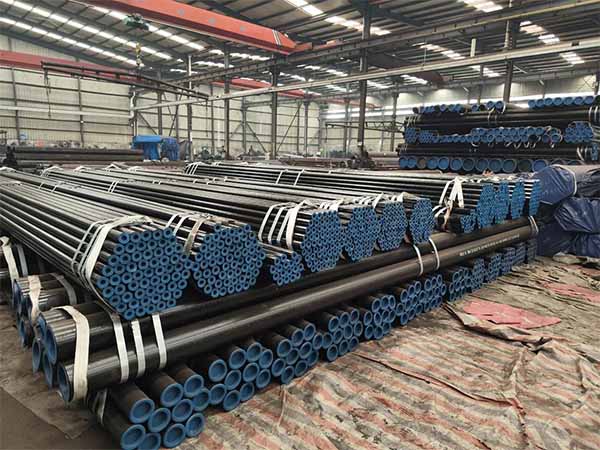
Seamless steel pipe is a type of steel pipe without any welded joints. It possesses excellent mechanical strength and a seamless, integrated structural characteristic. It is precisely this inherent strength advantage, stability, and outstanding pressure resistance that makes seamless steel pipe play a crucial role in many engineering fields, especially in the construction industry where safety, load-bearing capacity, and durability requirements are extremely high.
Seamless steel pipes are mainly used in the construction industry for the following purposes:
1. Structural Support Systems
One of the primary applications of seamless steel pipes in construction lies in structural support. Their high tensile strength and consistent wall thickness make them suitable for load-bearing frameworks such as high-rise building columns, truss structures, and industrial workshop supports. Compared with welded pipes, seamless steel pipe performs better under dynamic loads and harsh stress conditions, ensuring long-term safety and stability.
2. Plumbing and Water Supply Networks
Seamless steel pipes are widely used in building plumbing systems due to their leak-free structure and resistance to internal pressure. They are ideal for potable water delivery, fire-fighting systems, boiler pipework, and high-temperature or high-pressure water circulation systems. Their smooth internal surface reduces flow resistance and minimizes scaling, improving overall system efficiency.
3. HVAC and Mechanical Piping
Heating, ventilation, and air-conditioning (HVAC) systems rely heavily on high-performance pipes. Seamless steel pipe is commonly used for
chilled water lines, steam pipelines, and refrigerant transmission. Its ability to withstand temperature fluctuations and pressure variations ensures reliability in demanding mechanical environments, especially in large commercial buildings and industrial facilities.
4. Infrastructure and Foundation Engineering
Infrastructure projects such as bridges, tunnels, metro stations, and foundation piling also benefit from the durability and uniformity of seamless steel pipes. In piling applications, seamless pipes provide excellent vertical load capacity and resistance to deformation. In tunneling and underground engineering, they are used as casing pipes, supporting excavation safety and structural reinforcement.
5. Gas, Oil, and Energy Transmission in Buildings
Modern construction projects often include internal energy transportation networks. Seamless steel pipes are critical for the safe transfer of natural gas, heating fuels, and other building energy resources. Their superior pressure resistance and absence of welding joints significantly reduce the risk of leakage, helping to meet stringent building safety standards.
6. Architectural Aesthetic Applications
Beyond structural and mechanical uses, seamless steel pipes are increasingly appearing in architectural design. Their smooth surface, clean lines, and ability to be curved or shaped make them ideal for handrails, façade elements, decorative frames, and exposed structural art. Architects often choose seamless steel pipe to achieve both functional stability and visual impact.
Conclusion
The versatility, strength, and reliability of seamless steel pipe make it an indispensable material in today’s construction industry. From critical load-bearing structures to essential building service networks, seamless pipes continue to contribute to safer, more efficient, and more innovative construction worldwide.
Read more:What is a seamless steel pipe?
 Central Steel


 Language
 English
 Español
 بالعربية
 sales@central-steels.com
 0086-731-8865-5017