HFW steel pipe refers to a straight seam steel pipe produced by heating the edges of a hot-rolled steel coil to a plastic or molten state using heat generated by a high-frequency current (typically between 100 kHz and 800 kHz), followed by solid-phase/semi-solid-phase extrusion welding under the mechanical pressure of extrusion rollers.
Throughout the welding process, no welding wire, welding rod, or flux is required. The weld formation relies entirely on the diffusion and crystallization of the metal molecules within the base material of the steel coil under high temperature and pressure.
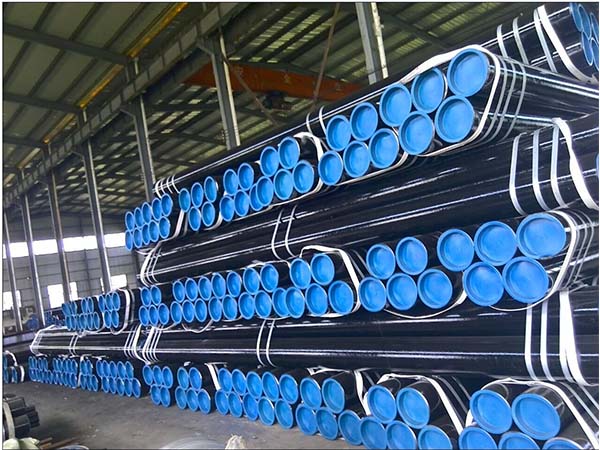
The Relationship Between HFW and ERW
Many people easily confuse HFW and ERW during procurement or technical exchanges. They are not opposing concepts, but rather related through a change in terminology.
ERW (Electric Resistance Welding) is a broad term encompassing all welding processes that utilize resistance heat. HFW (High-Frequency Welding) is a special case and advanced form of ERW resistance welding.
The Evolution of ERW:
Traditional ERW (Low-Medium Frequency): Early ERW steel pipes used low-frequency (50 Hz) or medium-frequency (1~3 kHz) current. Due to the low frequency, the current penetrated deeply, resulting in a wide heat-affected zone (HAZ), which easily led to poor fusion and inclusion defects. It has now been phased out or is only used in low-end structural applications.
Modern HFW (High Frequency): Utilizing a high-frequency power supply, the current is highly concentrated on the surface of the pipe blank. Combined with modern online medium-frequency normalizing (annealing) heat treatment processes and fully automated non-destructive testing (ultrasonic/eddy current), structural stress and hardened phases are eliminated, allowing the weld toughness and mechanical properties to approach the level of the base material.
In current oil and gas and high-specification engineering standards, ERW usually refers to HFW steel pipes using high-frequency welding technology.
The Influence and Role of Different Frequencies in Welding
In the resistance welding process, the current frequency is the most critical parameter determining heat distribution, weld quality, and production efficiency. High-frequency welding primarily relies on two physical effects: the skin effect and the proximity effect.
1. Core Physical Effects
Skin Effect: When a high-frequency current passes through a conductor, the current is no longer uniformly distributed across the conductor's cross-section, but rather tends to concentrate on the conductor's surface. The higher the frequency, the shallower the current penetration depth (δ).
Proximity Effect: When two conductors carrying currents in opposite directions approach each other, the current concentrates on the two closest opposing surfaces. In HFW, this results in a high concentration of current at the edges of the V-shaped tube blank.
2. Technical Comparison Across Frequency Ranges
|
Frequency Range
|
Applicable Wall Thickness
|
Physical Characteristics & Weld Performance
|
Advantages & Limitations
|
|
Low / Medium Frequency
(50 Hz - 3 kHz)
|
Heavy Wall
|
Deep current penetration; broad depth of heating.
|
Limitations: Excessively wide Heat-Affected Zone (HAZ); prone to grain coarsening and oxide inclusions; lower overall weld quality.
|
|
High Frequency
(100 kHz - 300 kHz)
|
Medium-to-Heavy Wall
(8 mm - 20 mm)
|
Balanced penetration depth; heat conducts evenly across the edge face.
|
Advantages: Ensures complete, uniform plasticity across the entire fusion face of thick walls without burning the outer surfaces.
|
|
Ultra-High Frequency
(300 kHz - 800 kHz)
|
Thin-to-Medium Wall
(< 8 mm)
|
Extremely strong skin effect; heat is intensely concentrated on the surface layer.
|
Advantages: Extremely fast heating rate; ultra-narrow HAZ (< 1 mm); high welding speeds; low energy consumption; easy ejection of molten flash/oxides.
|
The Core Role of High-Frequency Welding
Extremely Narrow Heat-Affected Zone (HAZ): The extremely high high-frequency energy density concentrates heating within a few micrometers to millimeters of the edge, reducing the impact on the heat-sensitive areas of the base material and preserving the original toughness of the base material.
Thorough Slag Removal and Pure Weld: The extremely fast heating rate combined with strong extrusion allows molten metal and oxide inclusions to be rapidly extruded into the weld.
Significantly Increased Welding Speed: High-frequency welding boasts high energy concentration efficiency, typically achieving welding speeds of 10-60 meters per minute, significantly boosting production capacity.
Summary
HFW steel pipe (high-frequency straight seam resistance welded steel pipe) represents the highest level of modern resistance welding technology. Leveraging the skin effect and proximity effect of high-frequency current, it achieves rapid and precise fusion of weld edges without the need for additional filler metal.
 Central Steel


 Language
 English
 Español
 بالعربية
 sales@central-steels.com
 0086-731-8865-5017