ERW steel pipes can be broadly classified into thin-walled and thick-walled types based on their wall thickness. While both types of pipes utilize the ERW process, they differ in material selection, forming difficulty, welding control, performance, and applications. Thick-walled ERW steel pipes offer advantages in load-bearing capacity and for medium- and high-pressure applications, while thin-walled ERW steel pipes excel in production speed and cost-effectiveness.
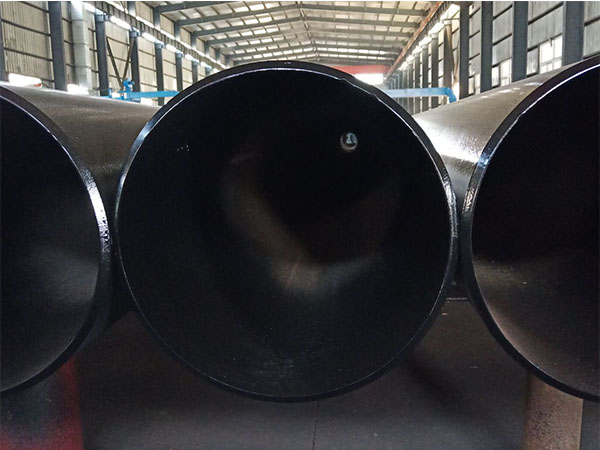
What is a Thick-walled ERW steel pipe?
Thick-walled ERW steel pipe refers to resistance-welded steel pipes with a relatively small diameter-to-wall-thickness ratio (usually less than 20). These pipes are typically used in applications requiring higher strength, pressure resistance, and impact resistance.
1. Core Characteristics and Performance Indicators
Excellent load-bearing and pressure-bearing capacity: Thick-walled ERW steel pipes can withstand medium to high internal pressure. Depending on the steel grade and specific wall thickness, its working pressure typically ranges from 10 MPa to over 32 MPa (approximately 1,450 to 4,600+ PSI).
Excellent mechanical properties: It possesses extremely strong resistance to bending, torsion, and external impact, and is not prone to structural deformation under heavy loads or complex geological conditions.
Commonly used high-specification materials: Medium carbon steel or low-alloy high-strength steel (HSLA) is commonly used to ensure high yield strength and excellent toughness.
2. Manufacturing Difficulty and Quality Control
Due to the thickness of the steel strip and the enormous deformation resistance, the weld seam must undergo online or offline normalizing treatment (PWHT/annealing) to eliminate residual welding stress, ensure the weld microstructure is consistent with the base metal, and prevent intergranular corrosion and brittle fracture.
What is Thin-walled ERW steel pipe?
Thin-walled ERW steel pipe refers to steel pipe with a large ratio of diameter to wall thickness (usually greater than 40 or 50 mm). The core design principle of this type of steel pipe is to achieve lightweight structure, extremely high material utilization, and economic efficiency.
1. Core Characteristics and Performance Indicators
High Cost-Effectiveness: The steel resources consumed per meter are significantly reduced, thereby significantly lowering the overall costs of raw material procurement, transportation, and on-site installation.
Extremely High Production Efficiency: Thin steel strips heat up and cool down rapidly during high-frequency welding, resulting in extremely high welding speeds and low manufacturing energy consumption.
Excellent Surface Quality: Thin-walled steel pipes typically have better surface smoothness, which is highly beneficial for subsequent cold drawing, precision machining, galvanizing, or painting treatments.
2. Manufacturing Difficulty and Quality Control
Thin-walled pipes have lower rigidity, making them prone to wavy lines or wrinkles at the edges during cold bending. Furthermore, excessive high-frequency power can easily lead to burn-through defects. Therefore, extremely high precision is required for the forming rollers and the instantaneous stability of the welding current.
The core differences between thick-walled ERW steel pipe and thin-walled ERW steel pipe
|
Feature / Metric
|
Thick-Walled ERW Steel Pipe
|
Thin-Walled ERW Steel Pipe
|
|
Diameter-to-Thickness Ratio ($D/t$)
|
Typically < 20 (Thick Wall)
|
Typically > 40 or 50 (Thin Wall)
|
|
Pressure Containment Rating
|
Mid-to-High Pressure ( ≥10 MPa /1450 PSI)
|
Low Pressure (< 1.6 MPa / < 230 PSI) or Gravity Flow
|
|
Comprehensive Cost per Meter
|
Higher (Due to high material volume and complex PWHT processing)
|
Lower (Significant material savings and ultra-fast production cycles)
|
|
Primary Fluid & Conveyance Standards
|
API 5L: Pipeline specification for petroleum & natural gas industriesASTM A53 / A53M: Standard specification for pipe, steel, black & hot-dippedGB/T 9711: Chinese standard for oil and gas transport steel pipes
|
ASTM A53 Type E (Grade A): Light-hazard/low-pressure fluid pipingBS EN 10255: Non-alloy steel tubes suitable for welding and threadingGB/T 3091: Welded steel pipes for low-pressure fluid delivery
|
|
Primary Structural & Mechanical Standards
|
ASTM A500 / A500M: Cold-formed welded carbon steel structural tubingEN 10219-1/2: Cold-formed welded structural hollow sections of non-alloy/fine grain steelsGB/T 13793: Longitudinally electric resistance welded steel tubes
|
ASTM A513: Electric Resistance Welded (ERW) carbon and alloy steel mechanical tubingEN 10305-3: Welded cold sized tubes for precision applicationsJIS G3445: Carbon steel tubes for automobile structural purposes
|
|
Core Steel Grades (Commonly Used)
|
API 5L: Grade B, X42, X52, X60, X65, X70ASTM A53: Grade BASTM A500: Grade B, Grade CEN 10219: S235JRH, S275J0H, S355J2H, S460MHChinese Grade: Q355B, Q355D, 20# Steel
|
ASTM A53: Grade AASTM A513: MT1010, MT1020, 1008EN 10305-3: E195, E235, E355JIS G3445: STKM 11A, STKM 12BChinese Grade: Q195, Q235B, SPCC
|
|
Manufacturing Challenges & Weld Treatment
|
High bending resistance during roll-forming; prone to edge mismatch. Post-Weld Heat Treatment (PWHT/Seam Annealing) is mandatory to normalize grain structure.
|
High risk of edge buckling/wrinkling and instant burn-through. High springback effect makes roundness (ovality) control difficult. PWHT is often optional.
|
|
Primary Application Examples
|
Oil & gas gathering networks, heavy structural piling, bridge casings, high-pressure municipal water mains, and heavy-duty machinery parts (hydraulic cylinders).
|
Automatic fire sprinkler systems, scaffolding tubes, HVAC water loops, automotive exhaust & seat frames, electrical conduits (EMT), and modern metal furniture.
|
How to choose the right ERW steel pipe?
1. Application areas of thick-walled ERW steel pipe:
Low-pressure oil and gas transmission and gathering pipelines: Strictly adhering to API 5L (PSL1/PSL2) standards, often using high-grade thick-walled pipes such as X52 or X60 to ensure resistance to acid corrosion and high tear toughness.
High-stress fluid and thermal pipelines: Using ASTM A53 Gr. B thick-walled pipes for urban high-pressure water supply trunk lines, boiler feedwater, and thermal steam pipelines.
Heavy Building Structures and Pile Driving: Following ASTM A500 Gr. C or EN 10219 S355J2H, used for steel structural columns in high-rise buildings, bridge casings, and dock piling pipes, utilizing their excellent bending stiffness.
Machining and Automotive Hollow Shafts: Manufacturing drive shafts, hydraulic cylinder liners, and idler roller tubes, requiring high wall thickness to meet subsequent cutting and boring processes.
2. Applications of Thin-Walled ERW Steel Pipes:
Automatic Fire Sprinkler Systems: Widely used are thin-walled galvanized steel pipes conforming to ASTM A53 Grade A or BS EN 10255, facilitating quick on-site grooving or threading connections.
Modern Automobiles and Light Industrial Machinery: Following ASTM A513 or EN 10305-3 standards, used for automotive exhaust pipes, seat frames, shock absorber housings, and other components requiring precision cold drawing or expansion.
General building structures and scaffolding: Thin-walled conduits conforming to EN 10219 S235JRH or GB/T 3091 Q235B are used for construction scaffolding, greenhouse frames, and urban road medians.
Electrical wiring and residential homes: Conduits (EMT/IMC) for protecting building electrical wiring and modern metal furniture frames.
 Central Steel


 Language
 English
 Español
 بالعربية
 sales@central-steels.com
 0086-731-8865-5017