 Central Steel
Central Steel
Central Steel
Central Steel
Central Steel
Hot-rolled and cold-rolled seamless steel pipes are both manufactured without a welded seam, but they differ significantly in manufacturing process, dimensional accuracy, surface finish, mechanical properties, size range, cost, and applications. Hot-rolled seamless pipes are generally preferred for large-diameter, thick-wall and general pressure or fluid-transport applications because they are economical and easier to produce, while cold-finished seamless pipes—including cold-drawn and cold-rolled pipes—are preferred when tighter dimensional tolerances, better surface finish, and higher precision are required.
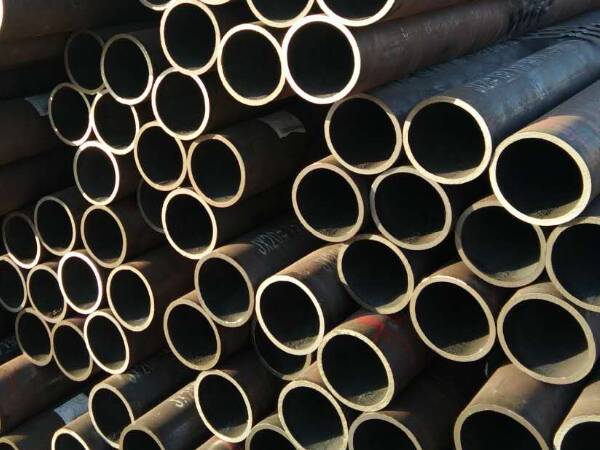
Hot Rolled vs Cold Rolled Seamless Steel Pipe: Quick Comparison
|
Feature |
Hot-Rolled Seamless Steel Pipe |
Cold-Finished Seamless Steel Pipe |
|
Manufacturing process |
Rolled and formed at high temperature |
Further processed at or near room temperature |
|
Typical cold-finishing methods |
Not applicable |
Cold drawing or cold rolling |
|
Dimensional accuracy |
Standard/relatively lower |
Higher, with tighter tolerances |
|
Surface finish |
Rougher, may have mill scale |
Smoother and cleaner |
|
Size range |
Generally better suited to larger diameters and thicker walls |
Generally preferred for smaller sizes and precision tubes |
|
Mechanical properties |
Good strength and ductility depending on grade and heat treatment |
Cold working can increase strength and hardness |
|
Surface treatment |
May require descaling, pickling or other treatment |
Usually has a cleaner surface after cold finishing |
|
Production cost |
Lower |
Higher due to additional processing |
|
Typical applications |
Oil and gas pipelines, pressure piping, boilers, structural and general industrial applications |
Hydraulic cylinders, precision machinery, automotive components, instrumentation and other precision applications |
|
Main advantage |
Economical production and large-size capability |
High dimensional precision and better surface finish |
|
Main limitation |
Lower dimensional precision and rougher surface |
Higher cost and more limited size range |
1. Production process gap:
Hot-rolled seamless steel pipes are formed by heating billets to high temperatures and then rolling them. It is to further process the hot-rolled seamless steel pipe at room temperature and produce it by cold drawing or cold rolling. The process does not involve heating, but rather plastic deformation to achieve the final size and accuracy of the steel pipe.The surface of the hot-rolled seamless steel pipe is relatively rough, usually with oxide skin and defects on the surface, and the color is dim. Subsequent surface treatment (such as pickling) is required to remove the oxide.
The cold-rolled seamless steel pipe has better surface quality, high finish and high dimensional accuracy because it is processed at low temperature. Therefore, cold-rolled tubes usually do not need to be surface treated.
Hot-rolled seamless steel pipes are usually used in situations where strength requirements are not high but large caliber is required, such as transportation pipelines, structural pipelines, large equipment components, etc. It is also commonly used in piping systems that withstand low and medium pressures.
Cold-rolled seamless steel pipe: mainly used in areas with high dimensional accuracy and surface finish requirements, such as precision machinery manufacturing, automotive industry, hydraulic system, instrument and meter manufacturing. Cold-rolled pipes are also suitable for high-pressure pipes or applications requiring high strength.
Disadvantages: Due to the influence of high temperature, the surface quality of hot-rolled seamless pipes is poor, the mechanical properties are weak, and the dimensional accuracy is low.
Cold rolled seamless steel pipe
Advantages: Clean surface, high dimensional accuracy, superior mechanical properties, suitable for high-precision occasions.Disadvantages: high cost, relatively complex process, high processing difficulty, low plasticity and toughness and limited size.
Frequently Asked Questions About Hot Rolled and Cold Rolled Seamless Steel Pipes
1. What is the main difference between hot rolled and cold rolled seamless steel pipe?
The main difference is the final manufacturing process. Hot-rolled seamless pipes are formed at elevated temperatures, while cold-finished seamless pipes undergo additional cold working such as cold drawing or cold rolling after hot finishing. Cold finishing generally provides better dimensional accuracy and surface finish.
2. Is cold rolled seamless pipe stronger than hot rolled seamless pipe?
Not necessarily in every case. Cold working can increase yield strength and hardness through strain hardening, but the final mechanical properties depend on the steel grade, amount of cold reduction and heat treatment. The applicable material standard should be used to compare actual mechanical properties.
3. Which is better, hot rolled or cold rolled seamless pipe?
Neither is universally better. Hot-rolled seamless pipe is generally better for large-size, thick-wall and cost-sensitive applications, while cold-finished seamless pipe is generally better for precision applications requiring tight tolerances and a smooth surface.
4. Which seamless pipe has better dimensional accuracy?
Cold-finished seamless pipe generally has better dimensional accuracy because the additional cold drawing or cold rolling process provides tighter control of dimensions and geometry.
Cold-rolled seamless steel pipe has the advantages of high precision, high strength and surface finish, which is suitable for areas requiri ng high precision and high performance, but the production cost is high and the plasticity is poor.
Read more: What is a seamless steel pipe? or What is hot rolling process


 Language
 English
 Español
 بالعربية
 sales@central-steels.com
 0086-731-8865-5017