 Central Steel
Central Steel
Central Steel
Central Steel
Central Steel
Large diameter seamless steel pipe is a seamless steel pipe with a relatively large outside diameter, commonly used for high-pressure fluid transportation, oil and gas pipelines, power generation, petrochemical processing, structural engineering, and other demanding industrial applications. There is no single international size threshold for the term “large diameter,” but NPS 12 / DN300 (OD 323.9 mm) and above is commonly used as a practical reference in international engineering applications. Depending on the required diameter, wall thickness, steel grade, and standard, large diameter seamless pipes can be manufactured by hot rolling, hot expansion, or other specialized hot-working processes.
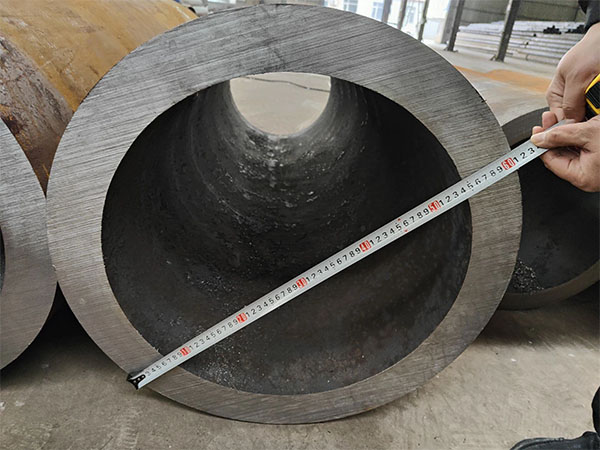
1. Technical Specifications & Material Grades
To simplify your procurement process, Central Steel offers a comprehensive range of material grades tailored to international engineering standards. We support full customization to match your specific project requirements:
| Material Category | Common Industry Grades | Standard Specifications | Key Benefits & Applications |
| Carbon Steel | Gr. B, X42, S235JR, S355JR | ASTM A106/A53, EN 10025 | Cost-effective, excellent weldability; ideal for structural engineering and water networks. |
| Line Pipe Steel | X42, X52, X60, X70, X80 (PSL1 & PSL2) | API Spec 5L | High yield strength, superior low-temperature toughness; designed for long-distance oil & gas transmission. |
| Alloy Steel | P11, P22, P91, 16Mo3 | ASTM A335, EN 10216-2 | Outstanding heat and creep resistance; specialized for high-pressure boilers and power plants. |
| Stainless Steel | 304/304L, 316/316L, 321H | ASTM A312, ASTM A790 | Extreme corrosion resistance; crucial for highly corrosive chemical and offshore marine environments. |
2. Main Manufacturing Process of Seamless Pipes
At Central Steel, our production line adheres to rigid quality control workflows. Large-diameter seamless pipes are primarily manufactured using advanced hot piercing and hot expansion techniques to ensure structural integrity:
Billet Preparation & Preheating: Round cast, rolled, or forged steel billets are meticulously inspected and preheated to an optimal rolling temperature of 1150°C to 1250°C.
Piercing (Forming the Shell): A solid billet is pierced by a rotating plug bar to form a hollow shell. For extra-large diameters, the initial hole is precisely milled and then expanded through hot rolling.
Hot Expansion: The inner and outer diameters are gradually expanded at high temperatures using specialized hydraulic/mechanical expansion machines to meet exact large-bore requirements.
Sizing and Straightening: The expanded pipe passes through advanced multi-stand sizing and straightening machinery to calibrate outer diameter tolerances, roundness, and straightness, while effectively eliminating internal compressive stress.
Heat Treatment: Depending on the material grade and structural demands, pipes undergo Normalizing, Annealing, or Quenching + Tempering (Q&T) to optimize mechanical properties and refine grain microstructure.
End Finishing & Beveling: Pipes are cut to exact lengths. Ends can be processed into plain ends, beveled ends for easy welding, or threaded based on client demands.
Surface Treatment & Anti-Corrosion: Final products undergo pickling, shot blasting, and are applied with protective coatings—such as black painting, anti-rust oil, FBE, or 3LPE external coatings—to drastically extend service life.
3. Core Mechanical Advantages & Benefits
Why do global engineering firms choose large-bore seamless pipes over welded alternatives (like LSAW/SSAW) for critical sections?
Zero-Weld Structural Integrity: The lack of a longitudinal weld seam entirely eliminates weld-line defects. This ensures 100% uniform pressure distribution and unmatched fatigue resistance under cyclical loads.
Superior Tensile & Low-Temperature Strength: With tensile strengths ranging from 490 to 650 MPa, our pipeline steels maintain exceptional charpy V-notch impact toughness even in freezing environments from -20°C to -40°C.
Extreme Temperature Resilience: Engineered alloy and stainless variants safely handle prolonged exposure within an ultra-wide range of -196°C to 600°C.
High Hydraulic Efficiency & Low Wear: A perfectly smooth internal wall minimizes fluid friction, optimizes transmission flow rates, and significantly reduces erosion-corrosion caused by abrasive mediums.
4. Heavy Industrial Applications
Central Steel's large diameter seamless steel pipes are extensively deployed worldwide across multiple strategic sectors:
Oil & Gas Transport: Main line pipes for long-distance high-pressure natural gas, crude oil, and hydrocarbon slurry transmission.
Petrochemical & Chemical Refineries: Process piping for volatile chemicals, acids, and gases working under high-temperature and high-pressure parameters.
Power & Thermal Generation: Heavy-wall boiler tubes and steam headers for high-pressure boilers, superheaters, and pressure vessels.
Civil & Marine Infrastructure: Heavy structural columns, high-capacity deep pile foundations for bridges, offshore platforms, jacket structures, and port construction.
Defense & Aerospace: Critical high-strength structural tubes, submarine systems, and missile storage casing.
FAQ About Large Diameter Seamless Steel Pipe
1. What is considered a large diameter seamless steel pipe?
There is no single universal definition. In international engineering practice, NPS 12 / DN300 (OD 323.9 mm) and above is commonly used as a practical reference for large diameter pipe, but manufacturers and industries may use different size thresholds.
2. What is the largest size of seamless steel pipe?
There is no single maximum size applicable to all manufacturers. The maximum outside diameter depends on the production equipment, manufacturing process, wall thickness, steel grade, and applicable standard. Large diameters can also be produced through hot expansion when direct rolling to the final diameter is not practical.
3. How is large diameter seamless steel pipe manufactured?
Large diameter seamless steel pipe is generally manufactured from a solid round billet through heating, piercing, hot rolling, sizing, and straightening. For larger diameters, hot expansion may be used to increase the pipe diameter and achieve the required dimensions.
Summary
Large-diameter seamless steel pipes, with their high strength, corrosion resistance, strong pressure-bearing capacity, seamless structure and high transmission efficiency, are irreplaceable in conveying systems, infrastructure, high-pressure equipment, chemical industry, petroleum and national defense equipment. The three processes of hot rolling, hot expansion and cold rolling ensure its size and performance. Combined with multi-standard testing and material customization, it meets the complex engineering requirements.
Read more : What is seamless steel pipe?


 Language
 English
 Español
 بالعربية
 sales@central-steels.com
 0086-731-8865-5017