In port construction, deep foundation pit engineering, cofferdam construction, and river regulation projects,
sheet piles are one of the most important support structures. With the development of sheet pile technology, the two most common types in engineering are currently Hot Rolled Sheet Pile and Cold Formed Sheet Pile.
Although the two types of sheet piles have similar uses, they differ significantly in manufacturing processes, interlocking structures, construction methods, costs, and engineering applications. This article will systematically analyze Hot Rolled vs Cold Formed Sheet Pile to help you better understand their characteristics.
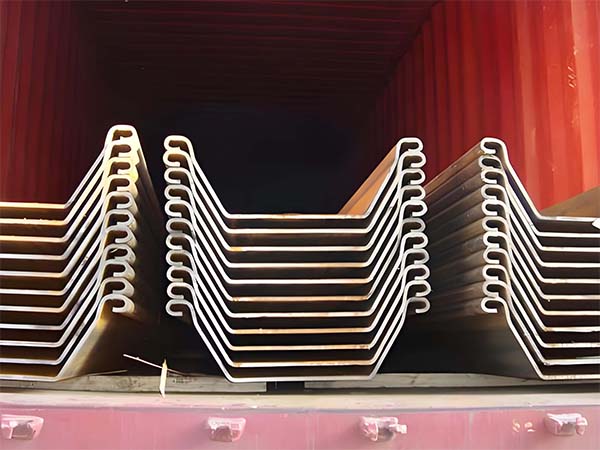
What is Hot Rolled Sheet Pile?
Hot Rolled Sheet Pile is a sheet pile produced through high-temperature rolling. During the manufacturing process, the steel billet is heated to approximately 1700°F (above approximately 930°C) and then formed once or twice by a rolling mill to ultimately form the sheet pile cross-section.
This manufacturing method has advantages such as a complete cross-sectional structure, higher strength, thicker interlocking structures, and suitability for construction in complex geological conditions. In addition, hot-rolled sheet piles can typically be produced in greater thicknesses and have tighter interlocking connections, making them very common in heavy engineering projects.
Typical applications include:
Port engineering
Marine engineering
Deep foundation pit support
Bridge foundations
Flood control engineering
What is Cold Formed Sheet Pile?
Cold Formed Sheet Pile is manufactured using a different method.
Its production process is generally divided into two stages:
Stage 1: Heating and rolling steel billets into coils
Stage 2: After the coils cool, they are formed into sheet piles at room temperature using forming equipment.
This production method has advantages such as flexible production, lower cost, a wide range of specifications, and easier mass production.
Cold-formed sheet piles typically have a more uniform cross-sectional thickness and can be offered in various sizes and depths to meet different engineering needs.
Therefore, this type of sheet pile is commonly found in:
Temporary works
Small to medium-sized retaining walls
Road engineering
Riverbank protection projects
Development and Background of Sheet Piles
The history of sheet piles can be traced back more than a hundred years. The earliest sheet piles were simple flat plate structures, primarily used in cofferdam projects. Later, with technological advancements, U-shaped and Z-shaped sheet piles emerged, becoming the mainstream structure in modern engineering.
One significant technological breakthrough was the invention of the Larssen interlocking system, which directly integrates the interlocking joint into the sheet pile structure, significantly improving the strength and sealing performance of the sheet piles and becoming an industry standard design.
As market demand expanded, cold-formed sheet piles entered the market in the 1970s and gradually became an economical solution.
Manufacturing Process Comparison: Production Method Determines Performance
In the selection of sheet piles, the production process is one of the most critical factors.
Hot-rolled sheet piles utilize a high-temperature rolling process, forming the steel while it is in a plastic state, resulting in a denser internal structure and better mechanical properties. This production method also allows for the creation of more complex cross-sectional shapes, such as
U-shaped,
Z-shaped, and high-modulus sheet piles. These structures significantly improve bending resistance and load-bearing capacity.
In contrast, cold-formed sheet piles are formed by cold-working rolled sheets or plates, resulting in a relatively simple cross-sectional structure, typically U-shaped, Z-shaped, or straight sheet piles.
While production is more flexible, the lack of high-temperature rolling limits the improvement in material properties.
Therefore, hot-rolled sheet piles are more advantageous for large-scale projects or deep foundation pit projects.
Structural Strength and Bearing Capacity
Structural performance is one of the most significant differences between hot-rolled and cold-formed sheet piles.
Hot-rolled sheet piles, due to their thicker cross-sections, stronger interlocks, and larger section modulus, exhibit greater stability under soil and water pressure. They are suitable for deep foundation pit support, port and dock engineering, marine engineering, and permanent structure engineering.
Furthermore, hot-rolled sheet piles generally have higher bending resistance, meaning that less steel can be used to achieve greater support capacity under the same conditions.
While cold-formed sheet piles are slightly weaker in strength, they perform well in medium-depth foundation pits, temporary cofferdams, municipal infrastructure projects, and projects with limited budgets.
Therefore, the larger the project and the higher the structural requirements, the more likely hot-rolled sheet piles are to be chosen.
Conclusion
Hot Rolled Sheet Pile and Cold Formed Sheet Pile each have their own advantages, and there is no absolute superiority or inferiority. The key is to choose according to the project requirements.
If the project requires higher structural strength, better waterproofing, and a longer service life, then hot-rolled sheet piles are a more reliable choice. However, if the project is smaller in scale, has a limited budget, or is a temporary structure, then cold-formed sheet piles are more cost-effective.
Read more : Steel Sheet Pile vs Concrete Retaining Wall
 Central Steel


 Language
 English
 Español
 بالعربية
 sales@central-steels.com
 0086-731-8865-5017