ERW and LSAW piling pipes can both be used for steel pipe pile applications, but they are suited to different project requirements. ERW piling pipe is generally preferred for small to medium diameters, standardized dimensions, high production efficiency, and cost-sensitive foundation projects, while LSAW piling pipe is commonly selected for larger diameters, thicker walls, and projects requiring large structural sections.
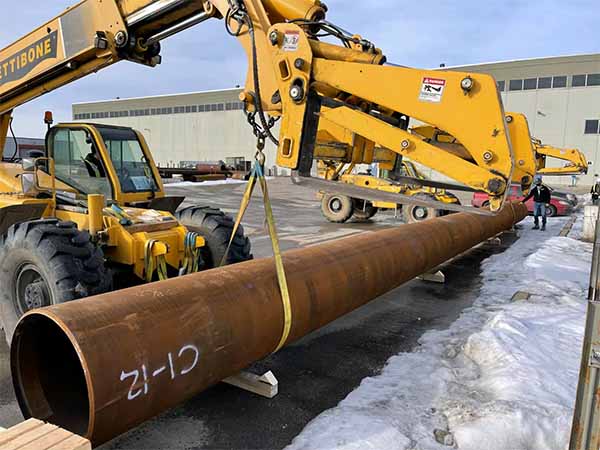
What are ERW and LSAW piling pipes?
ERW piling pipe: It is formed by heating the edge of the steel strip with high-frequency current and applying pressure for welding. This process features a compact structure, high dimensional accuracy, and a smooth surface, making it suitable for medium and small diameter pipe piles.
Features
The outer diameter is generally less than 24 inches
The weld seams are neat and the inner and outer surfaces are smooth
Low production cost and high production efficiency
LSAW piling pipe: by submerged arc welding, thick steel plates are rolled into shape and then longitudinally welded. The weld seam has deep penetration and high strength, and is very suitable for large-diameter and high-strength pile foundation projects.
Features
It can reach a large diameter of over 60 inches
The weld seam has high strength and can withstand relatively high loads
Suitable for deep foundations and Marine environments
ERW vs LSAW piling pipe
|
Feature
|
ERW piling pipe
|
LSAW piling pipe
|
|
Manufacturing method
|
High-frequency electric resistance welding
|
Longitudinal submerged arc welding
|
|
Typical raw material
|
Hot-rolled steel coil
|
Steel plate
|
|
Pipe diameter
|
Small to medium diameter
|
Medium to large diameter
|
|
Wall thickness
|
Commonly thinner sections
|
Suitable for thicker sections
|
|
Weld direction
|
Longitudinal
|
Longitudinal
|
|
Dimensional consistency
|
High
|
High
|
|
Production efficiency
|
High
|
Lower than ERW
|
|
Production flexibility
|
Efficient for standardized sizes
|
Flexible for large diameter and thick-wall sizes
|
|
Typical applications
|
Building foundations, infrastructure, general piling
|
Deep foundations, bridges, ports, marine and offshore structures
|
|
Cost consideration
|
Generally lower for suitable sizes
|
Generally higher for large and heavy sections
|
Key differences between ERW and LSAW piling pipes
1.Manufacturing process
ERW piling pipe: It is made from hot-rolled coil as raw material. After uncoiling and continuous forming, it is welded along the longitudinal direction of the pipe body by high-frequency resistance welding. The weld seams undergo online heat treatment and non-destructive testing to ensure their quality.
LSAW piling pipes: using single thick steel plates as raw materials, the steel plates are rolled into pipe blanks through forming processes such as UOE and JCO, longitudinal welding is carried out by double-sided submerged arc welding inside and outside, and finishing treatments such as expansion and straightening are performed. The weld quality is high and the strength is uniform.
2.Diameter and wall thickness
ERW piling pipe: mainly suitable for small to medium diameters, with wall thickness generally below 12mm. Due to the capacity limitations of the equipment, it is not suitable for ultra-thick or ultra-large diameter pipe piles.
LSAW piling pipe: applicable to medium to large diameters (up to 1500mm or more), can achieve relatively thick wall thickness (up to 40mm or more), the finished product has high roundness and straightness, dimensional accuracy, and is particularly suitable for large pile engineering.
3.Strength and performance
ERW piling pipe:
Due to the use of continuous strip steel production, the mechanical properties along the pipe body are relatively uniform.
The strength of the weld seam depends on the high-frequency welding parameters and the control of weld heat treatment.
It is applicable to pile foundation projects with general bearing capacity requirements.
LSAW piling pipe:
The submerged arc welding process is adopted, featuring a large weld penetration and high metal density.
It has excellent overall strength, bending resistance and fatigue resistance, and can withstand large loads and impacts.
It performs more reliably in high-demand environments such as the ocean, Bridges and ports.
4.Cost and availability
ERW piling pipe: low production cost, high production efficiency, capable of achieving large-scale supply, short delivery time, suitable for projects with low cost and short cycle.
LSAW piling pipe: Due to the high price of sheet materials and the complex welding and finishing processes, the cost of LSAW piling pipe is relatively high. Moreover, its production cycle is relatively long and it is often used in key or high-demand engineering projects.
Applications of ERW and LSAW piling pipes
ERW piling pipe applications:
Urban infrastructure
Bridge support structure
• General building foundation piles
• Light or medium load engineering projects
LSAW piling pipe applications:
• Marine engineering and port construction
• Deep foundation and heavy-load pile foundation for Bridges
• Coastal breakwaters and wharf piles
• Offshore wind power and oil platform foundations
Both ERW and LSAW piling pipes have their unique advantages. The choice depends on project requirements, budget, and environmental conditions.
Why choose Central steel?
Central steel specializes in the production of ERW, LSAW and SSAW pile tubes, which comply with international standards API 5L, ASTM A252 and EN 10219.
We are equipped with fully automatic welding equipment and ultrasonic testing systems, and can provide a full range of pile pipes with diameters ranging from 114mm to 1420mm.
The
engineering projects include: Lagos Coastal Highway Piling in Nigeria, Dubai Skyscraper Foundation Piling in UAE, Helsinki Harbor Expansion Piling in Finland et al.
FAQ about ERW vs LSAW piling pipe
1. What is the main difference between ERW and LSAW piling pipe?
The main difference is the manufacturing process. ERW pipe is formed from steel coil and welded longitudinally using electric resistance welding, while LSAW pipe is formed from steel plate and longitudinally welded using submerged arc welding.
2. Is ERW pipe suitable for piling?
Yes. ERW steel pipe can be used for pipe pile applications when its diameter, wall thickness, material grade, weld quality, testing, and other requirements meet the project specification.
3. Is LSAW pipe better than ERW for piling?
Not necessarily. LSAW and ERW are different manufacturing processes. LSAW is often selected for large-diameter or thick-wall piles, while ERW can be suitable for standardized small and medium diameter piles. The appropriate choice depends on the project design.
Summary
ERW piling pipes are cost-effective and suitable for standard foundation works, while LSAW piling pipes are ideal for heavy-duty and offshore structures.Contact Central Steel for technical guidance or to get a quote for your next piling project.
Read more:What is a piling pipe?
 Central Steel


 Language
 English
 Español
 بالعربية
 sales@central-steels.com
 0086-731-8865-5017