In the fluid transportation field,
ERW (Electric Resistance Welded) steel pipes have become one of the most commonly used types of steel pipes in modern infrastructure. Whether for municipal drinking water systems, industrial cooling loops, or agricultural irrigation, selecting the right ERW steel pipe is crucial for pipeline durability and safety.
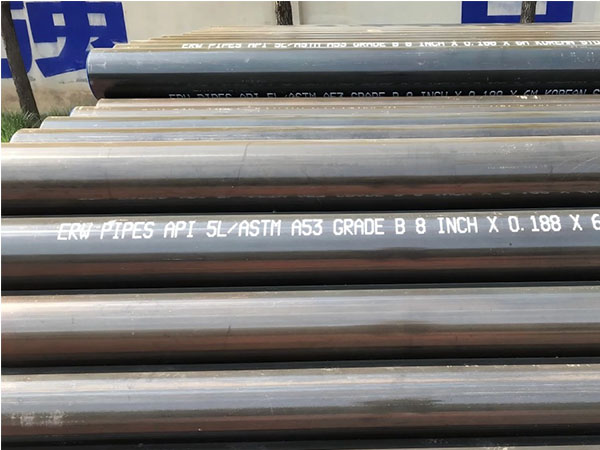
1. What are ERW steel pipes for water transportation?
ERW steel pipes are manufactured by cold-bending steel strips into a cylindrical shape. Electricity is then applied to tightly bond the two ends of the pipe together, forming a weld without the need for welding wire.
For water transportation, ERW steel pipes offer better dimensional accuracy, structural integrity, and cost-effectiveness compared to seamless steel pipes or larger diameter spiral steel pipes.
2. Core Manufacturing Standards for Water Pipes
To ensure safety and reliability, ERW pipes must meet stringent international standards. Depending on the pressure and application, the following are the most commonly used standards:
ASTM A53 (Class A and Class B)
This is likely the most widely used ERW pipe standard for general piping and water pipes.
Class A: Better ductility, easier to cold bend. Grade B: Higher yield strength, preferred for pressurized water systems.
API 5L (Grades B to X70)
API 5L pipes were originally designed for the oil and gas industry, but are now frequently used for high-pressure water supply trunk lines. Their stringent testing requirements for toughness and weld quality make them ideal for long-haul water pipelines.
ASTM A135
Coveres resistance-welded steel pipes for conveying gases, steam, water, or other liquids.
Regional Standards
EN 10217-1: European standard for non-alloy steel pressure pipes.
GB/T 3091: Chinese standard for low-pressure fluid transport, a key standard for infrastructure projects in Asia and Africa.
AS/NZS 1579: A key standard for projects in Australia and New Zealand, particularly for water supply and sewage steel pipes.
3. Common Specifications and Models
Outer Diameter (OD): Typically ranges from 1/2 inch (21.3 mm) for indoor pipes to 24 inches (610 mm) for municipal pipes. Wall Thickness: Common specifications include SCH 10, SCH 20, SCH 40 (standard), and SCH 80 (extra thick).
End Finishing Methods:
Right Angle Ends: For mechanical connections.
Beveled Ends: For field welding.
Threaded Connections (T&C): Commonly used for small-diameter galvanized pipes.
4. Key Factors: Water Quality Coating and Lining
Because steel is inherently prone to oxidation, the lifespan of water pipes depends entirely on their protective coating.
Inner Lining (Protecting the Water Source)
Mortar Lining (MSCL): A classic choice to prevent scaling (scale buildup) and maintain flow for decades.
Epoxy Coating: Must be NSF/ANSI 61 drinking water certified. It provides a smooth surface, reduces friction, and prevents corrosion.
Outer Coating (Protecting the Pipeline)
Hot-Dip Galvanizing (HDG): The zinc coating provides excellent protection for pipes exposed to the atmosphere.
3LPE/FBE Coating: For buried pipelines, a three-layer polyethylene (3LPE) or fusion-bonded epoxy (FBE) coating provides ultimate protection against soil corrosion and moisture.
5. ERW vs. SSAW vs. LSAW: Why Choose ERW?
In the medium diameter range (maximum 24 inches), ERW pipe offers several advantages over SSAW (spiral welded) and LSAW (longitudinal welded) pipe:
Smaller Tolerances: ERW pipe has more uniform wall thickness and diameter roundness.
Smoother Surface: ERW pipe does not have the heavy welds of SSAW pipe, resulting in a more uniform lining application.
Economy: Faster production speeds mean lower costs for the end user without sacrificing quality.
Frequently Asked Questions (FAQ)
Q: Can ERW steel pipe be used for drinking water?
A: Yes, provided it has a food-grade lining that meets local hygiene standards (e.g., certified epoxy or cement mortar).
Q: What is the maximum diameter of ERW steel pipe?
A: Most manufacturers produce ERW steel pipe with a maximum diameter of 24 inches (610 mm). For sizes larger than this, LSAW or SSAW steel pipe is typically used.
Q: Is ERW steel pipe cheaper than seamless steel pipe?
A: Generally, yes. ERW steel pipe is more cost-effective for water supply projects because the extreme pressure ratings of seamless steel pipe are often not necessary for ordinary water supply systems.
Conclusion
ERW steel pipe is a reliable, versatile, and efficient solution for modern water supply projects. By following international standards such as ASTM A53 or API 5L and using the correct lining, you can ensure your infrastructure has a lifespan exceeding 50 years.
 Central Steel


 Language
 English
 Español
 بالعربية
 sales@central-steels.com
 0086-731-8865-5017