An
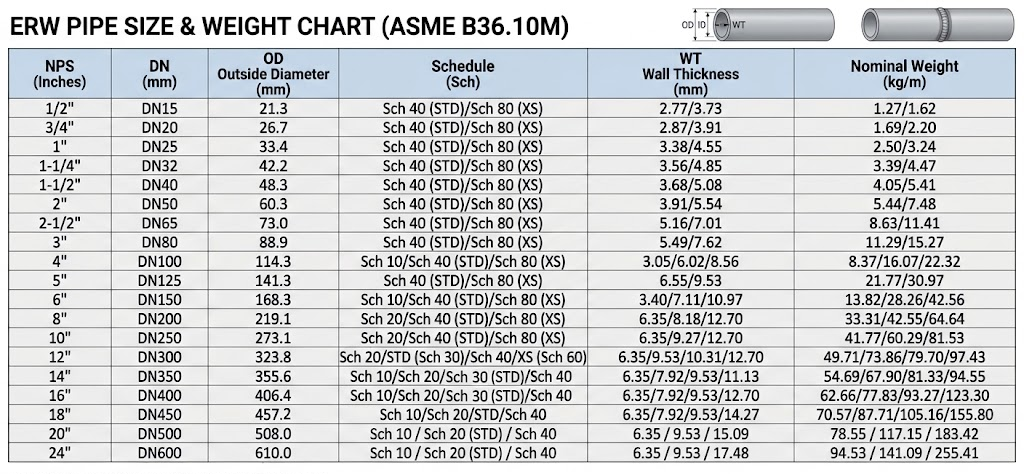
ERW (Electric Resistance Welded) steel pipe dimension chart typically provides key dimensional information for ERW steel pipes, including Nominal Pipe Size (NPS), Nominal Diameter (DN), Outside Diameter (OD), Wall Thickness (WT), Schedule (wall thickness class), and nominal weight per meter.
ERW steel pipes come in a wide variety of specifications, with a common size range spanning from 1/2 inch to 24 inches. Depending on specific technical requirements and applicable standards, various wall thicknesses are also available.
1. ERW Steel Pipe Dimension Chart (NPS, DN, OD, Wall Thickness, and Weight)
The dimensions of ERW steel pipes are generally defined by their Nominal Pipe Size (NPS), Outside Diameter (OD), and Wall Thickness (WT). Although both NPS and DN are used to denote nominal pipe size, they do not always correspond directly to the actual outside diameter. The actual dimensions depend on the applicable sizing standard and the specified wall thickness class (Schedule).
The ERW steel pipe dimension chart below provides reference dimensions for common sizes ranging from NPS 1/2 inch to 24 inches, covering various wall thickness classes, specific wall thickness values, and nominal weights.
2. Understanding ERW Steel Pipe Dimensions
Nominal Pipe Size (NPS) and DN:
NPS and DN are designations used to identify the nominal size of steel pipes. NPS is typically expressed in inches, while DN is expressed in millimeters. However, neither of these values should be confused with the actual outside diameter. For example, an "NPS 4" pipe has a nominal size of 4 inches, but its standard outside diameter is actually 114.3 mm, rather than 101.6 mm.
Outside Diameter (OD):
Outside Diameter refers to the measured distance across the pipe from one side of its outer surface to the other. For standard NPS pipe sizes, the outside diameter remains constant for a given nominal size, regardless of the wall thickness class (Schedule, abbreviated as "Sch"). For example, for an NPS 6 ERW steel pipe, the outside diameter (OD) is 168.3 mm, regardless of whether the wall thickness schedule is Sch 10, Sch 40, or Sch 80.
Wall Thickness (WT) and Schedule:
Wall thickness refers to the distance between the outer and inner surfaces of a steel pipe. It directly influences the pipe's inside diameter, cross-sectional area, weight, and structural load-bearing capacity. "Schedule" numbers—such as Sch 10, Sch 20, Sch 40, and Sch 80—are used to categorize standard pipe wall thicknesses. For a given Nominal Pipe Size (NPS), a higher schedule number generally indicates a thicker pipe wall.
|
Schedule
|
Wall Thickness (mm)
|
Nominal Weight (kg/m)
|
|
Sch 10
|
3.05
|
8.37
|
|
Sch 40
|
6.02
|
16.07
|
|
Sch 80
|
8.56
|
22.32
|
The nominal weight of a pipe is typically expressed in kilograms per meter (kg/m). It is based on the pipe's dimensions and material density, representing the theoretical weight of the pipe.
For carbon steel pipes, the common formula for calculating theoretical weight is:
W = 0.02466 × (OD − WT) × WT
Where:
W = Theoretical weight (kg/m)
OD = Outside diameter (mm)
WT = Wall thickness (mm)
0.02466 = An approximate coefficient derived based on a steel density of 7,850 kg/m³
For instance, for an NPS 4 Sch 40 steel pipe, the outside diameter is 114.3 mm and the wall thickness is 6.02 mm.
Its approximate theoretical weight is:
W = 0.02466 × (114.3 − 6.02) × 6.02
W ≈ 16.07 kg/m
This formula can be used for preliminary material estimation, transportation planning, and procurement calculations. The actual delivered weight may vary due to manufacturing tolerances and the specific product standards applied.
Frequently Asked Questions About ERW Steel Pipe Dimensions
1. What are the available size specifications for ERW steel pipes?
The nominal size range for ERW steel pipes is quite broad, depending on the manufacturing standards employed and the production capabilities of the supplier. Common sizes include NPS 1/2", 1", 2", 4", 6", 8", 10", and larger diameters. The reference table above covers various sizes ranging from NPS 1/2" to 24".
2. How is the weight of an ERW steel pipe calculated?
The theoretical weight per meter of a carbon steel pipe can be estimated using the following formula:
W = 0.02466 × (OD − WT) × WT
Where OD (outside diameter) and WT (wall thickness) are measured in millimeters, and W (weight) is expressed in kilograms per meter (kg/m). Multiplying the calculated weight per meter by the total length of the steel pipe provides an estimate of the total theoretical weight.
3. What is the difference between NPS and DN?
NPS (Nominal Pipe Size) is a sizing designation in inches, while DN (Nominal Diameter/Dimension) is a sizing designation in millimeters. Neither value is necessarily equal to the actual outside diameter. For example, NPS 4 corresponds to DN 100, which has a standard outside diameter of 114.3 mm.
Request a Quote for ERW Steel Pipes
Choosing the correct ERW pipe dimensions is an important step in ensuring compatibility with project design and installation requirements.
Central Steel supplies steel pipes for industrial, construction, and pipeline projects, with specifications evaluated according to applicable international standards and customer requirements.
If you are looking for ERW steel pipes in specific sizes, wall thicknesses, or material grades, contact our team with your technical requirements. We can help you review the specifications and identify suitable supply options.
Read more : Pressure Rating Chart for ERW Steel Pipes
 Central Steel


 Language
 English
 Español
 بالعربية
 sales@central-steels.com
 0086-731-8865-5017