ERW pipe is manufactured by forming a flat steel strip into a round shape, heating and joining the strip edges by electric resistance or high-frequency welding, removing the weld bead, sizing the pipe, and then performing inspection, testing, cutting, and finishing. Unlike seamless pipe, ERW pipe starts with flat-rolled steel coil and creates a longitudinal weld seam during the forming and welding process.
The typical ERW pipe manufacturing process includes steel coil preparation, strip forming, electric resistance welding, weld bead removal, sizing, heat treatment when required, nondestructive testing, hydrostatic testing, dimensional inspection, cutting, end finishing, marking, and packaging.
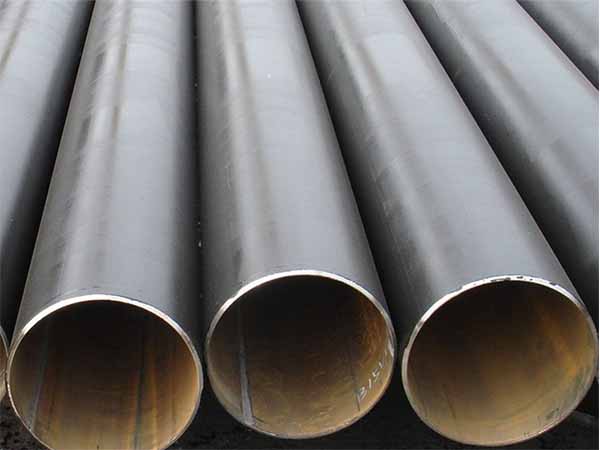
Raw Material Preparation: Steel Coil Selection
The ERW pipe manufacturing process starts with steel coils. These coils are produced according to specific chemical composition and mechanical property requirements defined by applicable standards.
Before forming begins, the steel coil is uncoiled and leveled to remove residual stress and shape deviation. Proper coil quality is critical, as defects in the raw material can directly affect weld integrity and final pipe performance.
Forming Process: From Flat Strip to Round Pipe
After leveling, the steel strip enters a series of forming rolls. These rolls gradually bend the flat strip into an open cylindrical shape. Unlike spiral welded pipes, ERW pipes are formed longitudinally, meaning the weld seam runs parallel to the pipe axis.
Accurate forming ensures that the strip edges align precisely before welding. Poor edge alignment can result in incomplete fusion or weld defects, making forming control a key quality factor.
High-Frequency Electric Resistance Welding
Once the strip edges are aligned, high-frequency electric current is applied. The resistance generated by the current heats the strip edges to a plastic or molten state. Mechanical pressure is then applied to forge the edges together, creating a solid longitudinal weld without the use of filler metal.
This welding method produces a narrow heat-affected zone and allows for high production efficiency. Welding parameters such as current frequency, heat input, and forging pressure are closely controlled to ensure weld strength and consistency.
Weld Bead Removal and Sizing
After welding, both the internal and external weld beads are typically removed using scarfing tools. This improves surface finish and dimensional accuracy, which is especially important for applications requiring tight tolerances.
The pipe then passes through sizing rolls that refine the outside diameter and roundness. Proper sizing ensures uniform wall thickness and improves pipe straightness.
Heat Treatment (When Required)
Depending on the standard and application, ERW pipes may undergo heat treatment such as normalizing or stress relieving. Heat treatment improves microstructure uniformity and reduces residual stress in the weld zone.
This step is particularly important for pressure applications or when required by specific material standards.
Inspection and Quality Control
Quality inspection is a critical part of the ERW pipe manufacturing process. Common inspection methods include:
- Eddy current or ultrasonic testing for weld integrity
- Hydrostatic pressure testing
- Dimensional inspection
- Visual surface inspection
These inspections ensure that the finished pipe meets mechanical, dimensional, and performance requirements.
Cutting, Finishing, and Packaging
After inspection, ERW pipes are cut to fixed or random lengths based on customer requirements. End finishing such as beveling or plain ends may be applied. Pipes are then surface treated, marked, bundled, and prepared for shipment.
Proper finishing and packaging help protect the pipe during transportation and storage.
How Manufacturing Affects ERW Pipe Applications
The manufacturing process directly influences where ERW pipes can be used. Due to their consistent wall thickness and smooth surface finish, ERW pipes are commonly used in water transmission, structural applications, and low to medium pressure pipelines.
ERW Pipe Manufacturing vs Other Pipe Types
Compared with seamless pipe manufacturing, ERW production offers higher efficiency and lower material waste. Compared with spiral welded pipes, ERW pipes provide better dimensional accuracy for small to medium diameters.
ERW Pipe vs. Seamless, LSAW and SSAW Pipe
|
Feature
|
ERW Pipe
|
Seamless Pipe
|
LSAW Pipe
|
SSAW Pipe
|
|
Starting Material
|
Steel coil/strip
|
Steel billet
|
Steel plate
|
Steel coil
|
|
Weld Seam
|
Longitudinal
|
None
|
Longitudinal
|
Spiral
|
|
Manufacturing Efficiency
|
High
|
Lower
|
Moderate
|
High
|
|
Dimensional Accuracy
|
Generally high
|
High
|
High
|
Moderate to high
|
|
Typical Size Range
|
Small to medium diameters
|
Wide range
|
Medium to large diameters
|
Large diameters
|
|
Typical Applications
|
Water, structural, mechanical, pipelines
|
High-pressure and demanding services
|
Oil & gas, large pipelines
|
Water transmission, piling, large-diameter pipelines
|
|
Main Advantage
|
Efficient production and good dimensional consistency
|
No weld seam
|
Suitable for large-diameter pipe
|
Efficient production of large-diameter pipe
|
Frequently Asked Questions About ERW Pipe Manufacturing
1. How is ERW pipe manufactured?
ERW pipe is manufactured by forming flat steel strip into a cylindrical shape and joining the longitudinal edges using electric resistance or electric-induction welding. After welding, the pipe is sized, inspected, tested, cut, finished, marked, and packaged.
2. What is the raw material for ERW pipe?
The primary raw material for ERW pipe is flat-rolled steel coil or strip. The material grade, thickness, width, and chemical composition are selected according to the required pipe specification.
3. Does ERW pipe have a weld seam?
Yes. ERW pipe has a longitudinal weld seam running parallel to the pipe axis. The seam is created when the two edges of the formed steel strip are joined during the welding process.
4. What is the difference between ERW and HFW pipe?
ERW refers to electric resistance welding, while HFW refers to high-frequency welding. Modern ERW pipe production commonly uses high-frequency electrical current, so the terms are closely related, but they describe slightly different aspects of the manufacturing process.
Conclusion
The ERW pipe manufacturing process combines precise forming, high-frequency welding, controlled heat treatment, and strict inspection to produce reliable welded steel.
 Central Steel


 Language
 English
 Español
 بالعربية
 sales@central-steels.com
 0086-731-8865-5017