 Central Steel
Central Steel
Central Steel
Central Steel
Central Steel
EN 10219 ERW pipe refers to cold-formed welded structural hollow sections manufactured to the EN 10219 standard, rather than a general-purpose pressure pipe. The standard covers circular, square, and rectangular hollow sections used mainly for structural applications. EN 10219-1 specifies technical delivery conditions, while EN 10219-2 covers dimensions, tolerances, and sectional properties. Common grades include S235JRH, S275J0H, S275J2H, S355J0H, and S355J2H.
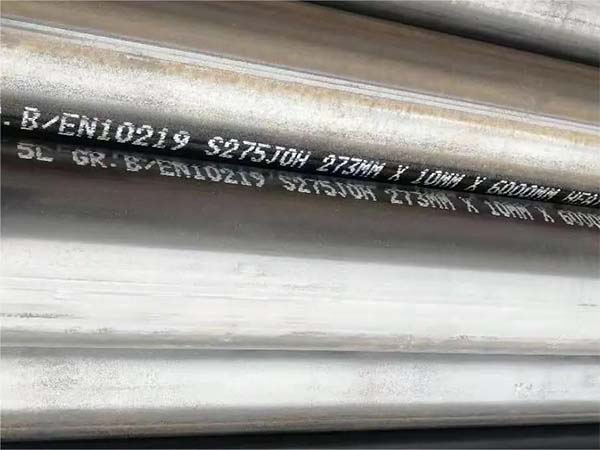
Standard EN 10219 specifies cold-formed welded hollow steel sections made of non-alloy steel and fine-grained steel. ERW steel pipes produced in accordance with this standard usually include circular, square and rectangular cross-sections. The manufacturing process involves rolling steel strips into the required shape and then performing resistance welding with high-frequency current to obtain pipes with uniform wall thickness, precise dimensions and smooth surface.
EN 10219 steel grades
EN 10219 includes several structural steel grades. The most commonly specified grades for welded hollow sections include S235JRH, S275J0H, S275J2H, S355J0H, and S355J2H.
|
Grade |
Minimum yield strength* |
Impact designation |
Typical use |
|
S235JRH |
235 MPa |
JR: 27 J at +20°C |
General structural applications |
|
S275J0H |
275 MPa |
J0: 27 J at 0°C |
Structural frames and machinery |
|
S275J2H |
275 MPa |
J2: 27 J at -20°C |
Structures requiring improved low-temperature toughness |
|
S355J0H |
355 MPa |
J0: 27 J at 0°C |
Heavy structural applications |
|
S355J2H |
355 MPa |
J2: 27 J at -20°C |
Heavy structures and demanding service conditions |
*Yield strength values depend on product thickness. For example, EN 10219 material tables specify reductions in minimum yield strength for thicker sections.
The designation also provides useful information about the material. The number 235, 275, or 355 refers to the nominal minimum yield strength in MPa for the relevant thickness range. JR, J0, and J2 identify different impact toughness requirements, while H indicates a hollow section.
For example, S355J2H is a structural hollow section grade with a nominal 355 MPa yield strength for the applicable thickness range and a specified impact toughness requirement at -20°C.
EN 10219 ERW Steel Pipe Manufacturing Process
The typical manufacturing process for EN 10219 ERW (High-Frequency Electric Resistance Welded) hollow sections involves the following stages:
1. Steel Coil Preparation
Steel strips or coils with specified chemical compositions and mechanical properties are prepared for forming. Material grades are selected based on the structural requirements of the project.
2. Cold Forming
The steel strip is progressively formed into a circular, square, or rectangular hollow section at ambient temperature.
3. ERW Welding
For ERW products, the longitudinal edges of the steel strip are joined using the electric resistance welding process. Welding parameters are controlled to ensure the formation of a continuous and uniform weld seam.
4. Sizing
After welding, the section passes through sizing equipment to achieve the specified external dimensions and cross-sectional geometry.
5. Cutting and Inspection
The hollow sections are cut to the specified lengths and inspected for dimensional accuracy, weld seam quality, surface condition, and other requirements.
EN 10219 vs EN 10210
|
Feature |
EN 10219 |
EN 10210 |
|
Product type |
Cold-formed welded structural hollow section |
Hot-finished structural hollow section |
|
Typical manufacturing condition |
Formed cold |
Hot finished or otherwise supplied according to EN 10210 requirements |
|
Cross-sections |
Circular, square, rectangular; current development also addresses elliptical sections |
Circular, square, rectangular; hot-finished sections |
|
Main standard parts |
EN 10219-1 and EN 10219-2 |
EN 10210-1 and EN 10210-2 |
|
Main focus |
Delivery conditions, dimensions, tolerances and sectional properties |
Delivery conditions, dimensions, tolerances and sectional properties |
|
Structural design |
Sectional properties must be taken from the applicable standard |
Sectional properties must be taken from the applicable standard |
An important point is that equivalent steel grades do not automatically mean equivalent structural sectional properties. EN 10219-2 and EN 10210-2 specify different sectional properties for square and rectangular hollow sections. Therefore, engineers should use the properties corresponding to the actual product standard rather than substituting one standard for the other.
EN 10219 ERW pipe FAQ
1. What is EN 10219 ERW pipe?
EN 10219 ERW pipe is a cold-formed welded structural hollow section manufactured according to the EN 10219 standard. It can have a circular, square, or rectangular cross-section and is mainly used for structural applications.
2. What grades are available under EN 10219?
Common EN 10219 grades include S235JRH, S275J0H, S275J2H, S355J0H, and S355J2H. The appropriate grade depends on the required yield strength, impact toughness, thickness, temperature, and structural design conditions.
3. What is the difference between S355J2H and S235JRH?
The main difference is the specified strength level and impact toughness designation. S355J2H has a nominal 355 MPa yield strength for the applicable thickness range and J2 impact requirements at -20°C, while S235JRH has a nominal 235 MPa yield strength and JR impact requirements at +20°C.


 Language
 English
 Español
 بالعربية
 sales@central-steels.com
 0086-731-8865-5017