ERW (Electric Resistance Welded) steel pipe offers several important advantages, including consistent dimensions, efficient production, smooth surfaces, and competitive cost. It is widely used for water transmission, gas pipelines, structural applications, piling, and general industrial piping.
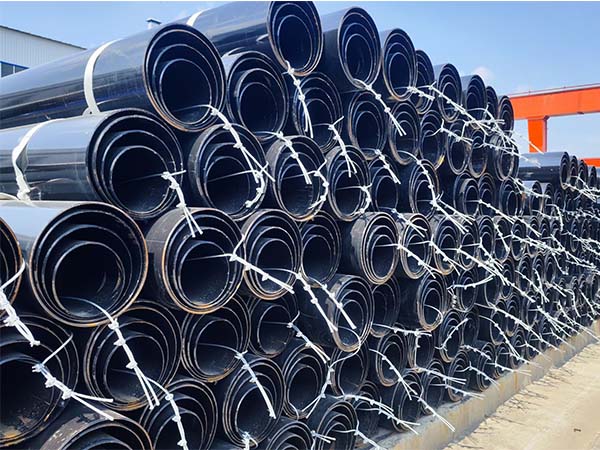
What is ERW Steel Pipe?
ERW is an abbreviation for "Electric Resistance Welding". The manufacturing process of ERW steel pipe does not require any filler metal. It involves rolling a flat steel strip or plate into a cylindrical shape, then using the resistance heat generated by high-frequency current (modernly often called HFW high-frequency straight seam welding) to heat the edges of the pipe to a molten state, and finally achieving perfect fusion through mechanical extrusion.
Four Core Advantages of ERW Steel Pipes
1. High Dimensional Accuracy
Because ERW steel pipes are formed by cold bending precision-rolled flat steel coils or plates, the thickness tolerance of the raw material is extremely small. Compared to the "eccentricity" or uneven wall thickness problems that easily occur in the piercing process of seamless steel pipes, ERW steel pipes have extremely uniform wall thickness, which is highly advantageous for pipeline connection and fluid calculation.
2. Superior Surface Finish
ERW steel pipes have relatively smooth inner and outer surfaces. This smooth inner wall not only reduces frictional resistance during fluid transmission but also provides a good adhesion base for subsequent internal
anti-corrosion coatings (such as FBE, 3PE).
3. Fast Lead Time
ERW steel pipe continuous production lines are extremely efficient. They can deliver large quantities in a short time and can flexibly customize various non-standard lengths (such as extra-long pipeline pipes), greatly shortening the procurement waiting time for engineering projects.
4. Significant Cost-Effectiveness
ERW steel pipes do not require complex piercing and heating processes, resulting in high material utilization. For the same outer diameter and wall thickness, the procurement cost of ERW steel pipes is typically 15% to 30% lower than that of seamless steel pipes. This translates to substantial budget savings in large-scale applications such as long-distance water transport and structural pipework.
Limitations and Disadvantages of ERW Steel Pipes
Despite the advanced nature of modern high-frequency welding (HFW) technology, ERW steel pipes still exhibit some significant limitations due to the inherent physical characteristics of the process:
1. Weaknesses in the Weld Seam and Heat-Affected Zone (HAZ)
Regardless of welding techniques, the metallographic structure of the weld seam and heat-affected zone (HAZ) is altered. Without rigorous post-weld heat treatment (PWHT), the toughness of this area will be lower than that of the base metal. Under extreme external forces or corrosive environments, the weld seam is often the first point of failure.
2. Lower Pressure Rating
Due to the presence of welds, the overall structural integrity of ERW steel pipes is inherently weaker than that of seamless steel pipes. In relevant ASME and API design codes, the safety factor for ERW steel pipes usually needs to be discounted, making them unsuitable for ultra-high pressure and ultra-high temperature environments (such as high-pressure boiler tubes).
3. Limitations on the Ratio of Outer Diameter to Wall Thickness
ERW technology makes it difficult to manufacture "extremely thick-walled" steel pipes. When the pipe wall is too thick, high-frequency current cannot penetrate the edges evenly, easily leading to welding defects. Therefore, for requirements of "small diameter and ultra-large wall thickness," seamless steel pipes are usually the only option.
When to Choose Which Pipe?
Scenarios for Choosing ERW Steel Pipes:
Municipal water supply and drainage systems, heating networks: Moderate pressure, large usage, significant cost savings.
Building structural support and piling: Excellent wall thickness uniformity ensures uniform load-bearing capacity.
Low-pressure natural gas transmission and oilfield gathering: Modern API 5L ERW line pipes (after flaw detection and heat treatment) fully meet these safety requirements.
Projects requiring high-quality anti-corrosion coatings: A smooth surface maximizes the lifespan of 3PE or FBE anti-corrosion coatings.
Scenarios where seamless steel pipes are chosen:
High-temperature, high-pressure pipelines in refineries and chemical plants (e.g., catalytic cracking units).
High-pressure boiler heat exchanger systems.
Offshore deepwater oil and gas exploration: The immense external pressure in deep water requires pipes with absolute structural integrity.
ERW Pipe Frequently Asked Questions (FAQ)
Q: Can modern ERW steel pipes replace seamless steel pipes?
A: In low-to-medium pressure and normal temperature applications, ERW steel pipes, after rigorous quality control (e.g., 100% ultrasonic flaw detection and medium-frequency annealing of welds), have widely replaced seamless steel pipes, not only meeting performance standards but also offering lower costs. However, under extreme temperature, high pressure, or highly toxic media conditions, the position of seamless steel pipes remains unshakable.
Q: How can I determine if the weld quality of the ERW steel pipe I purchased is reliable?
A: High-quality ERW pipes must undergo two key processes before leaving the factory: Non-destructive testing (NDT) (such as hydrostatic testing and ultrasonic UT testing to detect weld defects) and post-weld heat treatment (PWHT) (to eliminate welding stress and restore material toughness). When purchasing, be sure to request a Material Certificate (MTC) from the supplier with records of these tests.
Q: What is the difference between
ERW and EFW pipes?
A: ERW is resistance welding (heating by its own resistance) without the addition of welding wire; while EFW is electrofusion welding (such as submerged arc welding, SAW), requiring the addition of external filler metal (welding wire).
Summary
ERW steel pipes have very distinct advantages and disadvantages: they dominate the low- and medium-pressure transmission and structural application market with their perfect wall thickness, excellent surface finish, and extremely high cost-effectiveness; however, in high-pressure and high-temperature applications that challenge the limits of physics, their weld structure remains an inherent weakness.
 Central Steel


 Language
 English
 Español
 بالعربية
 sales@central-steels.com
 0086-731-8865-5017