 Central Steel
Central Steel
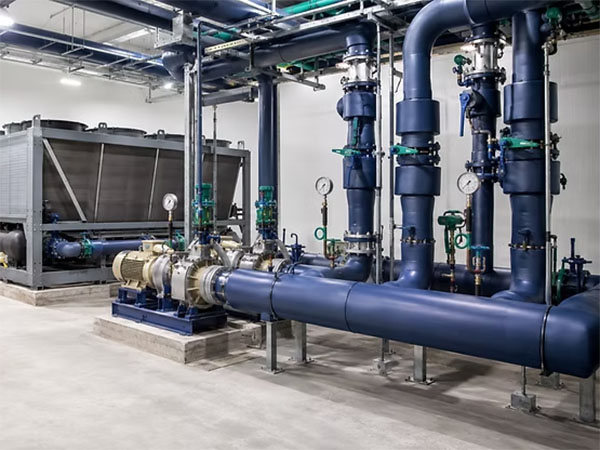
A complete chilled water piping system consists of several interconnected components. Each component serves a specific function, ensuring the maintenance of water circulation, heat transfer, and overall system stability.
|
Component |
Main Function |
|
Chiller |
Removes heat from circulating water and produces chilled water |
|
CHWS Pipe |
Delivers chilled water from the chiller to cooling equipment |
|
CHWR Pipe |
Returns warmer water from cooling equipment to the chiller |
|
Chilled Water Pump |
Provides the pressure and flow required for water circulation |
|
AHU (Air Handling Unit) |
Uses chilled water coils to cool and dehumidify air |
|
FCU (Fan Coil Unit) |
Uses chilled water to provide localized space cooling |
|
Valves |
Control, isolate, and regulate water flow |
|
Pipe Fittings |
Connect pipes and change flow direction or pipe diameter |
|
Expansion Tank |
Accommodates changes in water volume caused by temperature variations and helps maintain system pressure |
|
Air Separator |
Removes entrained air from circulating water |
|
Strainer |
Removes debris and particles to protect pumps and other equipment |
How does a chilled water piping system operate?
A chilled water piping system functions through continuous water circulation and heat exchange. A chiller produces chilled water, which is transported via supply piping to cooling equipment; the water, having absorbed heat, is then returned to the chiller through return piping.
1. Chilled Water Production
The chiller removes heat from the circulating water via its evaporator. Before entering the distribution network, the chilled water is adjusted to the required supply temperature.
2. Chilled Water Distribution
Circulation pumps drive the chilled water through supply piping (CHWS lines) to various cooling zones or industrial equipment. Depending on the system configuration, the chilled water may be distributed via a primary circuit, a secondary circuit, or a variable-flow distribution network.
3. Heat Exchange
When the chilled water reaches an air handling unit (AHU), fan coil unit (FCU), or industrial heat exchanger, it absorbs heat from the surrounding air or process fluid.
For example, in an air handling unit (AHU), warm air flows across a chilled water coil. Heat is transferred from the air to the water, lowering the air temperature, while the temperature of the chilled water itself rises.
4. Chilled Water Return
After absorbing heat, the water—now at a higher temperature—flows back to the chiller through return piping (CHWR lines).
5. Re-cooling and Recirculation
The chiller rejects the absorbed heat, lowering the water temperature once again. The chilled water is then circulated back through the supply piping, repeating the entire cooling cycle.
Through this continuous process, a chilled water system provides consistent cooling for building facilities and industrial production activities.
What is the most critical component of a chilled water piping system?
The piping network is one of the most essential parts of a chilled water system; its function is to transport chilled water from the chiller unit to cooling equipment and return the warmed water for re-cooling. Without a well-designed piping network, the system cannot effectively deliver cooling capacity or maintain a continuous water circulation.
The chilled water supply (CHWS) piping carries chilled water from the chiller to air handling units (AHUs), fan coil units (FCUs), and industrial heat exchangers, where the water absorbs heat from the surrounding air or process fluids. Subsequently, the chilled water return (CHWR) piping transports the warmed water back to the chiller to be cooled again.
As the primary distribution network, chilled water piping directly influences water flow rates, pressure loss, heat exchange efficiency, and the overall reliability of the system. Therefore, when selecting pipe materials, diameters, wall thicknesses, connection methods, and anti-corrosion measures, it is essential to carefully consider the system's operating conditions and the specific requirements of the project. Carbon steel piping, valued for its high mechanical strength, wide range of available sizes, and suitability for welding and flanged connections, is extensively used in various commercial and industrial chilled water systems.
Frequently Asked Questions (FAQ)
1. What are the two main pipes in a chilled water system?
The two main pipelines are CHWS (Chilled Water Supply) and CHWR (Chilled Water Return). CHWS delivers chilled water to cooling equipment, while CHWR returns warmer water to the chiller after heat absorption.
2. What pipe materials are used in chilled water systems?
Common materials include carbon steel, stainless steel, copper, HDPE, and certain plastic piping materials. The final selection depends on operating pressure, temperature, pipe diameter, corrosion conditions, and installation environment.
3. Why are carbon steel pipes used in chilled water systems?
Carbon steel pipes offer high mechanical strength, a wide range of available dimensions, and flexible connection options. They are commonly considered for commercial HVAC and industrial chilled water distribution systems, provided suitable corrosion protection is included in the design.
Summary
Chilled water piping is a vital component of centralized HVAC and industrial cooling infrastructure. By connecting the chiller unit to cooling equipment through supply and return lines, it enables the continuous circulation of chilled water, thereby removing heat from buildings or industrial processes.
Read more: What is the best pipe material for chilled water? or Carbon steel pipe for chilled water


 Language
 English
 Español
 بالعربية
 sales@central-steels.com
 0086-731-8865-5017