Seamless rectangular tubes are steel pipes with a rectangular cross-sectional area, manufactured through a seamless process and without weld seams. It is usually made of high-quality carbon steel, alloy steel and stainless steel, featuring excellent strength, precision and corrosion resistance.
Seamless rectangular tubes are formed by directly piercing solid round steel through hot or cold rolling processes during the manufacturing process. The internal metal structure is dense, capable of withstanding higher pressure and stress, and is suitable for engineering projects with high structural strength requirements.
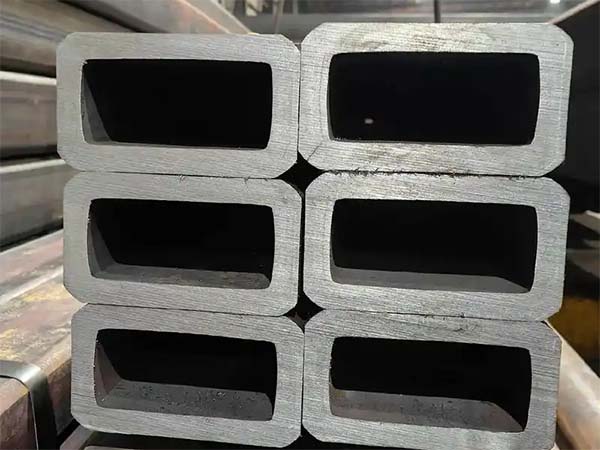
The manufacturing process of seamless rectangular tubes
The production of seamless rectangular tubes generally includes the following steps:
Heating of round steel
Heat the solid round steel billet to an appropriate temperature to make it have good plasticity.
Perforation (Piercing)
The heated steel billet is punched through the central hole by a punching machine to form a hollow tube.
Elongation & Sizing
The rough tubes are subjected to multiple deformations using rolling mills or cold drawing machines to control the wall thickness and dimensional accuracy.
Shaping to Rectangle
The round pipe is rolled into a rectangular cross-section through a special die to ensure that the edges and corners are straight and the dimensions are uniform.
Heat Treatment & Straightening
Annealing or normalizing the pipe material is carried out to improve its mechanical properties and straighten it.
Testing
Ensure the absence of cracks and defects through non-destructive testing methods such as ultrasonic waves and eddy currents.
Seamless rectangular tube vs. welded rectangular tube
The main difference is the manufacturing method. Seamless rectangular tubes are produced from seamless tubular material, while welded rectangular tubes are generally formed from steel strip or plate and joined along a longitudinal seam.
|
Feature
|
Seamless rectangular tube
|
Welded rectangular tube
|
|
Weld seam
|
None
|
Longitudinal weld seam
|
|
Manufacturing route
|
Seamless tube + forming
|
Strip/plate forming + welding
|
|
Material uniformity
|
No weld zone
|
Includes a welded joint
|
|
Dimensional availability
|
Often more limited
|
Generally broader
|
|
Production efficiency
|
More complex
|
Generally more efficient for large-volume production
|
|
Typical applications
|
Mechanical components, demanding structural or engineering applications
|
Structural frames, fabrication, construction and general engineering
|
|
Selection basis
|
Material, dimensions, standard and service requirements
|
Material, dimensions, weld quality and applicable standard
|
The main features and advantages of seamless structures
No Weld Seam structure: Higher structural integrity, avoiding the risk of stress concentration and corrosion at the weld seam.
High Strength & Pressure Resistance: Suitable for high-pressure fluids, structural supports and other applications.
Tight Dimensional Tolerance: Especially for cold-drawn products, the dimensional tolerance is small and the surface finish is high.
Excellent Mechanical Properties: It has a relatively high yield strength, tensile strength and elongation.
Versatile Application: It can be used in fields such as structure, machinery, automobiles, energy, and construction.
The specification representation of seamless rectangular tubes is usually: outer diameter (long side) × outer diameter (short side) × wall thickness (mm)
For example:
100×50×4mm
This indicates that the external cross-section of the pipe is rectangular, with the long side being 100mm, the short side 50mm, and the wall thickness 4mm.
Common specification ranges
Outer diameter (long side) : 20mm - 600mm
Outer diameter (short side) : 10mm - 400mm
Wall Thickness: 2mm - 50mm
Length: 4m - 12m (Customizable length upon request)
Common materials
Carbon Steel: such as ASTM A500 Gr.B, A513, ST52, Q235B, Q345B.
Alloy Steel: such as 20Cr, 40Cr, 15CrMo, 12Cr1MoV.
Stainless Steel: such as 304, 316L, 321, 310S.
Common application fields
Structural Engineering
It is used for building frames, steel structure supports, bridge structures, and mechanical skeletons.
Automotive and Machinery:
Used for mechanical arms, frames, and hydraulic system components.
Energy & Power:
Petroleum, natural gas, heat exchangers, boiler systems.
Construction & Fabrication:
It is used for factory steel structures, scaffolding, equipment supports and processed parts.
Furniture & Decoration
It is widely used in high-end furniture, railings, guardrails and other fields.
Why choose seamless rectangular tubes?
Choosing seamless rectangular tubes means higher safety, stability and durability.
In demanding industrial environments, such as high-pressure systems and mechanical load structures, the uniform force distribution and fatigue resistance of seamless rectangular tubes can effectively reduce risks and extend service life.
FAQ about seamless rectangular tubes
What is a seamless rectangular tube?
A seamless rectangular tube is a hollow rectangular steel section manufactured without a longitudinal welded seam. It is generally produced from seamless tubular material that is formed into a rectangular cross-section.
How is a seamless rectangular tube made?
A typical process involves heating a steel billet, piercing it into a hollow tube, hot working or cold finishing, forming the round tube into a rectangular shape, sizing, straightening, heat treatment when required, and final inspection.
Is a seamless rectangular tube stronger than a welded rectangular tube?
Not necessarily. Seamless construction eliminates the longitudinal weld seam, but overall performance depends on the steel grade, dimensions, wall thickness, manufacturing condition, heat treatment and applicable standard. A welded tube manufactured to an appropriate specification can also provide the required mechanical performance.
Conclusion
Seamless rectangular tubes are rectangular hollow steel sections manufactured without a longitudinal weld seam. They are mainly selected for mechanical, structural and engineering applications where the combination of rectangular geometry, material properties and seamless construction meets the project requirements.
 Central Steel


 Language
 English
 Español
 بالعربية
 sales@central-steels.com
 0086-731-8865-5017