A hot rolled seamless pipe is a steel pipe manufactured without a weld seam by heating a solid steel billet to a high temperature, piercing it to form a hollow tube, and then rolling, sizing, straightening, and inspecting it. Compared with cold-rolled or cold-drawn seamless pipes, hot rolled seamless pipes generally offer higher production efficiency, a wider size range, and good strength and toughness, making them suitable for oil and gas, industrial piping, mechanical engineering, structural applications, boilers, and other demanding services.
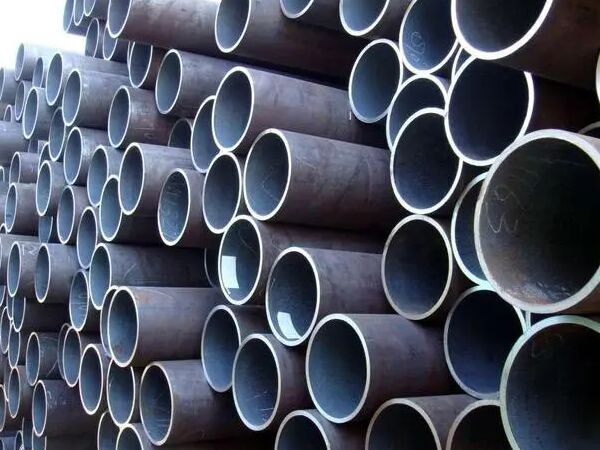
What Is Hot Rolled Seamless Pipe?
Hot rolled seamless pipe is a type of seamless steel pipe produced through a high-temperature forming process. Unlike welded steel pipe, it is not made by joining a steel plate or strip with a longitudinal or spiral weld.
The manufacturing process starts with a solid round steel billet. The billet is heated to a suitable temperature and pierced to create a hollow tube. The hollow tube is then rolled and sized to achieve the required outside diameter and wall thickness.
Because the pipe is formed at elevated temperatures, the steel is easier to deform and process. This makes hot rolling particularly suitable for producing seamless pipes with relatively large diameters and thick walls.
How Is Hot Rolled Seamless Pipe Manufactured?
The typical manufacturing process includes the following steps:
1. Billet Preparation
A solid round steel billet is selected according to the required steel grade and pipe specification. The billet is inspected and cut to the required length before heating.
2. Billet Heating
The billet is heated in a furnace to the appropriate hot-working temperature. Heating makes the steel sufficiently plastic for the piercing and rolling operations.
3. Piercing
The heated billet passes through a piercing mill, commonly using a rotary piercing process. A solid billet is transformed into a hollow tube.
This is the key step that differentiates seamless pipe production from welded pipe production.
4. Hot Rolling
The hollow shell passes through one or more rolling mills to reduce its wall thickness and increase its length. The rolling process also helps achieve the required pipe dimensions and mechanical properties.
5. Sizing and Reducing
The pipe is processed through sizing or reducing equipment to obtain the specified outside diameter and dimensional characteristics.
6. Cooling and Straightening
After rolling and sizing, the pipe is cooled and then straightened to meet the required straightness and dimensional requirements.
7. Inspection and Finishing
Depending on the applicable specification and customer requirements, the finished pipe may undergo dimensional inspection, visual inspection, mechanical testing, hydrostatic testing, and non-destructive testing.
The actual manufacturing route varies according to the steel grade, pipe size, wall thickness, applicable standard, and required properties. Central Steel's seamless pipe manufacturing guide also describes hot rolling as one of the principal manufacturing routes for seamless steel pipes.
Hot Rolled Seamless Pipe vs. Cold Rolled Seamless Pipe
The main difference between hot rolled and cold rolled seamless pipes is the manufacturing temperature and the resulting dimensional and surface characteristics.
|
Feature
|
Hot Rolled Seamless Pipe
|
Cold Rolled / Cold Drawn Seamless Pipe
|
|
Manufacturing temperature
|
Formed at elevated temperature
|
Further processed at or near room temperature
|
|
Production route
|
Heating, piercing, hot rolling, sizing
|
Usually starts with hot-rolled tube followed by cold working
|
|
Dimensional accuracy
|
Good, but generally lower than cold worked pipe
|
Higher dimensional accuracy
|
|
Surface finish
|
Generally rougher
|
Smoother and more uniform
|
|
Size capability
|
Suitable for a wide range of sizes, including larger sizes
|
Particularly suitable for smaller and precision sizes
|
|
Wall thickness
|
Suitable for relatively thick walls
|
Suitable for thin-wall and precision applications
|
|
Production efficiency
|
Generally higher for large-volume production
|
More processing-intensive
|
|
Cost
|
Generally more economical for many standard applications
|
Usually higher due to additional processing
|
|
Typical applications
|
Oil & gas, industrial piping, structural and mechanical applications
|
Precision machinery, hydraulic systems, instrumentation and other applications requiring tight tolerances
|
Applications of Hot Rolled Seamless Pipe
Oil and Gas
Hot rolled seamless pipes are used in oil and gas applications where appropriate grades and specifications are required for fluid transportation and other pipeline or equipment applications.
Boilers and Heat Exchangers
Specific seamless pipe grades designed for elevated-temperature service can be used in boilers, heat exchangers, and related equipment.
Mechanical Engineering
Hot rolled seamless tubes are used for mechanical components, machinery, equipment, and structural applications where suitable mechanical properties and dimensions are required.
Construction and Structural Applications
Seamless steel pipes can be used in structural components, supports, columns, and other engineering applications.
Industrial Piping
Depending on the material grade and applicable standard, hot rolled seamless pipes can be used for industrial fluid transportation and process piping systems.
How to Choose the Right Hot Rolled Seamless Pipe?
When purchasing hot rolled seamless pipe, consider the following factors:
Application: Determine whether the pipe will be used for fluid transportation, structural purposes, mechanical equipment, boiler service, or another application.
Steel grade: Select the material according to the required strength, temperature, corrosion resistance, and service conditions.
Standard: Confirm the applicable ASTM, API, EN, or other international specification.
Outside diameter and wall thickness: These dimensions should match the system design and operating requirements.
Schedule: For standard carbon steel piping, the required pipe schedule should be clearly specified where applicable.
Testing requirements: Determine whether hydrostatic testing, ultrasonic testing, eddy current testing, or other inspection is required.
Surface and end condition: Confirm whether plain ends, beveled ends, threaded ends, or special finishing is required.
Heat treatment: For certain grades and services, heat treatment requirements are critical to achieving the required mechanical properties.
Frequently Asked Questions About Hot Rolled Seamless Pipe
1. What is a hot rolled seamless pipe?
A hot rolled seamless pipe is a steel pipe manufactured without welding by heating a solid billet, piercing it to form a hollow tube, and then hot rolling and sizing it to the required dimensions.
2. Is hot rolled seamless pipe better than cold rolled seamless pipe?
Neither is universally better. Hot rolled seamless pipe is generally preferred for larger sizes, thicker walls, efficient production, and general industrial applications, while cold rolled or cold drawn seamless pipe is preferred when high dimensional accuracy, thin walls, or a better surface finish is required.
3. What is the difference between hot rolled and cold rolled seamless pipe?
The main difference is the manufacturing process. Hot rolled seamless pipe is formed at elevated temperatures, while cold rolled or cold drawn seamless pipe undergoes additional cold working after the initial hot-rolled tube has been produced. Cold working generally improves dimensional accuracy and surface finish.
4. Does hot rolled seamless pipe have a weld?
No. A seamless pipe is manufactured from a solid billet and does not have a longitudinal or spiral welded seam.
In summary:
Hot-rolled seamless pipe is an important part of many industries and applications, it has high strength, high pressure and high temperature resistance, suitable for a variety of industrial scenarios, especially in high temperature and high pressure demanding environments. Although its surface quality and dimensional accuracy are not as good as cold-rolled seamless pipes, it has obvious advantages in carrying capacity and processing convenience. It provides a reliable and efficient option for industries that require high quality steel pipes.
Read more: What is seamless steel pipe? or What is hot rolling process?
 Central Steel


 Language
 English
 Español
 بالعربية
 sales@central-steels.com
 0086-731-8865-5017