Seamless steel tube has evolved from a basic industrial tube into a high-The development of seamless steel tubes can be broadly divided into four stages: the invention of rotary piercing technology in the late 19th century, the expansion of hot-rolling and cold-rolling technologies in the 20th century, the development of high-performance materials and automated production in the late 20th and early 21st centuries, and the current transition toward intelligent, sustainable, and customized manufacturing.
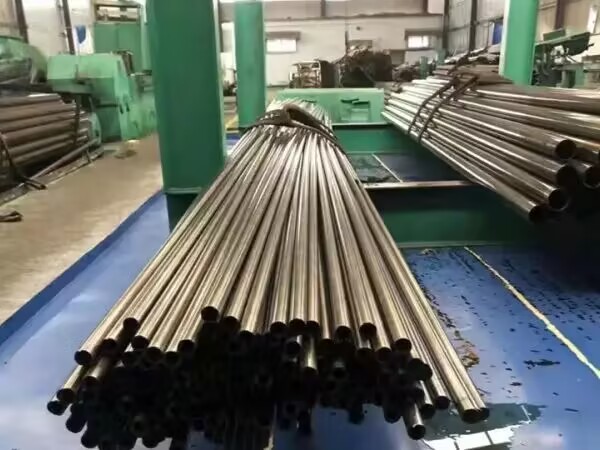
1. Historical development of seamless steel tubes
Early stage
1) Background
The advent of seamless steel tubes can be traced back to the Industrial Revolution. In the early 19th century, the booming industrial development in Europe and America created increasing demand for high-performance tubular materials, laying the foundation for the emergence of seamless steel tubes.
2) The invention of piercing technology
In 1885, German brothers Reinhard and Max Mannesmann invented the “skew roll piercing process” and developed the two-roll skew rolling piercing machine, which mechanically produced seamless steel tubes.
This invention marked the birth of the modern seamless steel tube industry.
In 1886, the Mannesmann brothers patented their technique and established the first seamless steel tube manufacturing plant in Germany. By 1891, they had also invented the pilger rolling mill.
Growth stage
1) Industrial demand
By the late 19th century, the rise of steam locomotives and boilers required large quantities of high-quality seamless steel tubes, driving their mass production.
2) Introduction of hot rolling technology
In the early 20th century, seamless steel tube manufacturing entered the hot rolling stage.
In 1903, Swiss engineer R.C. Stiefel invented the automatic pipe mill (also known as the plug rolling mill). Over time, continuous rolling mills and push benches emerged, laying the foundation for the modern seamless steel tube industry.
Development stage
1) Technological innovations
In the 1930s, the introduction of the three-roll pipe mill, extrusion machines, and pilger cold rolling mills improved the variety and quality of steel tubes.
By the 1960s, advancements in continuous rolling mills, three-roll piercing machines, and tension reducing mills, combined with the success of continuous casting, greatly enhanced production efficiency.
2) Material upgrades
The introduction of alloy and stainless steel provided seamless steel tubes with superior corrosion resistance and heat resistance.
By the 1970s, seamless steel tubes and welded pipes were competing neck-and-neck, with global steel tube production increasing by more than 5% annually.
Modern stage
1) High-performance applications
In the early 21st century, breakthroughs in materials science enabled the widespread use of high-strength, high-toughness seamless steel tubes in nuclear power and aerospace.
2) Automated manufacturing
Automated production lines, online non-destructive testing, and quality traceability systems were adopted, achieving unprecedented levels of production efficiency and quality control.
Key Milestones in Seamless Steel Tube Development
|
Period
|
Major Development
|
Impact on Seamless Steel Tube
|
|
Early 19th century
|
Industrial Revolution
|
Created increasing demand for high-performance tubular materials
|
|
1885
|
Mannesmann skew-roll piercing process
|
Established the foundation of modern seamless tube production
|
|
1886–1891
|
Mannesmann patents and Pilger development
|
Improved industrial production of seamless tubes
|
|
Early 20th century
|
Automatic and plug rolling mills
|
Increased production efficiency and tube length
|
|
1930s
|
Three-roll mills, extrusion, cold rolling
|
Improved product range and dimensional accuracy
|
|
1960s
|
Continuous rolling, tension reduction, continuous casting
|
Increased production efficiency and consistency
|
|
Late 20th century
|
Alloy and stainless steel development
|
Expanded applications into high-temperature and corrosive environments
|
|
21st century
|
Automation and online inspection
|
Improved quality control and production efficiency
|
|
Current stage
|
AI, digitalization, advanced materials, sustainability
|
Drives intelligent and low-carbon seamless tube manufacturing
|
2. Technological progress in seamless steel tubes
Manufacturing process upgrades
1) Rotary piercing technology
Transitioned from traditional cone roll piercing to modern three-roll piercing, significantly improving concentricity and wall thickness uniformity.
2) Hot rolling and cold rolling
Hot rolling enabled the production of large-diameter tubes, while cold rolling met demands for high-precision, small-diameter tubes.
3) Heat treatment technology
Advanced heat treatment techniques further enhanced the mechanical properties of seamless steel tubes.
Material innovations
1) High-strength alloy steel
Used in high-performance industries for superior strength and durability.
2) Stainless and corrosion-resistant steel
Widely applied in chemical engineering and marine projects.
3) Composite materials and coatings
Inner and outer wall coatings or composite materials improved the corrosion resistance and wear resistance of seamless steel tubes.
3. Application fields of seamless steel tubes
1) Energy and petrochemical
Used in oil and gas pipelines, refining equipment, and heat exchangers.
2) Machinery manufacturing
Core components for hydraulic and pneumatic systems in automotive and construction machinery.
3) Construction and infrastructure
Structural support for high-rise buildings and subsea pipelines.
4) Aerospace
Lightweight, high-strength tubes for fuel lines in aircraft.
5) Nuclear energy and supercritica
High-temperature and high-pressure tubes are essential in nuclear power plant steam pipelines.
6) Medical equipment
Stainless steel thin-walled seamless tubes are used in medical instruments and implants.
4. Future trends of seamless steel tubes
1) High-performance development
New materials with resistance to high temperatures, high pressures, and corrosion will be developed to meet the demands of extreme environments, such as deep-sea and polar conditions.
The development of thin-walled steel tubes will further combine high strength with lightweight characteristics.
2) Intelligent manufacturing
Incorporating IoT, big data, and AI technologies will optimize production processes and enhance quality control through real-time monitoring and online analysis.
3) Sustainable development
Reducing energy consumption and pollution, using eco-friendly lubricants and clean heating energy.
Increasing the recyclability of materials to minimize resource waste.
4) Customization
Developing diverse product specifications and performance characteristics tailored to different industries and special environments.
Frequently Asked Questions About Seamless Steel Tube
1. Who invented seamless steel tube?
The modern seamless steel tube manufacturing process is generally associated with German brothers Reinhard and Max Mannesmann, who developed the skew-roll piercing process in 1885. Their technology became a foundation of modern seamless tube production.
2. How is seamless steel tube made?
Seamless steel tube is generally manufactured from a solid round billet. The billet is heated, pierced to create a hollow shell, and then rolled or otherwise processed to achieve the required diameter and wall thickness. Depending on the product, cold drawing, cold rolling, heat treatment, sizing, straightening, and inspection may follow.
3. What is the main advantage of seamless steel tube?
The main advantage is that seamless steel tube has no longitudinal weld seam. This makes it suitable for many applications requiring reliable mechanical integrity, pressure resistance, and consistent performance.
Conclusion
The development of seamless steel tubes has evolved through multiple stages, from the technological beginnings of the 19th century to modern high-end and intelligent manufacturing. Driven by demand from industries such as energy, petrochemicals, and aerospace, the future of seamless steel tubes lies in pursuing higher performance, eco-friendliness, and smart production. These trends will ensure seamless steel tubes continue to provide crucial support for global industrial progress.
Read more : What is a seamless steel pipe?
 Central Steel


 Language
 English
 Español
 بالعربية
 sales@central-steels.com
 0086-731-8865-5017