Seamless steel pipe offers high structural integrity, good resistance to internal pressure, and reliable performance in high-temperature and demanding applications, but it also has disadvantages such as higher manufacturing cost, size limitations, and generally higher purchasing costs than welded pipe. Therefore, seamless pipe is usually preferred for high-pressure, high-temperature, and critical applications, while welded pipe may be more economical for large-diameter and less demanding services.
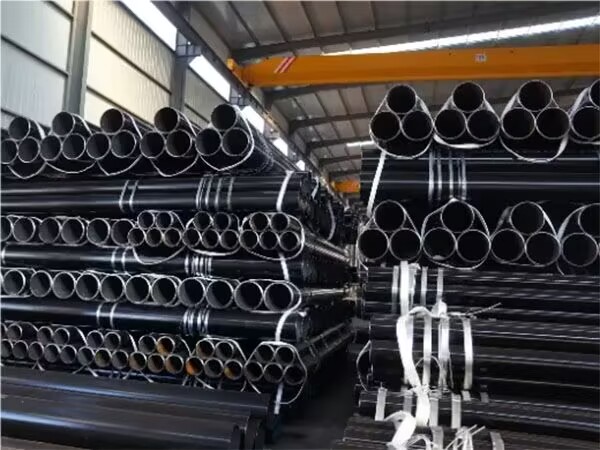
Advantages of Seamless Pipe
1. High Structural Integrity
One of the main advantages of seamless pipe is the absence of a welded seam.
A welded pipe contains a longitudinal or spiral weld that must meet the specified requirements for welding quality, inspection, and mechanical performance. Seamless pipe does not have this type of weld seam.
This continuous structure makes seamless pipe a strong option for applications involving:
High internal pressure
Mechanical loads
High temperatures
Cyclic operating conditions
Critical industrial service
However, the absence of a weld does not mean that every seamless pipe automatically has a higher pressure rating. The actual pressure capability depends on the material grade, outside diameter, wall thickness, temperature, manufacturing standard, and design code.
2. Good High-Pressure Performance
Seamless pipes are widely used in high-pressure piping systems because they do not have a welded seam that needs to be considered as a separate manufacturing feature.
Typical applications include:
High-pressure fluid transportation
Oil and gas equipment
Boilers
Power plants
Chemical processing systems
Hydraulic systems
For pressure service, pipe selection should always be based on the applicable standard and engineering design rather than simply assuming that seamless pipe has a higher pressure rating.
3. Suitable for High-Temperature Applications
Certain seamless carbon steel and alloy steel pipes are specifically designed for elevated-temperature service.
For example, ASTM A106 seamless carbon steel pipe is commonly used for high-temperature service, while alloy seamless pipes such as ASTM A335 grades are used in demanding power and petrochemical applications.
The ability of a seamless pipe to operate at high temperature depends primarily on its material grade, heat treatment, wall thickness, and applicable design standard.
4. No Weld-Related Defects
Because seamless pipe is not produced by joining the edges of a steel plate or coil, it does not have weld-related issues such as:
Weld porosity
Lack of fusion
Incomplete penetration
Weld undercut
Weld-zone cracking
This can simplify the consideration of weld-related failure mechanisms in some critical applications.
Nevertheless, seamless pipe is not defect-free. Manufacturing defects such as inclusions, laps, cracks, eccentricity, or dimensional deviations can still occur. Proper inspection and testing remain essential.
5. Good Mechanical Performance
Seamless steel pipes can provide good tensile strength, yield strength, toughness, and resistance to mechanical loads when manufactured from an appropriate grade and processed correctly.
For demanding applications, mechanical performance is determined by factors including:
Chemical composition
Heat treatment
Manufacturing process
Wall thickness
Steel grade
Applicable product specification
Therefore, the term “seamless” describes the manufacturing structure of the pipe, but it does not by itself define the complete mechanical performance.
Disadvantages of Seamless Pipe
1. Higher Manufacturing Cost
The manufacturing process of seamless pipe is generally more complex than that of many welded pipe products.
Seamless pipe commonly involves processes such as:
Billet heating
Piercing
Hot rolling or extrusion
Heat treatment
Sizing
Straightening
Cutting
Inspection and testing
These processes contribute to higher production costs.
As a result, seamless pipe is often more expensive than ERW or other welded pipe products with comparable material and dimensions.
2. Limited Large-Diameter Availability
The manufacturing process of seamless pipe places practical limitations on outside diameter, wall thickness combinations, production capacity, and available sizes.
For very large-diameter applications, LSAW and SSAW welded pipes are often more practical and economical.
This is particularly important for:
Large water pipelines
Large-diameter oil and gas pipelines
Piling applications
Large structural projects
Therefore, seamless pipe is not necessarily the best choice simply because it has no weld.
3. Higher Material and Production Consumption
Seamless pipe is manufactured from solid billets rather than forming a flat steel plate or coil and joining the edges.
The billet piercing and subsequent forming processes can result in greater material consumption and lower production efficiency compared with highly automated welded pipe production.
This is one reason why seamless pipe generally has a higher production cost.
Seamless Pipe vs Welded Pipe: Advantages and Disadvantages
The choice between seamless and welded pipe should be based on pressure, temperature, diameter, material, applicable standard, project requirements, and cost.
|
Feature
|
Seamless Pipe
|
Welded Pipe
|
|
Manufacturing
|
Solid billet piercing and forming
|
Steel plate/coil forming and welding
|
|
Weld seam
|
No weld seam
|
Longitudinal or spiral weld seam
|
|
Structural integrity
|
High
|
Depends strongly on weld quality and applicable standard
|
|
High-pressure applications
|
Excellent option
|
Also possible when properly designed and manufactured
|
|
High-temperature service
|
Excellent for suitable grades
|
Suitable grades are also available
|
|
Large diameters
|
More limited
|
Excellent availability
|
|
Production efficiency
|
Generally lower
|
Generally higher
|
|
Manufacturing cost
|
Generally higher
|
Generally lower
|
|
Size flexibility
|
More limited for some OD/wall combinations
|
Broad range, especially large diameters
|
|
Dimensional accuracy
|
Depends on hot/cold finishing process
|
Often good, depending on manufacturing process
|
|
Typical applications
|
Boilers, petrochemical, high-pressure systems, mechanical applications
|
Water pipelines, structural applications, large-diameter pipelines, general fluid transportation
|
|
Best selection criterion
|
Critical service and demanding conditions
|
Cost efficiency and suitable standard compliance
|
Frequently Asked Questions About Seamless Pipe
1. What are the main advantages of seamless pipe?
The main advantages of seamless pipe are its continuous structure without a weld seam, good pressure performance, suitability for high-temperature service, and reliable mechanical performance when the appropriate material and manufacturing standard are selected.
2. What are the disadvantages of seamless pipe?
The main disadvantages are higher manufacturing cost, limitations in some large-diameter sizes, greater production complexity, and potentially longer lead times for special grades and dimensions.
3. Is seamless pipe stronger than welded pipe?
Not necessarily in every case. Seamless pipe has no weld seam, which provides an important structural advantage in some applications. However, the actual strength and pressure capability depend on the steel grade, wall thickness, manufacturing standard, heat treatment, and design requirements. Properly manufactured welded pipe can also provide excellent performance.
4. Is seamless pipe better for high pressure?
Seamless pipe is commonly used for high-pressure applications because it has no welded seam and can be manufactured in suitable heavy-wall specifications. However, pressure capability must be calculated according to the applicable standard and design conditions rather than assumed from the pipe type alone.
Conclusion
Seamless pipe is worth choosing when pressure resistance, high-temperature performance, structural integrity, and reliability are more important than minimizing initial material cost. Its main disadvantages are higher manufacturing cost, limitations in some large-diameter sizes, and potentially longer production lead times.
Maybe you'd like to know more: Seamless steel pipe packaging and precautions or What is a seamless steel pipe?
 Central Steel


 Language
 English
 Español
 بالعربية
 sales@central-steels.com
 0086-731-8865-5017